
China Strengthens Paid Annual Leave Enforcement to Support Consumption and Work-Life Balance
China is placing greater emphasis on the effective implementation of its paid annual leave system as part of its broader strategy to stimulate domestic consumption and improve household welfare. Recent policy interpretations published by the State Council clarify that the government will strengthen enforcement of the paid annual leave system, improve compliance among employers and reinforce employees’ legal entitlement to annual leave.
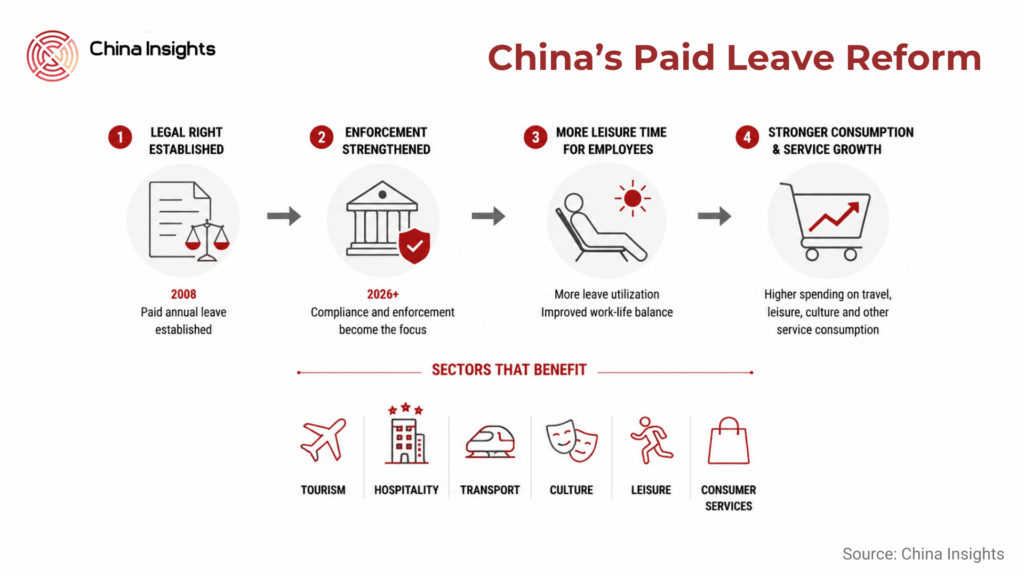
The policy forms part of the 15th Five-Year Plan for Expanding Consumption (《扩大消费“十五五”规划》), approved by the State Council in July 2026. While paid annual leave has been established under Chinese labor legislation for many years, policymakers acknowledge that implementation remains uneven across sectors and regions. The new policy therefore shifts attention from legislation to enforcement, aiming to make paid leave an effective instrument for supporting consumption, tourism and service-sector growth.
The initiative also reflects China’s broader objective of improving quality of life while expanding domestic demand. By ensuring that employees are both able and willing to take annual leave, the government expects to stimulate spending on travel, leisure, culture and other service-related consumption.
Executive Summary
- Authorities will reinforce enforcement of statutory paid annual leave and increase compliance among employers.
- The policy seeks to transform paid leave from a legal entitlement into a consistently implemented employment practice.
- Stronger enforcement supports China’s strategy of expanding service consumption, tourism and domestic demand.
- Employers should expect increased regulatory attention to labor compliance and leave management.
- The policy creates opportunities for businesses operating in tourism, hospitality, leisure, culture and consumer services.
Policy Background
China introduced the Regulations on Paid Annual Leave for Employees (《职工带薪年休假条例》) in 2008, establishing employees’ legal entitlement to paid annual leave based on years of continuous employment. The regulations are supported by the Labor Law of the People’s Republic of China and the Labor Contract Law, which provide the broader legal framework for employee rights and working conditions. Although the legal framework has existed for more than a decade, implementation has not always been consistent. In practice, employees in some industries continue to experience difficulties in taking their statutory leave because of operational pressures, staffing shortages or weak compliance mechanisms.
The 15th Five-Year Plan for Expanding Consumption, approved by the State Council, identifies stronger implementation of paid annual leave as one of several measures designed to increase household consumption by improving work-life balance and expanding leisure time. Rather than introducing new leave entitlements, the policy focuses on improving enforcement of existing legal requirements.
From Legal Right to Effective Implementation
The central policy objective is to strengthen execution of the paid annual leave system. According to the official policy interpretation, authorities will strictly implement the paid annual leave system and strengthen the rigidity of institutional enforcement. This wording reflects a shift from encouraging compliance towards ensuring that employers consistently fulfil their legal obligations.
The government recognizes that the existence of legal rights alone does not guarantee practical implementation. Stronger supervision, improved administrative enforcement and enhanced compliance mechanisms are therefore expected to play a larger role during the 15th Five-Year Plan period. For employers, this signals greater regulatory attention to labor management practices rather than the introduction of entirely new employment obligations.
Supporting Domestic Consumption
The policy also serves a broader macroeconomic objective. China increasingly views household consumption as a major driver of sustainable economic growth. While previous policies focused primarily on increasing household income, the government now recognizes that consumers also require sufficient time and confidence to spend. Paid annual leave directly supports this objective by increasing opportunities for travel, tourism, leisure activities and cultural consumption. Employees who are able to take annual leave are more likely to participate in domestic tourism, recreational activities and family-oriented consumption.
The policy therefore complements other measures within the 15th Five-Year Plan for Expanding Consumption, including improvements in household income, social security, elderly care, childcare and consumer services. Together, these measures seek to strengthen both the willingness and the ability of households to consume.
Supporting the Service Economy
One important implication of stronger paid leave enforcement is its potential impact on China’s service industries. Domestic tourism, hospitality, transportation, entertainment, sports, cultural activities and leisure services all benefit from higher levels of employee leave utilization. As more workers take annual leave, demand for travel-related services may become more evenly distributed throughout the year.
The government has consistently identified service consumption as an area with significant growth potential. The paid leave policy therefore supports the continued expansion of China’s service economy while contributing to broader economic restructuring. This approach also aligns with China’s objective of increasing the contribution of consumption to overall economic growth.
Labor Rights and Quality Development
The strengthened implementation of paid annual leave also reflects broader changes in China’s labor policy. Recent reforms increasingly emphasize high-quality employment rather than employment growth alone. Policymakers have expanded their focus to include income growth, vocational development, social protection and employee welfare.
Paid annual leave forms part of this wider framework. Better implementation contributes to improved working conditions, stronger labor protections and healthier work-life balance. The policy also supports China’s demographic and social development objectives by encouraging family-oriented leisure activities and improving overall quality of life. For employers, compliance with paid leave requirements may increasingly be viewed as part of broader environmental, social and governance (ESG) performance and responsible employment practices.
Compliance Expectations for Employers
Although the policy does not introduce new statutory leave entitlements, businesses should expect stronger enforcement of existing requirements. Employers should ensure that annual leave management systems accurately record employee entitlements, leave balances and leave utilization. Internal policies should clearly explain employee rights while supporting practical implementation across departments. Companies operating in sectors with traditionally low leave utilization may experience increased regulatory scrutiny regarding compliance with paid leave requirements. Businesses should also recognize that effective leave management contributes to employee satisfaction, retention and productivity. Improved compliance therefore supports both regulatory objectives and human resource management.
Interaction with Broader Consumption Policy
The paid annual leave initiative should be viewed within the broader context of China’s consumption strategy. The 15th Five-Year Plan for Expanding Consumption combines multiple policy instruments to strengthen domestic demand. These include improving employment opportunities, increasing household income, expanding social protection, strengthening consumer confidence and enhancing public services.
Paid annual leave complements these measures by addressing the time dimension of consumption. Households with greater financial security and more leisure time are expected to contribute more actively to China’s growing service economy. Rather than relying on short-term consumption stimulus, the government continues to build structural conditions that support sustainable growth in domestic demand.
What this means for business
The renewed emphasis on paid annual leave enforcement has implications across multiple industries.
Employers should review their leave management policies to ensure full compliance with statutory requirements. Human resource systems should accurately record leave entitlements, while managers should encourage employees to utilize their annual leave in accordance with legal requirements.
Companies operating in tourism, hospitality, transportation, entertainment, cultural industries, sports and leisure services may benefit from increased domestic travel and higher consumer spending as leave utilization improves.
Consumer-facing businesses should also recognize that stronger implementation of paid leave supports broader trends towards experience-based consumption and higher spending on services rather than goods alone.
More broadly, the policy demonstrates that labor regulation is increasingly integrated with China’s macroeconomic strategy. Paid annual leave is no longer viewed solely as an employment right but also as an instrument for supporting domestic consumption, improving quality of life and promoting high-quality economic development.
Source
https://www.gov.cn/zhengce/202607/content_7075301.htm
Author
Dr. Richard van Ostende

Related Articles