
China Targets Retail Transformation with New National Reform Strategy
China has introduced a new policy framework to accelerate the transformation of its retail sector as part of its broader strategy to expand domestic consumption and strengthen the country’s internal market. In July 2026, the Ministry of Commerce (MOFCOM), together with other ministries, jointly issued the Opinions on Accelerating the Innovative Development of the Retail Industry.
The policy seeks to strengthen China’s retail sector by improving market structure, supporting digital transformation, promoting fair competition, and encouraging innovation. It forms part of Beijing’s wider effort to boost domestic demand through higher-quality consumption and services.
For international retailers, consumer brands, investors and supply chain providers, the policy signals stronger government support for retail modernization alongside tighter regulatory oversight of market competition and digital commerce. Companies with long-term operations in China should monitor local implementation measures, which are likely to shape future market opportunities and compliance requirements.
Executive Summary
The policy addresses structural challenges including uneven retail development, insufficient high-quality supply and unfair online-offline competition.
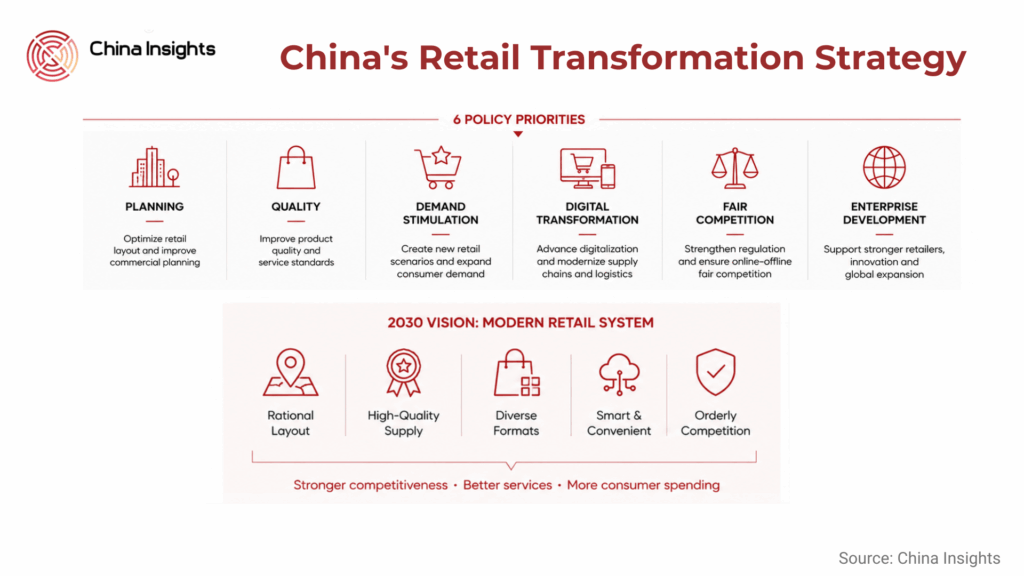
Authorities aim to establish a modern retail system by 2030 with smarter retail formats, stronger enterprises and improved consumer services.
Priorities include commercial planning, digital transformation, supply chain modernization, retail innovation and fair competition.
The reforms reinforce China’s long-term strategy of expanding domestic demand through consumption-led growth.

Retail Reform Supports Domestic Consumption
The government identifies retail as a strategic industry supporting consumption, employment and economic growth. While China’s retail market has expanded steadily, policymakers argue that structural weaknesses increasingly limit future development.
According to MOFCOM, these include uneven commercial development, limited availability of high-quality products and services, homogeneous competition and growing concerns over unfair competition between online and offline retailers. The government considers the sector to be entering a critical phase that requires coordinated policy support. Improving retail performance is therefore viewed as an important tool for stimulating household consumption and strengthening China’s domestic market.
Building a Modern Retail System
The policy sets a long-term objective of establishing a modern retail system by 2030. Authorities aim to create a sector characterized by balanced commercial development, higher-quality supply, diversified retail formats, smarter operations, and a more orderly competitive environment.
The government also plans to develop new retail consumption scenarios, encourage business model innovation, and cultivate internationally competitive retail enterprises. Alongside commercial objectives, the reforms are intended to strengthen public services and increase retail’s contribution to domestic consumption.
Key Reform Priorities
The policy outlines six broad priorities.
Improving commercial planning by better integrating retail infrastructure with territorial spatial planning and urban renewal programs.
Improving product quality and service standards, encouraging retailers to compete through customer experience rather than price alone.
Stimulate new consumer demand through innovative retail formats, renovation of aging commercial districts, and stronger community retail services.
Retailers are encouraged to digitalize inventory management, logistics, and supply chains while adopting common standards such as GS1 product barcodes to improve operational efficiency.
Establish fairer competitionby strengthening enforcement of the Anti-Unfair Competition Law and Anti-Monopoly Law, improve transparency in algorithmic recommendations and traffic allocation, and standardize regulatory enforcement across online and offline retail channels.
Supporting the development of stronger retail enterprises by encouraging supply chain integration, business model innovation, and international expansion.
A Larger Government Role
The policy gives the government a more active role in shaping retail development where market failures have resulted in inefficient commercial layouts or excessive competition. Authorities propose commercial planning standards and encourage industry organizations to develop mechanisms for assessing market saturation. They also aim to harmonize regulatory standards for promotional activities across online and offline retailers, creating a more consistent competitive environment.

Digitalization and Business Transformation
The policy also addresses profitability challenges facing retailers. Many companies have experienced revenue growth without corresponding improvements in earnings because of rising costs and intense competition.
To improve competitiveness, retailers are encouraged to shift from traditional merchandise sales towards integrated operations and service-based business models. The policy promotes private-label sourcing, supply chain integration, joint procurement, manufacturing-oriented retail, and digital management across inventory, logistics and distribution. Large retail enterprises are also encouraged to expand internationally through partnerships, acquisitions, and self-developed distribution channels.
What This Means for Business
The new policy confirms that retail has become an increasingly important component of China’s domestic demand strategy. Businesses should expect continued policy support for physical retail, digital transformation and supply chain modernization over the coming years.
Companies operating in retail technology, logistics, smart commerce, community retail and consumer services are likely to benefit as local governments implement the policy. At the same time, businesses should prepare for closer regulatory oversight of pricing practices, algorithmic recommendations and competitive conduct. As implementation measures will largely be introduced at the provincial and municipal level, companies should closely monitor local policy developments.
Source
https://www.gov.cn/zhengce/202607/content_7074888.htm
https://www.gov.cn/zhengce/202607/content_7074962.htm
Author
Dr. Richard van Ostende

Related Articles