China Strengthens Circular Economy and Environmental Risk Management with the 15th Five-Year Plan for Solid Waste Pollution Prevention
China is further strengthening its environmental governance with the release of the 15th Five-Year Plan for Solid Waste Pollution Prevention and Control (《固体废物污染防治“十五五”规划》). On 14 July 2026, the Ministry of Ecology and Environment (MEE), together with the National Development and Reform Commission (NDRC) and several other central government departments, jointly issued the plan to address one of China’s remaining environmental challenges.
The new plan shifts the focus from individual waste treatment measures towards comprehensive lifecycle management of solid waste. It combines stricter environmental supervision, expanded digital monitoring, stronger enforcement against illegal dumping and improved hazardous waste management. The plan also supports China’s broader objectives of building a circular economy, reducing environmental risks and advancing the Beautiful China initiative.
For businesses, the policy signals tighter compliance requirements across industrial production, waste generation, transportation, recycling and disposal. At the same time, it creates opportunities for companies providing environmental technologies, waste treatment services and digital monitoring solutions.
Executive Summary
- The plan establishes China’s solid waste management priorities for the 2026–2030 period.
- By 2030, China aims to significantly improve solid waste governance, reduce illegal dumping, strengthen digital supervision and expand the development of “Zero-Waste Cities”.
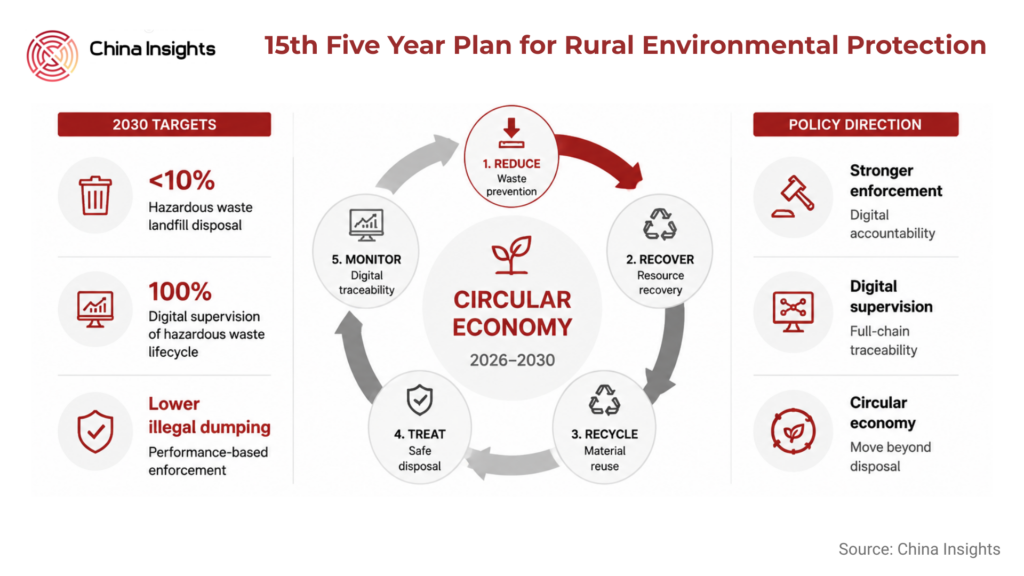
- Hazardous waste landfill disposal will be limited to no more than 10% of total hazardous waste treatment nationwide.
- Authorities will introduce full-process digital supervision covering waste generation, collection, storage, transportation and disposal.
- Businesses operating in waste-intensive industries should prepare for stricter regulatory oversight and enhanced traceability requirements.

Policy Background
China’s environmental policy has evolved considerably over the past decade. Significant progress has been achieved in improving air quality and reducing water pollution. According to the Ministry of Ecology and Environment, however, solid waste management has become one of the remaining weaknesses in China’s environmental protection framework.
China currently generates more than 11 billion tons of solid waste annually, while historical industrial solid waste stockpiles are estimated at approximately 30 billion tons. Challenges remain in waste utilization, treatment capacity, historical waste accumulation and illegal disposal.
The new Five-Year Plan identifies the period from 2026 to 2030 as both a strategic opportunity and a critical implementation phase for improving nationwide solid waste governance. The overarching objective is to strengthen environmental risk prevention throughout the entire waste management chain while improving regulatory coordination across regions and sectors.
Clear Targets for 2030
The plan establishes several measurable objectives for the end of the current planning period. By 2030, China aims to achieve significant progress in addressing solid waste challenges within priority industries and regions. Historical waste stockpiles are expected to come under effective control, illegal dumping incidents should decline substantially and the country’s overall capacity for integrated solid waste management should improve.
Another important objective is the nationwide expansion of digital environmental supervision. Authorities intend to establish a unified information network covering all major solid waste management activities across priority sectors. In addition, the government plans to further expand the development of Zero-Waste Cities, which serve as demonstration areas for integrated resource utilization, recycling and pollution prevention.
Illegal Dumping Becomes a National Enforcement Priority
One of the plan’s strongest messages concerns illegal dumping and illegal disposal of solid waste. In June 2025, with approval from the State Council, the Ministry of Ecology and Environment, together with the Supreme People’s Court and other authorities, launched a nationwide three-year campaign targeting illegal solid waste disposal. According to information released by the Ministry, by June 2026 authorities had investigated approximately 51,000 illegal dumping cases, completed remediation of more than 41,000 cases and removed approximately 71.22 million tons of illegally disposed waste.
The new Five-Year Plan builds upon this campaign by introducing a dedicated performance indicator measuring the incidence of illegal dumping and disposal. Rather than applying one national target, each province will receive its own baseline following a two-year trial evaluation period. Provincial governments will primarily be assessed on year-on-year improvements, allowing targets to reflect regional conditions while strengthening local accountability. This represents an important shift towards performance-based environmental governance supported by measurable indicators.
Hazardous Waste Management Tightens
Hazardous waste remains one of China’s highest environmental priorities because of its long-term and often hidden environmental risks. During the previous Five-Year Plan period, landfill disposal of hazardous waste increased rapidly, raising concerns regarding potential soil and groundwater contamination caused by landfill leakage. To address these risks, the new plan establishes a national objective of limiting hazardous waste landfill disposal to less than 10% of total hazardous waste treatment by 2030. Rather than expanding landfill capacity, authorities intend to encourage alternative treatment methods while improving local responsibility for hazardous waste management. Provincial governments will receive specific control targets, and environmental management requirements for landfill operations will become stricter. The policy reflects China’s broader objective of moving waste management higher up the waste hierarchy through greater resource recovery, treatment and recycling before disposal.

Digital Supervision Covers the Entire Waste Chain
Perhaps the most significant structural reform introduced by the plan is the expansion of digital supervision. The Ministry of Ecology and Environment identifies full-process digital management as the foundation for modernizing hazardous waste governance. The objective is to achieve 100% digital supervision coverage across the complete hazardous waste lifecycle. This includes waste generation, collection, temporary storage, transportation, treatment and final disposal. By integrating information across each stage of the waste chain, authorities aim to ensure that hazardous waste becomes fully traceable. The Ministry describes this objective as making hazardous waste “visible, manageable and traceable” throughout its lifecycle. This initiative reflects China’s broader digital governance strategy, where environmental regulation increasingly relies on real-time monitoring, integrated information platforms and data-driven enforcement.
Stronger Lifecycle Regulation
Beyond individual policy measures, the plan demonstrates a broader evolution in China’s environmental management philosophy. Rather than focusing exclusively on waste disposal, policymakers are adopting lifecycle regulation. Environmental supervision increasingly begins at the point of waste generation and continues through transportation, treatment and final disposal. This integrated approach is expected to improve regulatory coordination while reducing opportunities for illegal disposal and environmental leakage. For industrial enterprises, compliance will increasingly require comprehensive waste management systems supported by accurate environmental reporting and digital record keeping.
What this means for business
The 15th Five-Year Plan for Solid Waste Pollution Prevention and Control signals continued strengthening of China’s environmental compliance framework.
Manufacturers, chemical producers, mining companies, metal processors, energy companies and other waste-intensive industries should prepare for stricter supervision throughout the waste management process. Environmental compliance will increasingly extend beyond emissions control to include waste traceability, reporting and lifecycle management.
Companies generating hazardous waste should expect tighter controls on landfill disposal and greater expectations regarding waste reduction, recycling and alternative treatment methods. Investments in environmental management systems and digital tracking technologies are likely to become increasingly important.
The policy also creates market opportunities. Environmental engineering firms, hazardous waste treatment providers, recycling companies, digital monitoring providers and environmental software developers may benefit from growing demand as local governments implement the plan. More broadly, the plan reinforces China’s transition towards a circular economy supported by digital environmental governance. Businesses that integrate waste minimization, resource recovery and transparent environmental management into their operations will be better positioned to meet future regulatory expectations and participate in China’s evolving green economy.
Source
https://www.gov.cn/zhengce/jiedu/index.htm
Author
Dr. Richard van Ostende

Related Articles