
China Strengthens Employment Priorities, Social Protection and Workforce Skills
China is placing employment more firmly at the center of economic policy, while expanding social protection and investing in workforce capabilities. The agenda for the 15th Five-Year Plan (2026–2030) links job creation more closely to industrial development, technological change and the need to address mismatches between workforce skills and employer demand.
At a State Council Information Office press conference on 10 October 2026, the Ministry of Human Resources and Social Security outlined its priorities for employment and social-security development. These measures build on the State Council’s Plan for Implementing the Employment-First Strategy during the 15th Five-Year Plan Period, issued in June 2026. The direction is toward more systematic employment impact assessments, broader coverage for non-traditional workers and more targeted investment in skills.
Executive summary
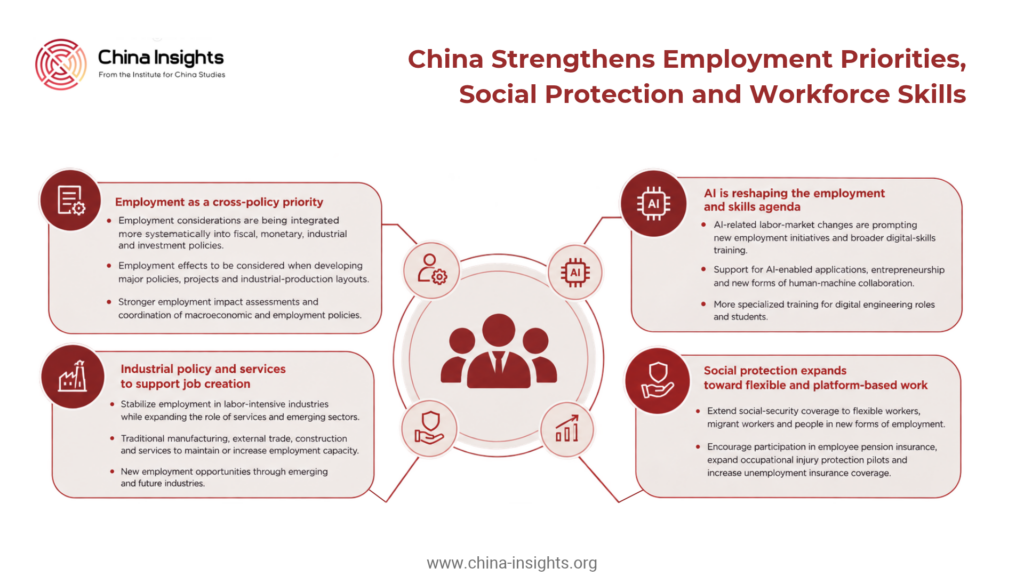
- Employment considerations are being integrated more systematically into fiscal, monetary, industrial and investment policies.
- AI-related labor-market changes are prompting new employment initiatives and broader digital-skills training.
- Services and emerging industries are expected to play a greater role in job creation, alongside continued support for labor-intensive sectors.
- Social-security coverage is set to expand among flexible workers, migrant workers and people in new forms of employment.
- National coordination of pension insurance, stronger fund supervision and more integrated digital services are priorities.
- Vocational training is being aligned more closely with changing occupational standards and industrial demand.

Employment becomes a cross-policy priority
The June 2026 employment-first plan formalizes a broader approach to job creation. Employment is no longer treated solely as an outcome of economic growth. The plan calls for employment effects to be considered when developing major policies, projects and industrial-production layouts, with fiscal, monetary, consumption, investment, trade and regional policies working in coordination.
The October briefing reinforces this direction. Authorities intend to strengthen employment impact assessments and coordinate macroeconomic and employment policies more closely. For businesses, this could make employment outcomes a more visible consideration in policy implementation, particularly in industries receiving public support or undergoing substantial technological change.
Industrial policy and services are expected to support job creation
The government intends to stabilize employment in labor-intensive industries while expanding the role of services and emerging sectors. The June plan identifies traditional manufacturing, external trade, construction and services as areas where employment capacity can be maintained or increased. It also calls for new employment opportunities to be developed through emerging and future industries.
The October briefing adds emphasis to service-sector employment and the need to respond to changing labor demand. This creates a closer link between industrial upgrading and workforce planning. Companies should therefore assess not only whether a sector is receiving development support, but also how its growth model, technology adoption and operating structure affect employment demand.
AI is reshaping the employment and skills agenda
The policy approach recognizes that AI and other new technologies can both create jobs and disrupt existing roles. The government plans to implement employment initiatives adapted to AI development, promote new employment opportunities and expand training for workers affected by technological change. The June plan also supports AI-enabled applications, entrepreneurship and new forms of human-machine collaboration.
The October briefing highlights an AI-skills initiative for the wider workforce, alongside more specialized training for digital engineering roles and students. This suggests that workforce development is being treated as part of the country’s technology-adoption strategy. Employers may face stronger incentives to invest in reskilling and to align training with changing job requirements, although the precise implementation and any company-level obligations will depend on subsequent measures.
Social protection expands toward flexible and platform-based work
The government also intends to extend social-security coverage to groups whose employment arrangements may not fit traditional employer-employee models. Priorities include encouraging flexible workers, migrant workers and people in new forms of employment to participate in employee pension insurance, expanding occupational injury protection pilots and increasing unemployment-insurance coverage among eligible groups.
This is relevant to companies that rely on platform-based, flexible or outsourced labor. Wider coverage may improve protection for workers, while potentially increasing the importance of clear employment classifications, contribution arrangements and compliance procedures. The announcement establishes policy direction; it does not by itself specify a uniform new contribution obligation for every business model.

Pension governance and service integration are being strengthened
The next phase of social-security reform also focuses on sustainability and administration. The government plans to improve national coordination of basic pension insurance, strengthen mechanisms for redistributing funds across regions and conduct regular long-term actuarial assessments. It also intends to reinforce cross-agency supervision and improve controls against fraud involving social-security funds.
At the service level, authorities plan to advance nationally standardized management of social-security records and individual entitlements, while making pension-insurance relationship transfers more accessible across regions. These changes aim to improve portability and administrative consistency. For employers with workforces spread across several provinces, better-integrated systems could simplify some employee-transfer and social-insurance procedures, subject to local implementation.
Skills development becomes a more direct economic investment
The government is linking vocational education more closely to industrial demand. Priorities include updating occupational classifications and national skills standards, expanding training resources and connecting qualifications more directly to skills progression and employment opportunities. Results and training methods from international skills competitions are also intended to inform everyday vocational education.
This signals a shift toward treating skills development as productive investment rather than simply a social-support measure. Employers in manufacturing, digital technology and other changing industries may find greater scope to engage with vocational institutions and workforce-development programs. The practical value will depend on whether training provision can keep pace with actual business needs and whether qualifications translate into job-ready capabilities.
What this means for business
- Employment impacts may become more relevant to policy decisions. Assess how investment, automation and restructuring plans align with employment priorities and sector-specific support.
- AI adoption should include workforce planning. Identify roles likely to change and establish reskilling plans that match operational needs.
- Social-security compliance deserves renewed attention. Review arrangements for flexible, migrant and platform-based workers as coverage expands.
- Skills partnerships may become more valuable. Consider cooperation with vocational institutions and training providers to address technical and digital-skills gaps.
- Multi-region employers should monitor administrative reforms. Improvements in portability and standardization may reduce friction in managing employees across provinces.
- Track implementation rather than relying on policy announcements alone. The operational impact will depend on subsequent rules, local execution and the specific eligibility requirements of individual programs.
Sources
https://www.gov.cn/zhengce/202610/content_7082936.htm
Author
Dr. Richard van Ostende

Related Articles