
China Extends and Optimizes Unemployment Insurance Policies to Stabilize Employment and Support Job Expansion
On 2 July 2026, the Ministry of Human Resources and Social Security, together with three other departments, issued a policy notice on unemployment insurance measures to support employment stabilization and job expansion. The policy framework introduces a “Two Continuations and One Optimization” approach. It extends existing enterprise subsidy schemes and refines vocational skills support mechanisms. The objective is to stabilize employment, reduce enterprise labor costs, and improve labor market adaptability.
Executive Summary
- China has introduced a “Two Continuations and One Optimization” unemployment insurance policy package.
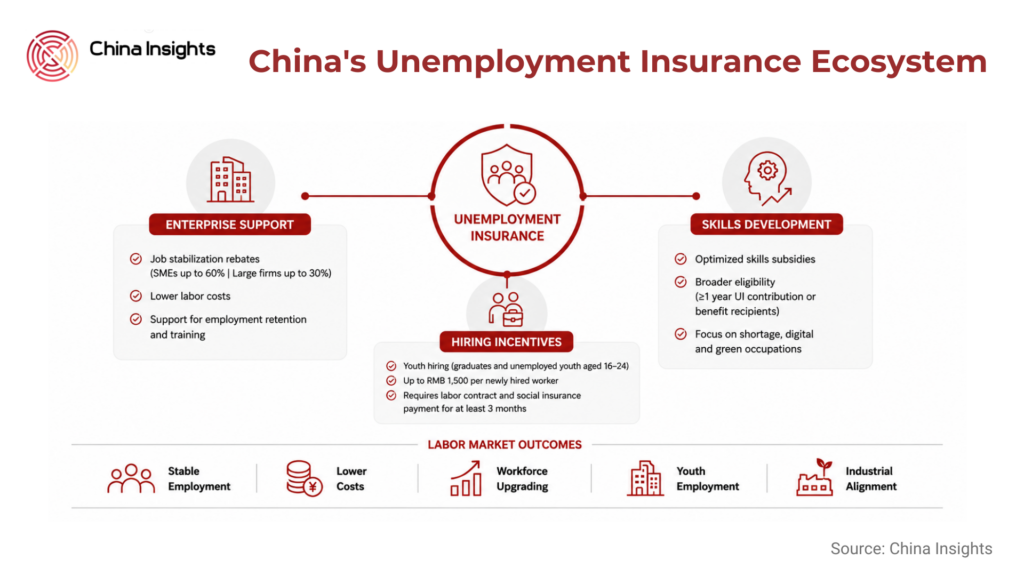
- The policy extends the unemployment insurance job stabilization rebate scheme as it continues the job expansion subsidy for hiring young workers, including graduates and registered unemployed youth.
- The skills upgrading subsidy system is optimized with broader eligibility and stricter targeting.
- Enterprises can receive up to 60% of unemployment insurance contributions back under the stabilization scheme for SMEs.
- Youth hiring subsidies are set at up to RMB 1,500 per person.
- Skills subsidies are linked to urgent labor market demand, green jobs, and digital occupations.

Policy Background and Labor Market Context
The unemployment insurance system in China has increasingly evolved beyond passive income protection toward active labor market intervention. The current policy package builds on measures implemented since 2015. Over time, the system has been adjusted to support enterprise stability, employment retention, and workforce skill development. The new policy reflects two structural labor market pressures. First, enterprises continue to face cost and employment stability challenges, particularly small and medium-sized enterprises. Second, labor market mismatches persist, especially in relation to skilled labor demand in emerging industries.
The policy therefore integrates enterprise support with workforce development measures.
“Two Continuations and One Optimization”
The policy is structured around three core components. These include continuation of the job stabilization rebate, continuation of the job expansion subsidy, and optimization of the skills upgrading subsidy. This framework reflects a shift from fragmented employment support tools toward a more coordinated unemployment insurance policy system. The measures are designed to address both demand-side (enterprise hiring capacity) and supply-side (labor skills and employability) constraints.
Continuation of Job Stabilization Rebates
The first policy component continues the unemployment insurance job stabilization rebate mechanism. Under the policy, enterprises that maintain stable employment levels or reduce layoffs are eligible for rebates from unemployment insurance contributions. Social organizations, law firms, accounting firms, and individually operated businesses participating in institutional insurance schemes are also included.
The policy introduces differentiated rebate rates. Large enterprises may receive rebates of up to 30 percent of their previous year’s unemployment insurance contributions. Small and medium-sized enterprises may receive up to 60 percent. This differentiation reflects policy prioritization of SMEs, which face higher employment volatility and lower financial resilience.
The policy also relaxes eligibility conditions for smaller firms. Enterprises with 30 or fewer insured employees are allowed a higher layoff threshold of up to 20 percent of total staff. This adjustment expands coverage for micro and small enterprises. Funds received under the rebate scheme can be used for employee welfare support, social insurance contributions, internal job transfers, and vocational training. This reinforces the policy’s dual objective of employment stability and cost reduction.
Continuation of Expansion Subsidies
The second component continues the one-time job expansion subsidy policy. This measure targets enterprises and social organizations that hire young workers, including recent graduates and unemployed youth aged 16 to 24. Eligible employers must sign labor contracts and contribute social insurance payments for at least three months. Qualified entities receive a subsidy of up to RMB 1,500 per newly hired worker. The policy maintains a targeted approach to youth employment, reflecting ongoing structural pressures in graduate labor market absorption.
Funding conditions are linked to unemployment insurance fund sustainability. Regions can implement the policy only when unemployment insurance fund reserves exceed one year of payout coverage. If reserves are insufficient, local governments must use employment subsidy funds. This mechanism introduces fiscal risk control into employment support policy design.

Optimization of Training Subsidies
The third component introduces an optimized framework for vocational skills subsidies. The policy expands eligibility to include individuals with at least one year of unemployment insurance contribution history. It also includes recipients of unemployment insurance benefits. Subsidies are now more tightly linked to labor market demand. Eligible certificates include those listed in local shortage occupation catalogs, occupations aligned with enterprise sector categories, and qualifications in digital or green industries.
The policy aims to improve alignment between workforce skills and industrial demand, particularly in manufacturing upgrading and services sector transformation. The subsidy frequency is limited to once per year. However, provincial authorities may allow up to three claims per person for multiple high-demand qualifications. This introduces a more flexible but controlled framework for skills upgrading incentives.
Regional Flexibility and Policy Experimentation
The policy grants provincial authorities discretion to adapt implementation mechanisms. Local governments are authorized to explore “job-post alignment” models that link certification subsidies directly to enterprise demand. This reflects a shift toward demand-driven skills training systems. The approach allows regional differentiation based on industrial structure, labor market conditions, and fiscal capacity. At the same time, authorities emphasize the need to ensure unemployment insurance fund safety and long-term sustainability.
Policy Implications for Labor Market Governance
The policy reflects an ongoing transformation of China’s employment support system. Unemployment insurance is increasingly functioning as a multi-purpose labor market instrument. It now combines income protection, enterprise stabilization, hiring incentives, and workforce development. The differentiated support structure for SMEs highlights continued concern over employment elasticity in smaller firms. These firms remain a central channel for job creation but face higher vulnerability to economic fluctuations. The integration of skills training subsidies with industrial policy priorities indicates a stronger alignment between labor policy and industrial upgrading strategies.
What this means for business
For enterprises, the policy reduces effective labor costs through continued stabilization rebates and targeted hiring subsidies. SMEs in particular benefit from higher rebate ratios and more flexible eligibility thresholds. Hiring incentives for young workers reduce recruitment costs and may improve access to entry-level labor, particularly in services and manufacturing sectors.
Companies operating in skill-intensive industries may benefit from expanded training subsidies, especially in digital and green technology fields. This supports internal workforce upgrading at lower cost. However, enterprises will face increasing expectations to align hiring and training practices with policy-defined skill categories and certification standards. Compliance and documentation requirements may increase. Overall, the policy strengthens state-supported labor market flexibility while reinforcing alignment between employment policy and industrial upgrading priorities.
Source
https://www.gov.cn/zhengce/202607/content_7074157.htm
Author
Dr. Richard van Ostende

Related Articles