
China Launches National Strategy for High-Quality Internet Infrastructure Resources
China has introduced a new policy framework to strengthen the technological foundations of its digital economy. In July 2026, the Ministry of Industry and Information Technology (MIIT), together with the Cyberspace Administration of China (CAC), the National Development and Reform Commission (NDRC) and the National Data Administration (NDA), jointly issued the Guiding Opinions on Promoting the High-Quality Development of Internet Infrastructure Resources (《关于推动互联网基础资源高质量发展的指导意见》).
The policy establishes a long-term roadmap for developing China’s internet infrastructure resources, including IP addresses, domain names, Autonomous System (AS) numbers, internet identifiers and the supporting technical architecture that enables internet connectivity and digital services. It links these foundational technologies directly to China’s broader objectives of new industrialization, digital transformation, cybersecurity and technological self-reliance.
Rather than focusing solely on network expansion, the policy aims to strengthen China’s capacity for innovation, governance and international participation in the development of future internet technologies. For technology companies, telecommunications providers and digital infrastructure investors, the guidance provides an important indication of China’s priorities through 2035.
Executive Summary
- The policy establishes development objectives for 2030 and a long-term vision extending to 2035.
- China aims to achieve breakthroughs in internet infrastructure technologies, technical standards, internet architecture and intelligent digital infrastructure.
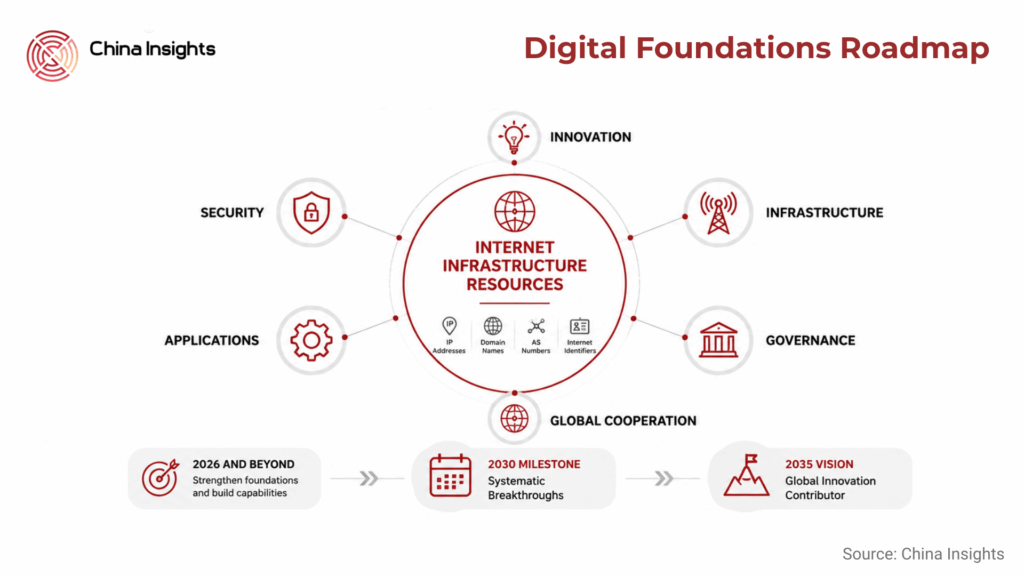
- Six policy areas and sixteen implementation tasks focus on innovation, infrastructure, security, applications, governance and international cooperation.
- The guidance strengthens China’s strategy of combining technological innovation with cybersecurity and digital governance.
- Companies operating in telecommunications, cloud services, internet infrastructure, digital platforms and cybersecurity are expected to benefit from continued policy support.
Policy Background
China considers internet infrastructure resources to be strategic national assets. These resources including IP addresses, domain names, Autonomous System numbers and internet identifiers, provide the essential functions that enable internet naming, routing, discovery, interconnection and data exchange.
According to the policy interpretation issued by the Ministry of Industry and Information Technology, strengthening these foundational technologies has become increasingly important as China advances digital industrialization, artificial intelligence, cloud computing and the data economy.
The policy is also closely linked to the 15th Five-Year Plan and the Recommendations of the Central Committee of the Communist Party of China for Formulating the 15th Five-Year Plan, which call for stronger indigenous innovation and appropriately advanced deployment of new digital infrastructure.
Development Objectives Through 2035
The policy establishes two major milestones. These objectives reflect China’s ambition not only to adopt international technologies but also to contribute actively to the future development of global internet standards.
- The first milestone targets 2030. By then, China aims to achieve systematic breakthroughs in the development of internet infrastructure resources. Authorities expect progress in original technologies, the establishment of leading technical standards, modernization of internet architecture and the construction of intelligent internet infrastructure capable of supporting next-generation digital applications.
- The second milestone extends to 2035. By that date, China seeks to become a globally important source of innovation in internet infrastructure technologies while establishing an advanced internet architecture that is fully interconnected, high-speed, secure and independently controllable.
Strengthening Indigenous Innovation
Innovation forms the first pillar of the new guidance. The policy calls for stronger coordination of national scientific resources to support fundamental research into internet technologies. Authorities will increase efforts to overcome critical technological bottlenecks while strengthening innovation platforms that connect research institutions, universities and industry. Technical standards also receive significant attention. China intends to accelerate the development of leading standards for internet infrastructure technologies, reflecting its broader objective of increasing influence within global technology standard-setting organizations. Rather than focusing solely on commercial deployment, the guidance emphasizes long-term research capabilities as the foundation for future technological competitiveness.
Modernizing Internet Infrastructure
The second policy priority concerns infrastructure development. The guidance proposes optimizing existing internet infrastructure while simultaneously exploring next-generation network facilities capable of supporting future digital services. This includes improvements to traditional infrastructure as well as investment in new forms of intelligent internet infrastructure.
Although the policy does not specify individual technologies, it aligns with China’s wider strategy of deploying advanced digital infrastructure capable of supporting artificial intelligence, industrial internet applications, cloud computing and data-intensive services. Infrastructure modernization is therefore viewed as both an economic development objective and a prerequisite for digital transformation across multiple industries.
Security and Resilience Become Core Requirements
Cybersecurity and operational resilience are central themes throughout the guidance.
The policy introduces a dedicated program to strengthen the security of internet infrastructure resources. Authorities aim to improve both supply security and operational security while expanding risk monitoring, early warning systems and emergency response capabilities. This reflects China’s longstanding policy of integrating development and security. Internet infrastructure is increasingly viewed not only as an economic resource but also as critical national infrastructure requiring comprehensive protection. For infrastructure operators, security management is expected to become increasingly integrated into network planning, technology deployment and operational governance.
Expanding Internet Applications
The guidance also focuses on improving the practical use of internet infrastructure resources. Authorities intend to develop a multidimensional application service system that improves the efficiency of internet resource utilization while supporting a broader range of digital applications.
Particular emphasis is placed on strengthening the integration of digital technologies with the real economy. Internet infrastructure is expected to support industrial digitalization, intelligent manufacturing, cloud services and other applications contributing to China’s development of new quality productive forces. This objective reflects China’s broader strategy of ensuring that investments in digital infrastructure generate productivity improvements across the wider economy.
Improving Governance and International Cooperation
The policy also seeks to modernize internet governance. Authorities plan to improve administrative regulations, strengthen technical governance capabilities and establish more comprehensive regulatory systems for internet infrastructure resources. At the same time, the guidance encourages greater international engagement. China intends to strengthen international communication, participate actively in global internet governance and contribute more extensively to international technical cooperation. This dual approach combines stronger domestic governance with continued participation in international internet development.
Implementation Mechanisms
Successful implementation will require coordination across multiple government agencies. The guidance assigns responsibility to central government departments for overall coordination while encouraging provincial authorities to integrate implementation with local development priorities. The policy also emphasizes participation by research institutions, enterprises and other stakeholders. Supporting measures include stronger policy coordination, resource integration and ongoing evaluation of implementation progress. This multi-stakeholder approach reflects the increasingly complex nature of internet infrastructure development, where government policy, technological innovation and commercial investment are closely interconnected.
What this means for business
The new guidance provides a clear indication of China’s long-term priorities for digital infrastructure development. Telecommunications operators, cloud service providers, internet infrastructure companies, cybersecurity firms and digital platform providers are likely to benefit from continued government support for next-generation internet technologies and infrastructure modernization.
Technology companies involved in internet protocols, domain name services, network architecture, cloud infrastructure, digital identity and data infrastructure should expect increased investment in research, standardization and commercial deployment.
Businesses should also anticipate stronger cybersecurity expectations. As internet infrastructure becomes increasingly classified as strategic infrastructure, regulatory requirements concerning operational resilience, risk management and technical governance are likely to become more comprehensive.
Foreign technology companies operating in China should closely monitor developments in internet architecture, technical standards and governance requirements. China’s emphasis on indigenous innovation and security may influence technology partnerships, market access and technical compliance requirements.
Overall, the guidance demonstrates that China views internet infrastructure as a strategic foundation for future economic growth. By combining technological innovation, infrastructure modernization, cybersecurity and international engagement, the policy seeks to position China as a leading global contributor to the next generation of internet technologies.
Source
https://www.gov.cn/zhengce/202607/content_7075335.htm
Author
Dr. Richard van Ostende

Related Articles