
China Launches National “AI + Human Resources and Social Security” Strategy to Modernize Employment and Workforce Governance
On 8 July 2026, the Ministry of Human Resources and Social Security (MOHRSS), together with the National Development and Reform Commission, the Ministry of Industry and Information Technology, and the National Data Administration, jointly issued the Implementation Opinions on Accelerating the Development of “Artificial Intelligence + Human Resources and Social Security” Applications.
The policy aligns with China’s broader “AI+” Action and the Digital Human Resources and Social Security initiative launched in 2023. Rather than promoting AI adoption in isolation, the document positions AI as a tool to modernize public services, improve labor market efficiency and strengthen workforce governance.
The strategy combines industrial policy with administrative reform, creating demand for AI infrastructure, data platforms and industry-specific applications across the employment ecosystem.
Executive Summary
The policy establishes a national framework for integrating AI into employment services, social insurance, talent development, labor relations, human resource services and public administration.
Authorities identified 6 major application areas, 19 secondary scenarios and 67 detailed AI use cases, providing one of China’s most comprehensive sector-specific AI deployment plans.
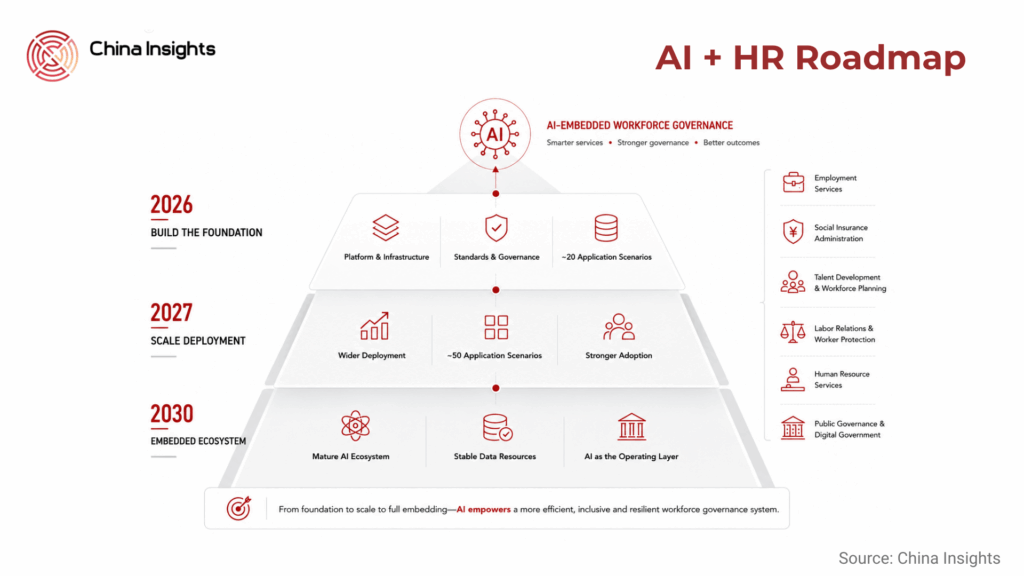
The strategy follows a three-stage roadmap extending to 2030, with targets to develop industry-specific large language models (LLMs), AI agents and high-quality datasets.
The initiative creates opportunities for AI vendors, HR technology providers, workforce analytics firms and enterprise software companies while reinforcing China’s approach of combining AI development with public service modernization.

Six National AI Application Areas
The implementation plan identifies six priority areas where AI will be deployed.
The first focuses on digital employment services. Authorities aim to build occupational knowledge graphs and AI-powered recruitment models capable of matching employers with job seekers more efficiently. The policy also introduces plans to establish an AI employment impact assessment system to monitor how AI affects labor markets and to encourage innovation that creates employment rather than displaces workers.
The second area targets smart social insurance administration. AI will support eligibility verification, benefit approval, fraud prevention, fund supervision and operational management, with the objective of improving administrative efficiency and service quality.
Read more about social insurance.
The third priority concerns talent development and workforce planning. Authorities plan to build shortage occupation maps, core technology talent databases and labor market forecasting systems. AI will analyze regional, industrial and occupational trends to support vocational training, talent recruitment and better alignment between industrial development and workforce supply.
A fourth area addresses labor relations and worker protection. Planned applications include AI assistants for employment guidance, policy consultation and rights protection. AI will also support labor dispute mediation by identifying dispute characteristics and recommending mediation strategies.
The fifth application area focuses on human resource services. The policy encourages AI-enabled workforce matching, employee assessment, talent development and enterprise HR management, while exploring new AI-based workforce management models.
The final area covers public governance and digital government services. Authorities plan to upgrade national online platforms, including employment services, social insurance services, electronic social security cards and the “12333” public service platform through AI-enabled digital transformation.
Together, these six areas encompass 19 secondary application categories and 67 detailed implementation scenarios, which will be updated as deployment progresses.
Building the AI Infrastructure
The document outlines four foundational components for enabling infrastructure required to support AI deployment.
First, China will establish a coordinated AI application platform based on a “1 + N + 32” architecture. This includes one national-level platform, collaboration with national AI application testing bases and participation from all provincial human resources and social security departments.
Second, authorities will develop high-quality industry datasets and AI training corpora. Policy documents, business knowledge, administrative cases and other sector-specific resources will be standardized and curated to improve model training and deployment.
Third, the government will support the development of specialized AI models, AI agents and industry tools tailored to human resources and social security applications. Local governments, HR service providers and vocational training institutions will be able to adopt these technologies according to operational needs.
Finally, the policy calls for establishing standards, governance frameworks and industry ecosystems to promote interoperability, encourage collaborative research and support safe AI deployment.

A Three-Stage Roadmap to 2030
The first milestone is 2026, when authorities aim to establish the basic AI application framework, standards and supporting infrastructure. During this phase, China intends to cultivate a number of high-performance industry-specific AI models and AI agents while developing approximately 20 application scenarios supported by corresponding high-quality datasets.
By 2027, the focus shifts toward wider deployment. Authorities expect AI models and intelligent applications to become broadly adopted across the human resources and social security system while expanding implementation to around 50 high-value application scenarios.
The final objective is 2030, when AI is expected to become a standard component of human resources and social security administration. At that stage, authorities envision mature industry-specific AI models, stable data resources and a comprehensive AI application ecosystem supporting governance, employment services and workforce development.
Managing Employment Risks from AI
The implementation plan proposes establishing an AI employment impact assessment system alongside an institutional mechanism for monitoring AI’s influence on employment. Rather than focusing exclusively on automation, policymakers aim to direct innovation toward technologies that generate new employment opportunities while reducing disruption.
The document also highlights AI skills development as a policy priority. Authorities plan to strengthen AI-related vocational training and skills evaluation to improve workforce readiness and raise overall AI literacy.
What This Means for Business
The implementation plan signals that China is moving beyond general AI policy toward large-scale deployment in specific government sectors. Human resources and social security now joins manufacturing, healthcare and education as priority areas for AI commercialization.
For technology companies, the policy creates demand for industry-specific AI models, intelligent agents, workforce analytics, digital government platforms and secure data management solutions. HR technology providers and enterprise software firms may also find opportunities as local governments and public institutions implement new digital systems.
For employers, AI-enabled employment matching, workforce planning and skills development could improve labor market efficiency while increasing the sophistication of recruitment and talent management.
The policy also reinforces China’s emphasis on building domestic AI ecosystems around proprietary datasets, standardized infrastructure and government-led implementation. Companies seeking to participate in this market will need to align with evolving technical standards, data governance requirements and public sector procurement priorities.
As implementation progresses toward the 2027 and 2030 milestones, the initiative is likely to become an important driver of AI adoption across China’s labor market and public administration system.
Source
https://www.gov.cn/zhengce/202607/content_7074728.htm https://www.gov.cn/zhengce/202607/content_7074728.htm
Author
Dr. Richard van Ostende

Related Articles