China Refocuses the Belt and Road Initiative on Trade, Investment and Emerging Industries
China is positioning the Belt and Road Initiative (BRI) as a more commercially focused platform for international cooperation during the 15th Five-Year Plan period (2026–2030). The priorities are shifting towards stronger trade and investment links, more integrated transport and logistics networks, and cooperation in digital, green and technology-related industries. Beijing is also placing greater emphasis on project quality, financial sustainability and risk management.
These priorities were outlined at a press conference held by the National Development and Reform Commission (NDRC) on 11 November 2026. Representatives from the NDRC, Ministry of Commerce (MOFCOM), Ministry of Ecology and Environment and Ministry of Education presented their respective priorities for high-quality Belt and Road cooperation. The direction is consistent with the 15th Five-Year Plan Outline, which gives high-quality BRI development a dedicated place in China’s external cooperation agenda.
Executive Summary
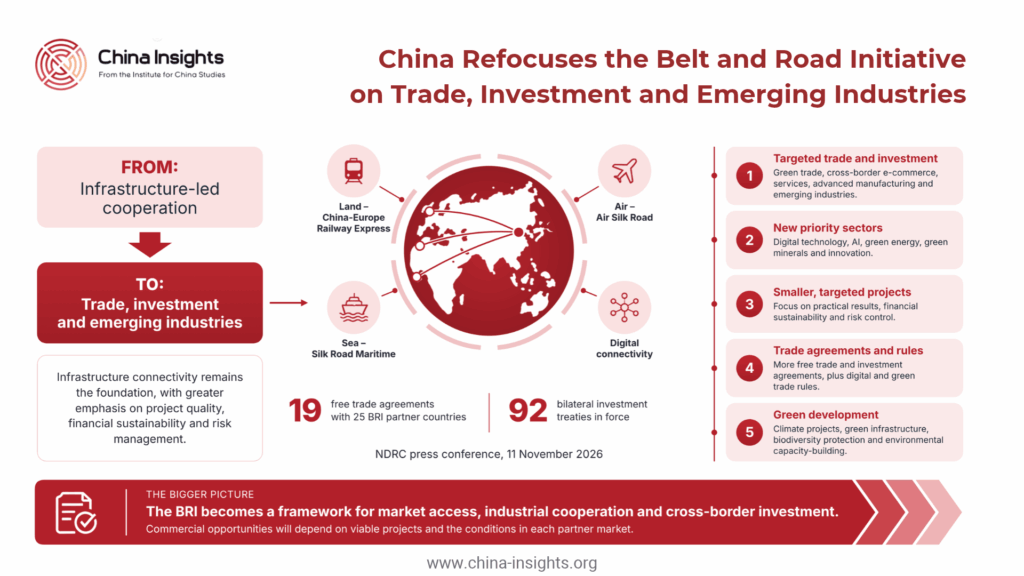
- Trade and investment are becoming more commercially targeted: China will deepen cooperation in green trade, cross-border e-commerce, services, advanced manufacturing and emerging industries.
- Connectivity is expanding beyond physical infrastructure: Rail, maritime and aviation links will be complemented by digital connectivity and wider logistics integration.
- New sectors are gaining priority: Digital technology, artificial intelligence, green energy, green minerals and innovation are identified as areas for expanded cooperation.
- Project selection is becoming more focused: Greater attention will be given to smaller, targeted projects, financial sustainability and risk control.
- Economic cooperation is increasingly linked to international rules: China intends to expand free trade and investment agreements and promote cooperation on digital and green trade rules.
- Green development is being integrated into overseas cooperation: Climate projects, green infrastructure, biodiversity protection and environmental capacity-building are part of the agenda.

From Infrastructure Connectivity to Integrated Economic Networks
The BRI’s original emphasis on infrastructure connectivity remains central, but the next phase is broader. The NDRC plans to strengthen an integrated network covering land, sea, air and digital connectivity. Priorities include improving China-Europe Railway Express services, developing the Silk Road Maritime network and upgrading the Air Silk Road.
The significance is the closer integration of transport infrastructure with trade and logistics services. Port, shipping, rail and aviation connectivity can support more efficient supply chains and improve access to markets across participating countries. Digital connectivity adds another dimension, particularly for cross-border commerce and services.
For businesses, this creates opportunities beyond construction and infrastructure investment. Logistics providers, manufacturers, technology companies and service businesses may benefit from improved transport links and more integrated trade networks. The commercial value will depend on the implementation of individual corridors, local market conditions and the reliability of cross-border arrangements.
Trade and Investment Cooperation Targets New Sectors
MOFCOM identified four priorities for deeper economic cooperation: trade innovation, two-way investment, project implementation and institutional coordination. Trade initiatives will include green products, cross-border e-commerce, services, research and design. China also intends to expand imports of quality products from partner countries and promote exports from emerging industries.
Investment cooperation is being directed towards green energy, green minerals, digital industries and artificial intelligence. The government also intends to strengthen industrial and supply-chain cooperation, supported by bilateral economic mechanisms and trade platforms.
This represents a broader commercial agenda than traditional infrastructure-led cooperation. It creates potential opportunities for companies involved in energy transition, digital services, industrial technology and supply-chain development. However, the emphasis on two-way investment and local development also means that businesses should assess opportunities in terms of local market demand, operating conditions and the interests of partner countries.
Greater Attention to Project Quality and Financial Risk
The NDRC has placed emphasis on practical results rather than the number or scale of projects. The next phase will promote smaller, targeted projects alongside major cooperation initiatives. The stated approach also calls for diversified and sustainable financing, improved risk management and stronger coordination in project implementation.
This indicates a more selective approach to overseas cooperation. Projects are expected to demonstrate practical benefits and remain financially and operationally sustainable. The emphasis on integrity and risk control also reinforces the importance of due diligence, transparent procurement and sound project governance.
For companies, this may raise expectations regarding project preparation and execution. Financial viability, local partnerships, regulatory compliance and long-term operating arrangements will be important factors in securing and delivering BRI-related contracts.

Trade Agreements and International Rules Gain Importance
China also intends to strengthen the institutional foundations of BRI economic cooperation. Priorities include expanding its network of free trade agreements, upgrading existing agreements and negotiating new investment arrangements. Cooperation on digital economy and green development rules is also expected to increase.
The government reported that China had signed 19 free trade agreements with 25 BRI partner countries. It also highlighted 92 bilateral investment treaties with partner countries that had entered into force. These arrangements provide a basis for trade preferences and investment protection, although their practical value depends on the provisions of individual agreements and their implementation.
The direction is relevant to companies planning regional supply chains or investment across multiple markets. Trade agreements and investment treaties can influence market access, customs procedures and investor protections. Businesses should therefore assess the specific agreements applicable to their products, services and investment destinations rather than assume that BRI participation provides uniform benefits.
Green and Digital Cooperation Becomes More Prominent
Digital and green development are emerging as cross-cutting priorities. The NDRC identified digital, innovation, green and health-related cooperation as areas for further development. Proposed activities include cross-border e-commerce, scientific and technological cooperation, climate initiatives and healthcare partnerships.
The Ministry of Ecology and Environment also outlined plans to expand climate cooperation, support low-carbon demonstration projects, strengthen biodiversity protection and develop environmental expertise in partner countries. Green infrastructure and logistics are included in this agenda.
These priorities create potential demand for environmental technology, renewable energy, energy efficiency, digital infrastructure and professional services. They also suggest that environmental performance and sustainability considerations will become more relevant to the design and implementation of overseas projects.
What This Means for Business
- Reassess BRI market opportunities: Look beyond infrastructure contracts towards digital services, green technology, advanced manufacturing and supply-chain cooperation.
- Identify relevant trade agreements: Evaluate the specific free trade and investment agreements that may affect market access, tariffs and investment protection.
- Develop local partnerships: Projects are increasingly expected to deliver practical benefits and align with the development priorities of partner countries.
- Strengthen project risk assessment: Review financing structures, regulatory exposure, political and operational risks, procurement arrangements and long-term project viability.
- Position for green and digital demand: Assess opportunities in renewable energy, environmental services, digital infrastructure, AI and cross-border commerce.
- Monitor implementation: Government priorities create a framework for cooperation, but commercial opportunities will depend on project-level agreements, financing and execution.
China’s BRI agenda for 2026–2030 retains infrastructure connectivity as a foundation but places greater emphasis on trade, investment, emerging industries and sustainable project delivery. For international businesses, the initiative should be assessed less as a single infrastructure program and more as a framework connecting market access, industrial cooperation and cross-border investment. The commercial opportunity will depend on identifying viable projects and understanding the regulatory and operating conditions in each participating market.
Sources
- National Development and Reform Commission (NDRC): Press Conference on High-Quality Belt and Road Cooperation during the 15th Five-Year Plan Period, 11 November 2026. Official announcement and access to the press conference transcript.
https://www.ndrc.gov.cn/xwdt/xwfb/202611/t20261111_1408783.html - Xinhua News Agency: Deepening Opening-Up and Improving Global Connectivity: NDRC Press Conference Focuses on High-Quality Belt and Road Cooperation, 11 November 2026.
https://www.xinhuanet.com/politics/20261111/c6f677df76a145dd9c49c35647e1a3b6/c.html - Ministry of Commerce, China: China Has Signed 19 Free Trade Agreements with 25 Belt and Road Partner Countries, 12 November 2026.
https://dzswgf.mofcom.gov.cn/news/183/2026/11/1794453063091.html - Ministry of Commerce, China: China to Deepen Cooperation with Belt and Road Partner Countries in Green Trade and Cross-Border E-Commerce, 12 November 2026.
https://dzswgf.mofcom.gov.cn/news/182/2026/11/1794446507328.html
Author
Dr. Richard van Ostende

Related Articles