
China Moves AI in Transport from Pilot Projects to Scaled Deployment
China is moving artificial intelligence in transport from individual applications toward broader commercial and operational deployment. The focus is shifting from testing whether AI can be used in transport to creating the conditions for repeatable, scalable applications across infrastructure, vehicles, logistics and transport services.
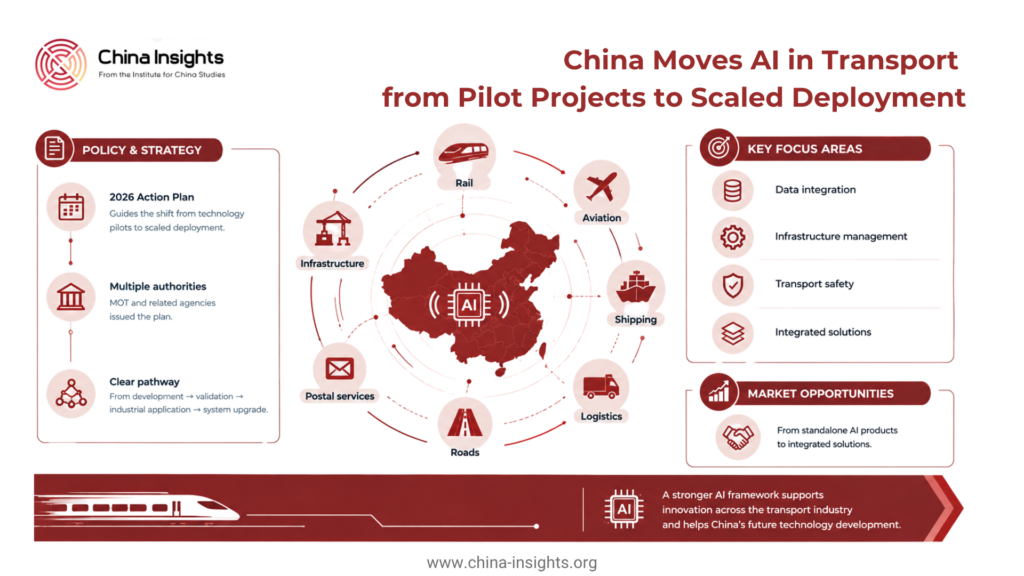
The Ministry of Transport (MOT), together with the National Railway Administration, Civil Aviation Administration of China, State Post Bureau and China State Railway Group, issued the “Action Plan for Innovation in Typical Application Scenarios of ‘AI + Transportation’” on 4 June 2026. The State Council policy interpretation published on 21 August 2026 highlights the acceleration of this transition. The action plan establishes a structured pathway from technology development and scenario validation to industrial application and system upgrading.
Executive summary
- AI deployment in transport is moving from experimentation toward scaled application.
- Authorities are opening a growing number of practical application scenarios to technology providers.
- The policy focus extends across roads, rail, aviation, shipping, logistics, infrastructure and transport safety.
- Data integration and AI-enabled coordination are becoming central to transport-system modernization.
- The emerging market is shifting from standalone AI products toward integrated solutions and sector-specific systems.
- Companies should assess opportunities through application scenarios, partnerships and industrial ecosystems rather than technology capability alone.
From technology pilots to application at scale
The most important change is the shift in policy emphasis. China’s transport authorities are no longer treating AI primarily as a research and pilot topic. The 2026 action plan establishes application scenarios as the mechanism for connecting technology suppliers with transport-sector demand. It identifies application promotion, innovation demonstration and technological breakthroughs as different implementation categories.
This creates a clearer route from technology development to commercial deployment. Mature technologies can be introduced into existing operational environments, while less mature technologies can be tested through demonstration projects. For businesses, this reduces some of the uncertainty around how transport-sector AI solutions can move from proof of concept to larger contracts.
Application scenarios become the main market-entry mechanism
The action plan covers ten priority areas, including intelligent driving, smart highways, intelligent railways, smart shipping, smart civil aviation, smart postal services, intelligent infrastructure construction and maintenance, smart mobility, smart freight and intelligent safety supervision.
The significance is that demand is being defined around operational problems rather than around AI technologies themselves. This favors companies that can demonstrate measurable improvements in transport efficiency, safety, asset management or service quality. AI suppliers will increasingly need sector knowledge and implementation capabilities alongside technical expertise.
Transport data becomes a strategic asset
A second major change is the stronger emphasis on data integration. Transport systems generate large amounts of operational data, but information remains fragmented between transport modes and organisations. The new application agenda places greater emphasis on connecting data across road, rail, water, aviation and postal systems.
This is particularly important for multimodal transport. AI can combine information on vehicle movements, infrastructure conditions, freight flows and network capacity to improve scheduling and resource allocation. The policy therefore creates demand not only for AI models but also for data platforms, interfaces, computing infrastructure and systems capable of operating across organisational boundaries.
Infrastructure management becomes an AI market
AI deployment is expanding beyond vehicles and passenger services. The action plan specifically targets infrastructure inspection, maintenance and lifecycle management. Technologies such as intelligent sensing, robotics, unmanned aerial systems and multimodal AI models are being applied to identify infrastructure conditions, predict risks and support maintenance decisions.
This expands the addressable market for technology suppliers. Transport infrastructure represents a large installed asset base with recurring inspection and maintenance requirements. AI solutions that can reduce inspection costs, improve asset utilization or identify risks earlier may therefore have applications well beyond new infrastructure construction.
Safety is moving from response to prediction
AI is also changing the approach to transport safety. The policy direction places greater emphasis on automated risk identification, early warning and intervention. This includes monitoring transport operations, infrastructure and high-risk activities.
The shift matters because it changes the value proposition of AI. The technology is increasingly being assessed on whether it can prevent incidents rather than simply improve operational efficiency. This creates opportunities for companies offering computer vision, predictive analytics, intelligent monitoring and decision-support systems, but it also raises requirements for reliability, testing and accountability.
Logistics and multimodal transport are priority areas
Freight transport is another important area of expansion. Authorities are promoting AI applications in intelligent dispatching, warehousing coordination, abnormal-event alerts and multimodal transport. The objective is to improve coordination across different transport modes and create more integrated freight-management systems.
For logistics companies, the potential impact extends beyond individual vehicles or warehouses. AI can increasingly become part of the wider supply-chain operating system. This may create new demand for integrated platforms that coordinate transport, inventory, routing and terminal operations.
The market is becoming more accessible but more competitive
The policy framework creates more opportunities for technology companies because transport authorities are explicitly opening application scenarios. However, access to these markets is likely to depend on cooperation with infrastructure operators, transport companies and public-sector organisations.
The earlier MOT-led “AI + Transportation” Implementation Opinions, issued in September 2025, already established the objective of moving AI into typical transport scenarios and building a governance framework. The 2026 action plan represents a more operational stage of that strategy.
What this means for business
- Scenario access matters: AI companies should identify transport-sector partners and application scenarios rather than relying solely on technology demonstrations.
- Integrated solutions will gain importance: Opportunities will increasingly favor systems combining AI, data, sensors, software and operational services.
- Transport data capabilities are strategic: Companies should assess their ability to integrate and manage heterogeneous operational data.
- Infrastructure offers a growing market: Inspection, maintenance and asset-management applications provide opportunities beyond passenger and freight transport.
- Safety applications require higher standards: Reliability, validation and risk-management capabilities will become increasingly important.
- Partnerships will be critical: Cooperation with transport operators, infrastructure owners, research institutions and technology providers may be essential for scaling solutions.
Sources
- https://www.gov.cn/zhengce/202608/content_7078855.htm
- https://xxgk.mot.gov.cn/jigou/kjs/202606/t20260624_4208160.html
- https://jtyst.jl.gov.cn/zw_133208/zcjd/202607/t20260706_9660465.html
- https://xxgk.mot.gov.cn/2020/jigou/kjs/202509/t20250925_4177256.html
- https://www.mot.gov.cn/gongkai/zcjd/202512/t20251226_4191467.html
Author
Dr. Richard van Ostende

Related Articles