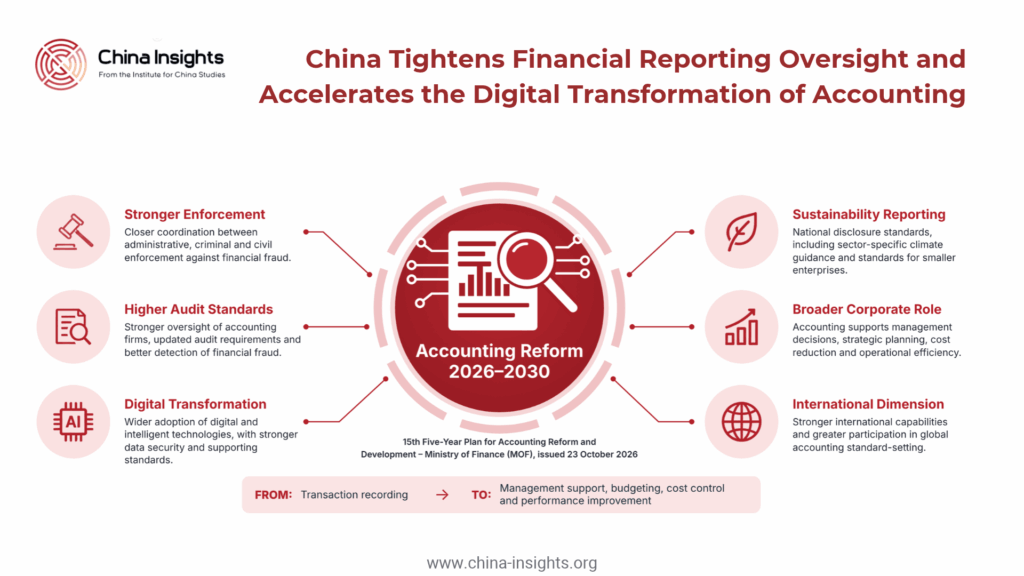
China Tightens Financial Reporting Oversight and Accelerates the Digital Transformation of Accounting
China is using its 15th Five-Year Plan period (2026–2030) to strengthen the quality, reliability and strategic value of accounting information. The Ministry of Finance (MOF) is placing greater emphasis on enforcement, audit quality, digital transformation and the integration of accounting into corporate management. The changes point to a more demanding environment for companies, auditors and professional service providers operating in China.
The policy direction is set out in the 15th Five-Year Plan for Accounting Reform and Development (《会计改革与发展“十五五”规划》), issued by the Ministry of Finance on 23 October 2026 and published on its website on 5 November 2026. The plan was also discussed at a MOF press conference on 11 November 2026. It establishes priorities across seven areas, including accounting regulation, professional talent, services, supervision, technology, international engagement and the development of China’s accounting knowledge system.
Executive Summary
- Stronger enforcement: China will intensify supervision of financial reporting and auditing, with greater coordination between administrative, criminal and civil enforcement.
- Higher audit standards: The government plans to strengthen accounting firm oversight, improve audit requirements and address weaknesses in the detection of financial fraud.
- Digital transformation: Accounting organisations are expected to adopt digital and intelligent technologies while strengthening data security and supporting standards.
- Expanded sustainability reporting: China will continue developing national sustainability disclosure standards, including sector-specific climate guidance and standards for smaller enterprises.
- A broader corporate role: Accounting is expected to move beyond transaction recording towards management support, budgeting, cost control and business performance improvement.
- International dimension: China aims to strengthen the international capabilities of its accounting profession and increase its participation in global accounting standard-setting.

From Legal Reform to Stronger Enforcement
The most significant shift is the move from strengthening the legal framework towards more systematic implementation and enforcement. Following amendments to the Accounting Law and the Certified Public Accountants Law, the MOF intends to complete the supporting regulatory framework.
Planned measures include revisions to the rules governing accounting firms, professional registration, accounting records and regulatory supervision. The ministry also intends to review access requirements for firms auditing listed companies and introduce more structured arrangements for audit rotation.
Financial fraud remains a central enforcement priority. The MOF plans to strengthen the existing multi-agency framework for addressing false financial reporting. Administrative enforcement will be more closely connected with criminal penalties, civil compensation and disciplinary supervision. This signals that financial misrepresentation is increasingly being treated as a governance and accountability issue, rather than solely an accounting violation.
Higher Expectations for Financial Reporting and Auditing
The plan places greater emphasis on the quality and reliability of corporate financial information. The MOF will strengthen accounting standards, improve their implementation and increase coordination between standard-setting and regulatory supervision.
Audit requirements will also be updated. The ministry intends to revise standards related to the identification of financial fraud and issue practical guidance for sectors and business activities with specific risks. Particular attention will be given to complex or coordinated forms of fraud, including situations involving third parties.
This direction has implications for both domestic and foreign-invested companies. Reliable financial information is important for financing, investment decisions, taxation and corporate governance. Companies should expect greater scrutiny of their accounting controls, supporting documentation and audit processes. The quality of financial reporting may also become a more important consideration for lenders, investors and business partners.
Digitalization Becomes a Core Accounting Priority
The MOF identifies the integration of accounting with modern information technology as a key driver of professional development. The plan moves beyond general encouragement of digitalization and calls for stronger institutional standards, wider technology adoption and improved security arrangements.
The policy agenda includes further research and practical guidance on accounting issues arising from artificial intelligence, the digital economy, platform businesses and financial innovation. It also calls for more effective use of digital technologies in auditing and professional services.
For companies, this means that accounting transformation should increasingly be considered part of wider digital and governance strategies. Investment in data quality, systems integration, internal controls and information security will become more relevant to financial reporting and audit readiness.

Sustainability Reporting Moves Towards a More Complete Framework
China is continuing to develop a national system for sustainability disclosure. The plan identifies climate-related reporting as an important area and calls for sector-specific application guidance. It also proposes further standards covering biodiversity and smaller enterprises, alongside requirements for the assurance of sustainability information.
This is a meaningful development for companies preparing for more structured environmental, social and governance reporting. The direction suggests that sustainability information will increasingly be subject to formal standards and verification rather than remaining primarily a voluntary reporting exercise.
The pace and scope of implementation will matter. Companies should monitor the publication of detailed standards and sector guidance, particularly where their reporting requirements extend across Chinese and international operations.
Accounting Shifts Towards Management and Business Performance
Another important development is the intended expansion of management accounting. The MOF plans to issue guidance on financial shared services, value-chain management and comprehensive budgeting. It also intends to promote the use of management accounting across different industries.
This reflects a broader change in the expected role of accounting professionals. The plan calls for a transition from transaction-focused accounting towards roles that support management decisions, strategic planning, cost reduction and operational efficiency.
The government also intends to strengthen professional training, develop high-level talent and improve the use of accounting expertise in policy research and corporate management. This could support demand for professionals combining accounting knowledge with digital, sustainability and business management capabilities.
What This Means for Business
- Review financial controls: Companies should assess accounting procedures, documentation and internal controls against the direction of stronger supervision and enforcement.
- Prepare for closer audit scrutiny: Financial reporting quality, audit readiness and the reliability of third-party information will require greater management attention.
- Invest in digital capabilities: Accounting systems, data governance, cybersecurity and automation should be integrated into wider digital transformation plans.
- Monitor sustainability requirements: Companies should follow the development of Chinese disclosure and assurance standards, particularly sector-specific guidance.
- Strengthen management accounting: Finance functions should develop capabilities in budgeting, cost management, value-chain analysis and performance monitoring.
- Assess professional service needs: Foreign-invested companies may need to review their accounting, audit and advisory arrangements as regulatory requirements and professional standards evolve.
China’s accounting reform agenda for 2026–2030 is not limited to technical changes in accounting rules. It seeks to strengthen the credibility of financial information, improve corporate governance and make accounting more relevant to business management. For companies operating in China, the practical challenge will be to translate these policy priorities into stronger controls, more reliable data and better-informed management decisions.
Sources
- Primary policy document: Ministry of Finance, Notice on Issuing the 15th Five-Year Plan for Accounting Reform and Development (关于印发《会计改革与发展“十五五”规划》的通知), document 财会〔2026〕13号, issued 23 October 2026 and published 5 November 2026.
https://kjs.mof.gov.cn/zhengcefabu/202611/t20261105_4004148.htm - MOF press conference transcript: Press Conference on High-Quality Accounting Development during the 15th Five-Year Plan Period, 11 November 2026.
https://www.mof.gov.cn/zhengwuxinxi/caizhengxinwen/202611/t20261111_4004515.htm - MOF notice and full plan: Notice on Issuing the 15th Five-Year Plan for Accounting Reform and Development, document 财会〔2026〕13号.
https://m.mof.gov.cn/zcfb/202611/t20261105_4004148.htm
Author
Dr. Richard van Ostende

Related Articles