
China Links AI Deployment, Data Infrastructure and Marine Industries in Its Next Growth Agenda
China is placing greater emphasis on the commercial application of emerging technologies and the development of new industrial sectors. The next phase of its 15th Five-Year Plan (2026–2030) agenda is focused not only on technological innovation, but also on deploying technologies in industrial settings, developing supporting infrastructure and creating new markets.
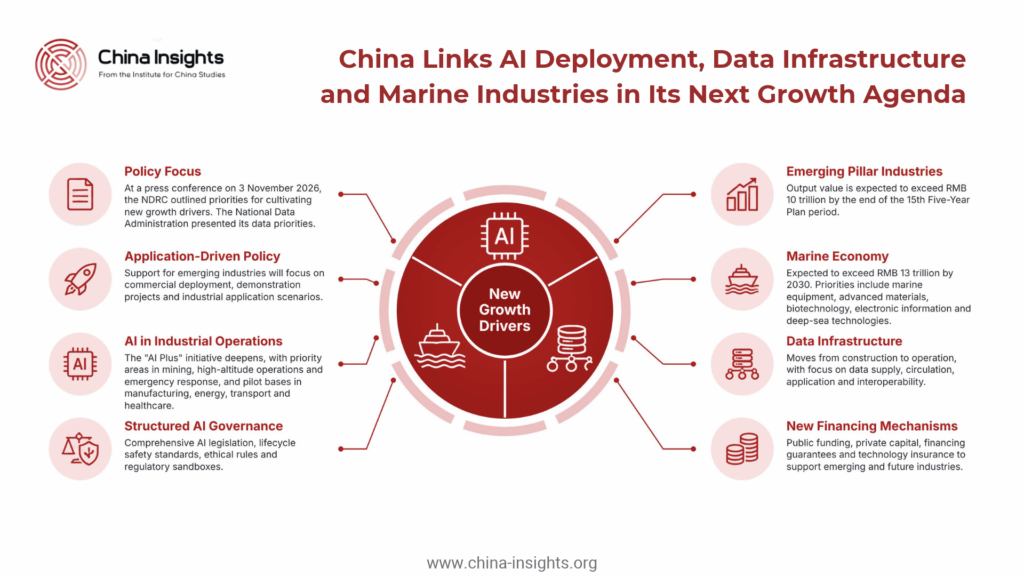
At a press conference on 3 November 2026, the National Development and Reform Commission (NDRC) outlined priorities for cultivating new growth drivers. The discussion covered emerging pillar industries, future industries, artificial intelligence (AI), the marine economy and data infrastructure. The National Data Administration also presented its priorities for data development and digital transformation.
The announcements indicate a more application-oriented approach to industrial policy. Government support is expected to focus on technologies that address operational needs, improve industrial productivity and create commercially viable applications. For foreign companies, this creates opportunities in selected technology and industrial segments, but also raises the importance of local partnerships, regulatory compliance and alignment with national priorities.
Executive Summary
- Industrial policy is becoming more application-driven: Support for emerging industries will increasingly focus on commercial deployment, demonstration projects and the development of industrial application scenarios.
- AI moves deeper into industrial operations: Priority applications include manufacturing, energy, transport and other sectors where AI can address operational challenges.
- AI governance will become more structured: China plans to develop comprehensive legislation, lifecycle safety standards and regulatory sandboxes.
- The marine economy is gaining strategic importance: Priorities include marine equipment, advanced materials, biotechnology, electronic information and deep-sea technologies.
- Data infrastructure shifts towards practical use: Policy will focus on data circulation, interoperability, commercial applications and operating models.
- New financing mechanisms are planned: Public funding, private capital, financing guarantees and technology insurance are intended to support emerging and future industries.

Emerging Industries Move from Innovation to Commercial Deployment
The NDRC’s 3 November press conference placed practical application at the center of emerging-industry development. The Commission aims to strengthen national innovation centers and industrial technology engineering centers, while organizing industrial innovation projects to accelerate the adoption of domestic technologies and products.
A notable change is the emphasis on building application scenarios at different levels. These include major integrated projects, industry-wide applications and smaller, high-value use cases. This approach is intended to connect technology development with identifiable market demand and operational problems. The NDRC expects the output value of emerging pillar industries to exceed RMB 10 trillion by the end of the 15th Five-Year Plan period.
For businesses, the direction suggests that access to demonstration projects, industrial customers and application platforms will become increasingly important. Technology providers may need to demonstrate measurable operational benefits, rather than relying primarily on technical performance or research credentials. The emphasis on application also creates potential opportunities for specialized foreign technology suppliers working with Chinese industrial partners.
For future industries, the NDRC highlighted basic research, regional specialization and stronger enterprise participation in national technology programs. It also referred to financing guarantees, risk compensation and dedicated technology insurance products.
This indicates an effort to address the financing risks associated with technologies that are not yet commercially mature. Companies operating in emerging technology fields should monitor the specific programs and eligibility conditions that follow. Support is likely to be selective, with local authorities encouraged to focus on areas where they have existing industrial capabilities and comparative advantages.
AI Policy Shifts Towards Industrial Integration and Governance
The NDRC intends to deepen the national “AI Plus” initiative through application-led innovation. Priority areas include mining, high-altitude operations and emergency response, where AI can address specific operational risks and productivity constraints. The government will also continue developing national AI application pilot bases in manufacturing, energy, transport and healthcare.
The policy direction is significant because it connects AI development more directly with industrial processes. It creates demand for solutions that can be integrated into existing equipment, production systems and operational workflows. For technology companies, sector expertise and the ability to deliver reliable implementation will be important commercial differentiators.
The NDRC also outlined plans to accelerate fundamental and comprehensive AI legislation, establish safety standards and ethical rules covering the full AI lifecycle, and support regulatory sandboxes for different application areas. It also intends to improve coordination between government departments and promote mutual recognition of regulatory outcomes.
This creates a more structured compliance environment for AI developers and users. Companies should expect closer attention to data, model training, safety, deployment and accountability. Regulatory sandboxes may provide controlled environments for testing new applications, although their practical scope and eligibility requirements will depend on subsequent implementation measures.

Marine Industries Become a Strategic Growth Area
The NDRC identified marine technology, industrial development and the expansion of maritime operating areas as three priorities for the next five years. Technology development will focus on addressing weaknesses in high-end instruments, critical materials and foundational software. Industrial priorities include strengthening marine equipment manufacturing and maritime transport, while developing marine biotechnology, advanced materials and electronic information.
The NDRC expects China’s marine economy to exceed RMB 13 trillion by 2030. The policy agenda also includes marine energy development and the expansion of capabilities in deep-sea and polar operations. Marine economic demonstration zones and modern marine cities are expected to support regional industrial development.
For businesses, the priorities create potential opportunities in specialized equipment, sensors, materials, marine engineering, biotechnology and digital systems. However, the emphasis on technological self-reliance means that foreign suppliers should assess local sourcing requirements, technology cooperation expectations and the competitive position of domestic manufacturers.
Data Infrastructure Moves from Construction to Operation
The National Data Administration plans to implement action plans for the digital economy, digital society and data infrastructure. A key objective is to move data infrastructure beyond construction and towards effective operation. Priorities include facilities for data supply, circulation and application, as well as improved interoperability between systems.
The administration also intends to strengthen data-related institutional arrangements, develop standards and support comprehensive digital platforms. Manufacturing supply chains are among the areas targeted for deeper integration of digital technologies. These measures are intended to improve the availability and commercial use of data across industries.
For businesses, the direction creates opportunities in data infrastructure, digital platforms, industrial software and data services. It also makes data governance and cross-system compatibility more important. Companies using data-intensive AI applications should monitor forthcoming rules on data circulation, security and compliance.
What This Means for Business
- Prioritize application-led partnerships: Identify Chinese industrial customers and pilot projects where technologies can address specific operational needs.
- Monitor AI implementation and regulation: Assess the implications of forthcoming AI legislation, lifecycle standards and sector-specific guidance.
- Evaluate marine-industry opportunities: Track demand in marine equipment, advanced materials, biotechnology, electronic information and deep-sea engineering.
- Assess local technology requirements: Consider how domestic innovation priorities and localization expectations may affect market access and partnership structures.
- Prepare for greater data integration: Review data governance, interoperability and compliance requirements when developing digital and AI-based services in China.
- Track financing and demonstration programs: Monitor national and regional support mechanisms, while distinguishing announced policy intentions from confirmed funding opportunities.
Sources
https://www.gov.cn/zhengce/202611/content_7084907.htm
Author
Dr. Richard van Ostende

Related Articles