
China Strengthens Foundation Governance, Transparency and Financial Oversight
China is tightening the regulatory framework governing foundations, with implications for organisations involved in philanthropy, corporate social responsibility (CSR), charitable funding and public-interest projects. The revised rules place greater emphasis on governance accountability, financial management, disclosure and regulatory supervision. They also introduce more explicit requirements for fundraising, investment activities and the management of charitable projects.
The State Council revised the Regulation on the Administration of Foundations (《基金会管理条例》) through State Council Decree No. 848, signed on 13 October 2026. The Ministry of Justice (MOJ) and Ministry of Civil Affairs (MCA) explained the changes in a joint Q&A published on 10 November 2026. The revised regulation replaces the framework established in 2004 and takes effect on 1 January 2027.
Executive Summary
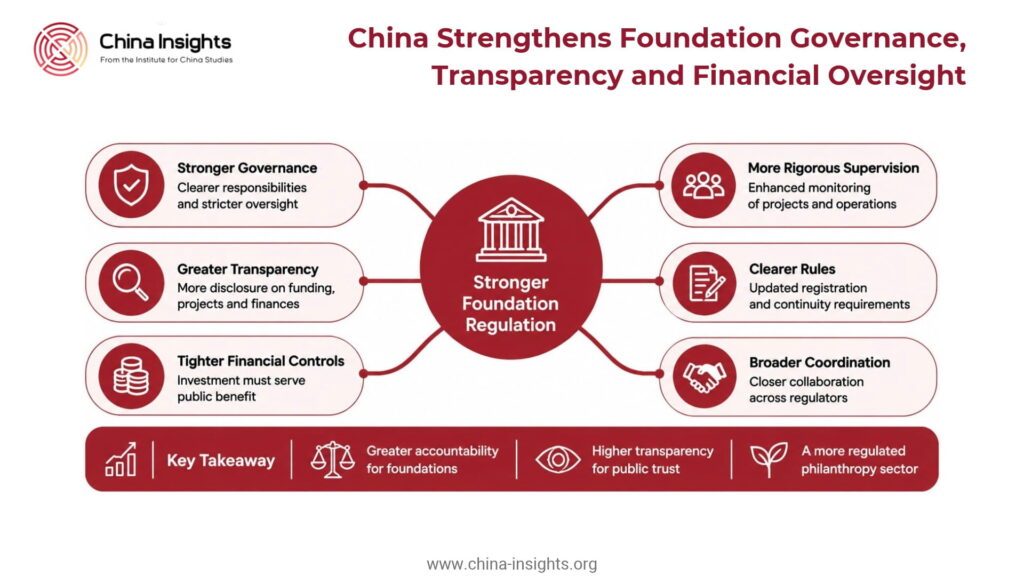
- Stronger governance requirements: Founders, directors and senior managers face clearer responsibilities, restrictions on conflicts of interest and more detailed governance requirements.
- Greater transparency: Foundations must disclose more information about donations, projects, investments, significant transactions and related-party dealings.
- Tighter financial controls: Investment activities must follow legality, safety, prudence and effectiveness principles. Investment returns must be used entirely for public-benefit purposes.
- More rigorous project oversight: Foundations must monitor projects and assess organisations appointed to implement them.
- Expanded regulatory coordination: Civil affairs authorities will work more closely with supervisory, finance and audit departments.
- Changes to registration and continuity: Registration requirements are clarified, direct registration is permitted in specified charitable fields, and foundations that remain inactive for two consecutive years must terminate.

Governance Accountability Moves to the Foreground
The revised regulation strengthens the responsibilities of founders and foundation leadership. Founders are explicitly responsible for preparatory activities before registration. The rules also introduce restrictions on who may act as a founder or responsible person, including individuals associated with certain disqualified organisations or serious breaches of trust.
Governance arrangements are more clearly defined. The regulation specifies the responsibilities and procedures of boards, supervisory bodies and executive organisations. It also requires greater attention to conflicts of interest. Founders, major donors, directors and supervisors must not use related-party relationships to harm the interests of the foundation, its beneficiaries or the public. Individuals with relevant personal or family interests must not participate in related decisions.
For companies establishing or supporting foundations, these changes increase the importance of governance design. Board composition, appointment procedures, decision-making records and related-party controls should be reviewed rather than treated as administrative formalities.
Disclosure Requirements Become More Extensive
The revised regulation introduces a dedicated chapter on information disclosure. Foundations must publish accurate, complete and timely information through the unified information platform established by the Ministry of Civil Affairs. Required disclosures include basic organisational information, fundraising activities, public-benefit projects, major asset changes and investments, significant transactions, financial flows and related-party dealings.
Foundations must also submit an annual work report and an audit report prepared by an accounting firm by 31 May each year. The annual report covers governance, fundraising, donations, grants, financial information, cooperation with overseas organisations and information disclosure.
The changes increase the visibility of foundation activities to regulators, donors, beneficiaries and the public. Companies working with foundations should therefore expect greater scrutiny of how funds are transferred, allocated and used. Contractual arrangements and reporting procedures will need to support the foundation’s disclosure obligations.
Financial Management and Project Execution Face Tighter Controls
The regulation introduces clearer requirements for managing and investing foundation assets. Investment must comply with applicable rules and follow the principles of legality, safety, prudence and effectiveness. Returns must be used entirely for public-benefit purposes. Foundations are also required to maintain their net assets at or above the statutory registration capital threshold.
Project management is subject to more explicit controls. Foundations must establish projects within the purposes and business scope defined in their articles of association, monitor implementation and ensure that projects retain their public-benefit character. Where implementation is outsourced, the foundation must assess and supervise the appointed organization.
These provisions are relevant to companies acting as project implementers, service providers or suppliers to foundations. Selection procedures must be transparent and fair, while project delivery, expenditure and outcomes need to be properly documented. Foundations cannot treat the transfer of funds to a third party as the end of their responsibility.
Registration and Operating Requirements Are Clarified
The revised regulation clarifies registration responsibilities and introduces differentiated minimum registered capital requirements according to the level of the registering authority. It also allows direct registration for foundations operating in specified areas, including poverty relief, elderly care, disability support, medical assistance, education and disaster relief. Such foundations must have a designated industry management department.
The regulation also strengthens requirements for changes to registration and termination. A foundation that has not conducted public-benefit activities for two consecutive years must terminate. The rules further clarify liquidation procedures before deregistration.
These changes matter to organisations considering the establishment of a foundation in China or restructuring an existing entity. Registration eligibility, capital requirements, operating activity and eventual closure arrangements should be assessed before commitments are made.

Regulatory Supervision Becomes More Coordinated
The revised framework assigns clearer responsibilities to registration authorities, business supervisory units and industry management departments. Authorities can use interviews with foundation leaders and coordinate inspections with finance, audit and other relevant departments. Financial supervision will draw on annual report reviews, special inspections, accounting supervision and account monitoring.
The regulation also increases penalties for violations and strengthens the role of public oversight. Foundations must comply with disclosure and operational requirements, while industry organisations are expected to improve professional standards and self-regulation.
The direction is towards more integrated supervision rather than reliance on registration and periodic reporting alone. Foundations should expect closer examination of their financial activities, governance arrangements and project implementation.
What This Means for Business
- Review foundation partnerships: Companies funding or cooperating with Chinese foundations should assess governance standards, disclosure practices and financial controls.
- Strengthen due diligence: Verify the registration status, leadership, governance arrangements and financial reporting of prospective foundation partners.
- Formalize project oversight: Contracts should define fund use, reporting obligations, implementation responsibilities, audit rights and monitoring arrangements.
- Manage conflicts of interest: Review procurement, supplier selection and related-party transactions involving foundations and their corporate partners.
- Prepare for greater transparency: Ensure that donations, grants and project expenditure can be documented and reconciled with disclosure requirements.
- Reassess foundation structures: Organisations planning to establish or maintain a foundation should review registration, capital, activity and termination requirements before the new rules take effect.
The revised regulation represents a substantial update to China’s foundation governance framework. Its practical effect extends beyond foundations themselves to the companies, donors and service providers working with them. From January 2027, stronger governance, financial accountability and transparency will be central to the operation of public-benefit organisations in China. Businesses should review existing arrangements before the implementation date rather than wait for regulatory inspections or disclosure issues to identify weaknesses.
Sources
Author
Dr. Richard van Ostende

Related Articles