China Expands Rural Consumption Strategy with Focus on Electric Vehicles and Green Products
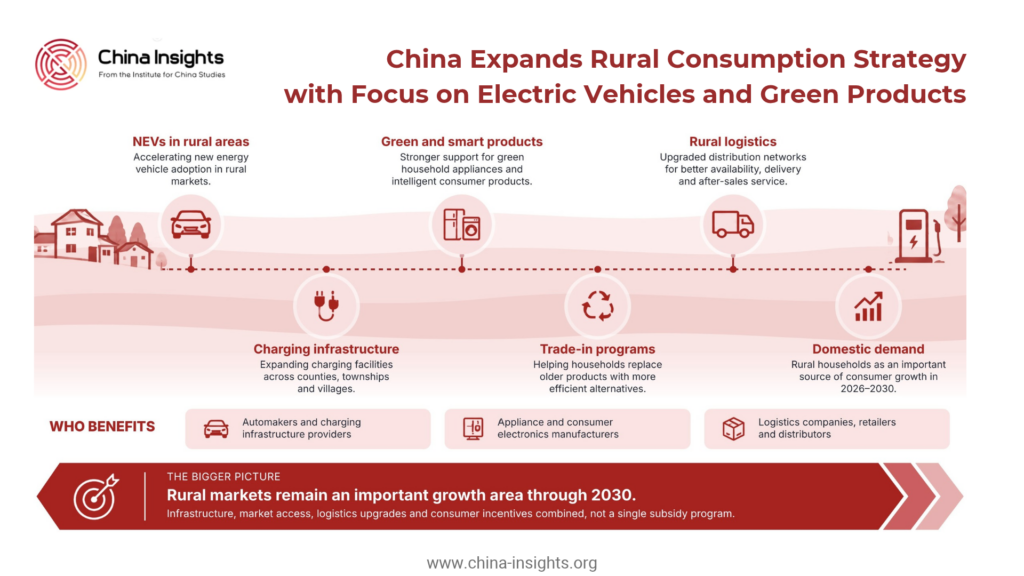
China is strengthening its rural consumption strategy by accelerating the adoption of new energy vehicles (NEVs), green household appliances, and smart consumer products in rural markets. During a State Council policy briefing on 20 August 2026, the Ministry of Commerce (MOFCOM) outlined measures to expand charging infrastructure, improve rural logistics, and increase the availability of high-quality consumer goods in lower-tier markets.
The initiative forms part of China’s broader effort to stimulate domestic demand during the 15th Five-Year Plan period (2026–2030). Rather than relying solely on urban consumption, policymakers are increasingly targeting rural households as an important source of future consumer growth while supporting green and digital economic development.
Executive Summary
- China will accelerate NEV adoption in rural areas.
- Charging infrastructure will expand across counties and villages.
- Green and smart consumer products will receive stronger policy support.
- Rural logistics and distribution networks will be upgraded.
- Consumer trade-in programs will continue supporting household purchases.
- The measures aim to strengthen domestic demand during the 15th Five-Year Plan period.

Rural Consumption Becomes a Growth Driver
MOFCOM identified rural consumption as an important component of China’s domestic demand strategy. As income levels improve and infrastructure develops, rural markets are expected to generate additional demand for durable consumer goods and services.
The ministry intends to improve market access for quality products while reducing barriers to consumption in less-developed regions. This approach aligns consumption policy with broader rural revitalization objectives.
Electric Vehicles Move Deeper into Rural Markets
New energy vehicles remain a central priority of the policy package. MOFCOM will continue promoting NEVs in rural areas through coordinated government programs while improving supporting infrastructure.
A key measure is expanding charging facilities across counties, townships, and villages. Wider charging coverage is intended to reduce adoption barriers for rural consumers and create a more practical operating environment for electric vehicles outside major cities.
The policy complements China’s broader objective of expanding NEV adoption nationwide while supporting domestic automotive manufacturers.
Green and Smart Products Receive Additional Support
The ministry also plans to encourage greater rural adoption of green household appliances and intelligent consumer products.
These products include energy-efficient appliances and smart devices that support lower energy consumption and improved household convenience. Expanding their availability in rural markets serves both consumption growth and China’s environmental objectives.
Trade-in programs for consumer goods will continue helping households replace older products with more efficient alternatives.
Improving Rural Distribution Networks
Infrastructure improvements extend beyond vehicle charging. MOFCOM plans to strengthen rural logistics and distribution systems to improve product availability and delivery efficiency.
Better logistics are expected to reduce distribution costs while making a wider range of consumer goods accessible in lower-tier markets. More efficient supply chains should also improve after-sales service and product maintenance in rural communities.
Supporting Domestic Demand
The measures reflect China’s continued emphasis on domestic consumption as a long-term economic driver.
Rather than introducing a single subsidy program, the ministry is combining infrastructure investment, market access improvements, logistics upgrades, and consumer incentive mechanisms. This integrated approach aims to strengthen purchasing confidence while creating conditions for sustained consumption growth across rural China.
The strategy also supports national priorities including green development, digital transformation, and balanced regional development.

What this means for business
The latest rural consumption measures create opportunities across several industries.
Automotive manufacturers and charging infrastructure providers may benefit from expanded rural deployment of electric vehicles. Appliance manufacturers and consumer electronics companies could see growing demand for energy-efficient and smart products as trade-in programs continue.
Logistics companies, retailers, and distribution service providers may also benefit as rural supply chains receive further investment. For businesses already operating in China, the policy signals that rural markets will remain an important growth area during the 2026–2030 planning period.
Sources
https://www.gov.cn/zhengce/202608/content_7078604.htm
Author
Dr. Richard van Ostende

Related Articles