
China Advances Intellectual Property Strategy with 15th Five-Year Plan Framework
China is preparing the next stage of its intellectual property (IP) development strategy as part of the broader 15th Five-Year Plan period (2026–2030). Intellectual property protection and commercialization have become increasingly important elements of China’s innovation policy, industrial upgrading strategy and efforts to strengthen technology competitiveness.
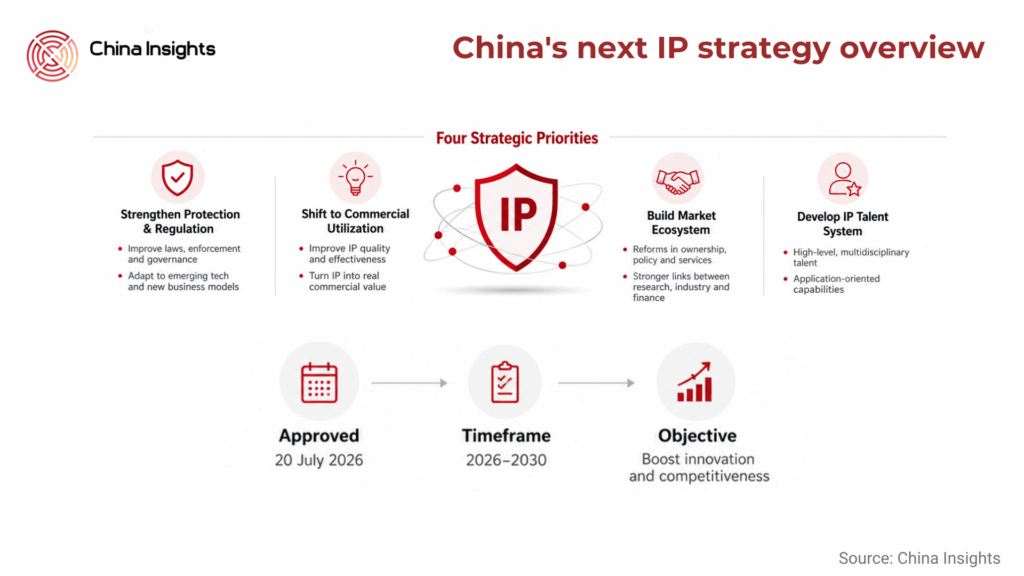
On 20 July 2026, the State Council reviewed and approved the “15th Five-Year Plan for Intellectual Property Protection and Utilization” (《知识产权保护和运用“十五五”规划》) during a State Council executive meeting. The plan is expected to define China’s strategic priorities for intellectual property protection, IP commercialization, regulatory improvement and talent development during the next five-year period.
The policy direction reflects China’s continued shift from an investment- and manufacturing-driven growth model toward an innovation-driven economy. Stronger intellectual property systems are considered an important foundation for supporting advanced manufacturing, emerging industries and technology commercialization.
Executive Summary
- The plan focuses on improving IP-related laws and regulations, strengthening IP protection mechanisms and increasing the commercial utilization of intellectual property.
- China aims to improve the quality and efficiency of intellectual property creation, protection and market application.
- The policy supports broader national objectives to strengthen innovation capabilities and develop new quality productive forces (“新质生产力”).
- Companies operating in China should expect continued improvements in IP governance, stronger enforcement mechanisms and increased emphasis on IP value creation.
Intellectual Property as a Strategic Component of China’s Innovation Economy
China has increasingly positioned intellectual property as a strategic asset supporting technological development and industrial competitiveness. The approval of the “15th Five-Year Plan for Intellectual Property Protection and Utilization” demonstrates that IP policy will remain closely connected with national innovation objectives. The upcoming plan will focus on addressing institutional gaps, improving supporting policies and creating a stronger environment for innovation. The government intends to further enhance the role of intellectual property in supporting technology development, industrial transformation and market competitiveness.
Strengthening the Intellectual Property Legal and Regulatory Framework
A key priority is improving the institutional foundation of intellectual property protection. The government will accelerate the review, revision, implementation and interpretation of relevant laws and regulations. This approach indicates that China intends to continue upgrading its IP governance framework to better match developments in emerging technologies and new business models. Areas affected may include technology commercialization, digital innovation, artificial intelligence-related applications, biotechnology and advanced manufacturing.
For foreign companies operating in China, regulatory improvements could contribute to greater predictability in IP-related processes. However, companies will also need to ensure that their intellectual property management systems remain aligned with evolving Chinese requirements. The direction reflects China’s broader policy objective of creating an innovation environment capable of supporting domestic technology development while attracting international investment and cooperation.
Moving from Intellectual Property Creation to Commercial Application
The State Council emphasized improving the quality of intellectual property supply and increasing the effectiveness of IP utilization. This indicates a stronger focus on transforming intellectual property from registered assets into commercially valuable resources.
Historically, China’s IP development has focused significantly on increasing the quantity of patents, trademarks and other intellectual property registrations. The next stage places greater emphasis on quality, economic value and practical application.
China plans to deepen reforms related to ownership rights distribution, strengthen policy support and improve market services. These measures are intended to support better connections between research institutions, enterprises and financial markets.
For industries such as advanced manufacturing, automotive, electronics, biotechnology and green technologies, improved IP commercialization mechanisms may create new opportunities for technology licensing, research cooperation and innovation partnerships.
Building Intellectual Property Management Capabilities and Talent Systems
Another priority highlighted by the State Council is the development of a comprehensive intellectual property talent system. The government aims to accelerate the creation of high-level, multidisciplinary and application-oriented IP professionals. This reflects recognition that effective IP management requires not only legal expertise but also business, technology and commercialization capabilities.
For companies, this trend suggests increasing demand for internal IP management capabilities. Businesses operating in China may need stronger coordination between research and development departments, legal teams, compliance functions and commercial units. Multinational companies with significant research activities in China may particularly need to strengthen local IP governance structures to manage patent portfolios, technology cooperation and potential commercialization opportunities.
Implications for Innovation Competition and Industrial Policy
The new IP plan is closely linked with China’s broader industrial development strategy. The government views intellectual property protection as an important tool for supporting “new quality productive forces,” a policy concept emphasizing innovation-driven growth, advanced technologies and productivity improvements.
The timing of the plan reflects a more competitive global innovation environment. Countries are increasingly focusing on technology leadership, supply chain resilience and strategic industries. Intellectual property has become an important factor in international economic competition. China’s approach combines stronger domestic innovation capabilities with efforts to improve the overall business environment for technology development. The effectiveness of these measures will depend on implementation, enforcement consistency and market acceptance. For international businesses, the development of China’s IP framework remains an important factor when evaluating research, investment and localization strategies.
What this means for business
The approval of China’s “15th Five-Year Plan for Intellectual Property Protection and Utilization” signals continued policy attention on intellectual property as a strategic business asset.
Companies operating in China should consider the following implications:
- Review IP strategies: Businesses should reassess their China IP strategies, including patent portfolios, trademark protection and technology ownership arrangements.
- Monitor regulatory developments: Changes to IP-related laws, regulations and implementation measures may create new compliance requirements.
- Focus on commercialization: Companies should evaluate opportunities to convert intellectual property into business value through licensing, partnerships and technology transfer.
- Strengthen local capabilities: Enterprises may need stronger internal IP management capabilities to support innovation activities in China.
- Integrate IP into investment decisions: Intellectual property considerations should remain part of market entry, research cooperation and supply chain strategies.
The next five years are expected to see continued development of China’s intellectual property system. Businesses that integrate IP management into broader innovation and investment strategies will be better positioned to participate in China’s evolving technology ecosystem.
Source
https://www.gov.cn/zhengce/202607/content_7076146.htm
Author
Dr. Richard van Ostende

Related Articles