China Releases 15th Five-Year Plan for Universal Healthcare Security
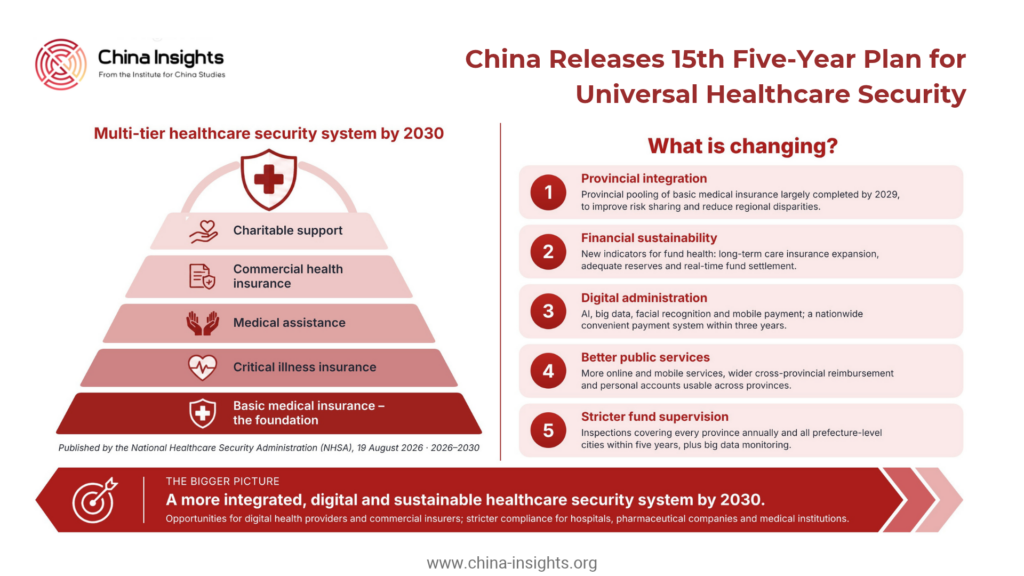
China has released its 15th Five-Year Plan for Universal Healthcare Security (2026–2030), setting out the country’s roadmap for healthcare insurance reform through 2030. Published by the National Healthcare Security Administration (NHSA) on 19 August 2026, the plan aims to build a more integrated and sustainable healthcare security system that combines public insurance, commercial insurance, medical assistance, and charitable support. The policy responds to demographic ageing, rising healthcare demand, and increasing pressure on healthcare financing.
Executive Summary
- China aims to establish a comprehensive multi-tier healthcare security system by 2030.
- Provincial pooling of basic medical insurance should be largely completed by 2029.
- Long-term care insurance coverage will expand.
- AI and big data will become central to healthcare insurance administration.
- Commercial health insurance will play a larger complementary role.
- Cross-provincial healthcare payments and reimbursement will become more integrated.
- Healthcare fund supervision will intensify through nationwide inspections and data-driven monitoring.

Building a More Integrated System
The plan sets a clear objective of creating a healthcare security system that is universal, equitable, sustainable, and legally standardized by 2030. Basic medical insurance remains the foundation of the system, but the government also intends to strengthen coordination with critical illness insurance, medical assistance, commercial insurance, and charitable support. This broader approach is designed to reduce out-of-pocket healthcare costs while improving long-term system resilience.
Strengthening Financial Sustainability
Financial sustainability is a central theme of the plan. Rather than focusing solely on expanding participation, the NHSA introduces new performance indicators that measure the financial health of healthcare insurance funds. These include expanding long-term care insurance, maintaining adequate reserve levels, increasing real-time fund settlement, and improving direct payment of maternity allowances. The emphasis reflects growing pressure from an ageing population and rising medical expenditure.
Advancing Provincial Integration
The plan accelerates the consolidation of healthcare insurance administration at the provincial level. Many insurance funds are still managed by local coordinating regions, creating differences in funding capacity and administration. By largely completing provincial pooling by 2029, the government aims to improve risk sharing, increase fund efficiency, and reduce regional disparities.
Expanding Digital Healthcare Administration
Digitalization becomes a key operational priority during the 15th Five-Year Plan period. The NHSA plans to expand the use of artificial intelligence, big data, facial recognition, and mobile payment technologies across healthcare insurance administration. A nationwide convenient payment system is targeted within three years, while AI-powered customer service will support citizens with policy enquiries and administrative procedures. These measures are intended to reduce processing times and improve service accessibility.

Improving Public Services
The plan also focuses on making healthcare insurance services more accessible. More services will become available through online and mobile platforms, while administrative procedures will be standardized nationwide. Cross-provincial reimbursement will continue expanding, including for maternity-related medical expenses. Employee medical insurance personal accounts will also become usable across provincial boundaries, making healthcare payments more flexible for families.
Expanding the Role of Commercial Insurance
The NHSA recognizes that public insurance alone cannot meet increasingly diverse healthcare needs. The plan therefore encourages stronger development of commercial health insurance as a complementary layer within China’s healthcare security system. Charitable organisations are also expected to play a greater role in supporting vulnerable groups and patients facing catastrophic medical expenses, creating a more diversified healthcare protection framework.
Tightening Healthcare Fund Supervision
Fund supervision will become significantly more rigorous during the 2026–2030 period. The NHSA plans nationwide inspections that will cover every province annually and all prefecture-level cities within five years. At the same time, authorities will expand big data monitoring to identify irregularities involving medicines, medical consumables, treatment procedures, and insurance claims. The objective is to strengthen fraud prevention while improving compliance across the healthcare sector.
What this means for business
The 15th Five-Year Plan for Universal Healthcare Security reinforces healthcare as a long-term policy priority through 2030. Digital health technology providers, commercial insurers, and healthcare service companies may benefit from greater investment in digital infrastructure and complementary insurance products. At the same time, hospitals, pharmaceutical companies, and medical institutions should prepare for stricter compliance requirements as data-driven supervision and provincial integration become more advanced.
Sources
https://www.gov.cn/zhengce/202608/content_7078670.htm
Author
Dr. Richard van Ostende

Related Articles