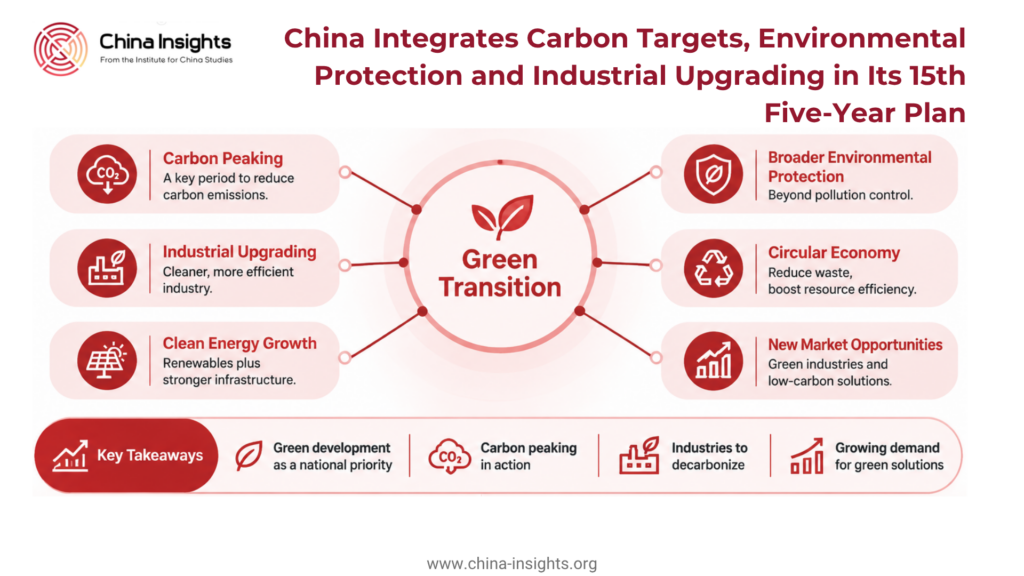
China Integrates Carbon Targets, Environmental Protection and Industrial Upgrading in Its 15th Five-Year Plan
China is moving towards a more integrated approach to green development. Environmental protection, carbon reduction, industrial transformation and resource efficiency are increasingly treated as connected policy priorities. A series of 15th Five-Year Plan (2026–2030) sectoral plans translates this direction into targets and measures for energy, manufacturing, waste management, transport and consumption.
A Xinhua report published on 4 November 2026, Improving Environmental Quality and Advancing Carbon Peaking: Green Development Priorities in the 15th Five-Year Plan, highlights the scope of this policy shift. It follows the State Council’s Beautiful China Construction 15th Five-Year Plan, issued in June, and the 15th Five-Year Carbon Peaking Action Plan, issued in July. Together with sector-specific plans, these documents provide a more coordinated framework for China’s green transition.
For businesses, the implications extend beyond emissions reduction. Companies will face changing expectations for energy use, production efficiency, pollution control and resource management. At the same time, policy priorities are creating demand for clean energy, green manufacturing, environmental services and circular-economy solutions.
Executive Summary
- Green development becomes a cross-sector policy priority: Environmental protection, carbon reduction, industrial upgrading and resource efficiency are being coordinated through multiple national plans.
- Carbon peaking enters an implementation phase: The 15th Five-Year Plan period is identified as a critical period for achieving China’s carbon-peak objective.
- Industrial decarbonization will affect investment decisions: Energy efficiency, low-carbon processes and emissions management are becoming more prominent in manufacturing policy.
- Clean energy deployment is shifting towards system integration: Renewable generation is accompanied by priorities for storage, grid flexibility, direct green-power supply and energy management.
- Environmental compliance is broadening: Solid waste, emerging pollutants, soil and water quality are receiving greater attention.
- New markets are emerging: Zero-carbon industrial parks, green factories, recycling systems and low-carbon services are receiving policy support.

Environmental Policy Expands Beyond Pollution Control
The State Council issued the Beautiful China Construction 15th Five-Year Plan on 21 June 2026. The plan marks a broader approach to environmental policy. Rather than focusing primarily on conventional pollution control, it links carbon reduction, pollution prevention, ecological protection and economic growth. It sets out seven areas of work and 20 major projects.
The policy agenda also extends environmental management into areas that have received less attention in previous planning cycles. These include solid waste, emerging pollutants, agricultural and rural environments, groundwater and ecological restoration. The 15th Five-Year Plan for Solid Waste Pollution Prevention and Control also identifies pollution from decommissioned new-energy equipment as an area requiring attention.
For businesses, this broadens the scope of environmental risk management. Compliance considerations will increasingly involve waste treatment, product end-of-life management and the environmental performance of supply chains. Companies operating in manufacturing, construction, energy and infrastructure should assess whether existing environmental management systems cover these areas.
Carbon Peaking Becomes a More Direct Industrial Constraint
The State Council issued the 15th Five-Year Carbon Peaking Action Plan on 5 July 2026. It identifies energy restructuring and industrial decarbonization as central mechanisms for achieving the national carbon-peak objective. The plan sets a target to reduce carbon dioxide emissions per unit of GDP by 17% compared with 2025 by 2030, while increasing the share of non-fossil energy consumption.
The measures extend beyond the expansion of renewable energy. They include energy-efficiency improvements in existing industrial facilities, restrictions on high-energy and high-emission projects, and the phase-out of inefficient production capacity. The plan also promotes low-carbon industrial processes, digital energy management and third-party energy-saving services.
The direction is relevant to both new investment and existing operations. Energy consumption and emissions performance are becoming more important considerations in project approval, equipment selection and operational planning. Companies with energy-intensive production processes may need to accelerate efficiency improvements and assess the availability of lower-carbon energy.
Renewable Energy Growth Requires New Infrastructure
The National Development and Reform Commission (NDRC) and National Energy Administration (NEA) issued the Renewable Energy Development 15th Five-Year Plan on 6 July 2026. The policy direction combines continued renewable generation growth with improvements in the power system’s ability to absorb and distribute variable electricity supply.
The carbon-peaking action plan reinforces this approach. It identifies energy storage, cross-regional transmission, green-power direct supply and virtual power plants as important supporting mechanisms. This indicates that the next stage of renewable-energy development will involve not only generation assets but also grid infrastructure, storage and demand-side management.
This creates opportunities across the energy value chain. Potential areas include battery storage, grid equipment, power electronics, energy-management software and integrated energy solutions for industrial users. For manufacturers, access to renewable electricity and the development of direct green-power supply arrangements may also become more relevant to investment and sourcing decisions.
Industrial Decarbonization Creates New Market Requirements
The Ministry of Industry and Information Technology (MIIT) issued the Industrial Green and Low-Carbon Development 15th Five-Year Plan on 15 July 2026, with publication on 31 July. The plan sets a 2030 objective for industrial-sector carbon emissions to reach a peak. It also seeks to strengthen the competitiveness of green and low-carbon industries.
The wider policy framework promotes energy-saving equipment, process upgrades, digital energy management and the development of zero-carbon industrial parks and factories. The carbon-peaking action plan provides for the development of around 100 national-level zero-carbon parks and 500 zero-carbon factories during the 15th Five-Year Plan period.
This creates demand for industrial energy-efficiency solutions, low-carbon equipment, emissions monitoring and carbon-management services. It may also influence the location and design of new industrial projects. Suppliers able to demonstrate measurable energy and emissions performance could gain an advantage when serving industrial customers pursuing decarbonization targets.

Circular Economy and Green Consumption Expand the Transition
The policy agenda also links industrial transformation with resource recycling and consumption patterns. The Circular Economy Development 15th Five-Year Plan, as reported by Xinhua, prioritizes improving waste collection networks and upgrading circular-economy industries. Related plans address green consumption, sustainable construction materials, energy-efficient household products and new-energy vehicles.
The inclusion of retired renewable-energy equipment in the solid-waste agenda is particularly relevant. As deployment of solar, wind and battery technologies expands, the management and recycling of equipment at the end of its service life will become a more significant industrial issue. This creates a need for recycling capacity, material recovery technologies and specialized environmental services.
For businesses, circularity is becoming more closely connected to resource security and industrial competitiveness. Companies should assess opportunities to reduce material consumption, recover valuable inputs and develop products with improved durability and recyclability.
What This Means for Business
- Review industrial investment plans: Include energy efficiency, emissions performance and environmental compliance in project design and equipment decisions.
- Assess renewable-energy options: Monitor opportunities for green-power procurement, direct supply, storage and integrated energy-management solutions.
- Prepare for broader environmental requirements: Review waste handling, recycling, pollution prevention and end-of-life responsibilities.
- Identify opportunities in green manufacturing: Demand may expand for energy-saving equipment, emissions monitoring, digital energy management and low-carbon production technologies.
- Evaluate zero-carbon industrial locations: Track the development of national and local zero-carbon parks and factories when considering new facilities or expansion.
- Integrate circularity into operations: Explore material recovery, recycling partnerships and resource-efficiency measures as part of supply-chain planning.
Sources
Author
Dr. Richard van Ostende

Related Articles