China Strengthens Resource-Efficiency Requirements Across Industry and Investment
China is strengthening its approach to resource management. Energy, water, food, land, minerals and raw materials are increasingly being addressed within one national conservation framework. The policy direction is shifting from individual efficiency improvements towards more systematic resource management across production, investment and consumption.
On 29 September 2026, the National Development and Reform Commission (NDRC), Ministry of Industry and Information Technology (MIIT), Ministry of Natural Resources, Ministry of Water Resources and National Government Offices Administration jointly issued the Action Plan for Implementing the Comprehensive Resource Conservation Strategy (《实施全面节约战略行动方案》). The document was published on the NDRC website on 4 November 2026.
The plan sets quantified resource-efficiency targets for 2030. It also calls for stronger legal and regulatory frameworks, stricter project assessments, improved resource recycling and greater use of technology. For businesses, this signals that resource productivity will become a more important factor in investment decisions, operational performance and compliance.
Executive Summary
- Resource efficiency becomes a cross-sector priority: The plan integrates energy, water, food, land, minerals and materials into a single conservation framework.
- New 2030 targets provide measurable direction: Energy consumption, water use and construction land use per unit of GDP are targeted for substantial reductions from 2025 levels.
- Investment assessments will become more consequential: The plan calls for stricter implementation of energy-conservation reviews and carbon-emissions assessments for fixed-asset investment projects.
- Circular use of materials gains importance: Recycling, reuse and resource recovery are identified as key components of industrial resource efficiency.
- Regulatory requirements may become more stringent: The plan proposes revisions to relevant laws and regulations, alongside stronger supervision and enforcement.
- Technology and efficiency solutions could benefit: Demand may increase for energy and water management, resource recovery, green manufacturing and process optimization.

From Separate Efficiency Measures to Full-Chain Management
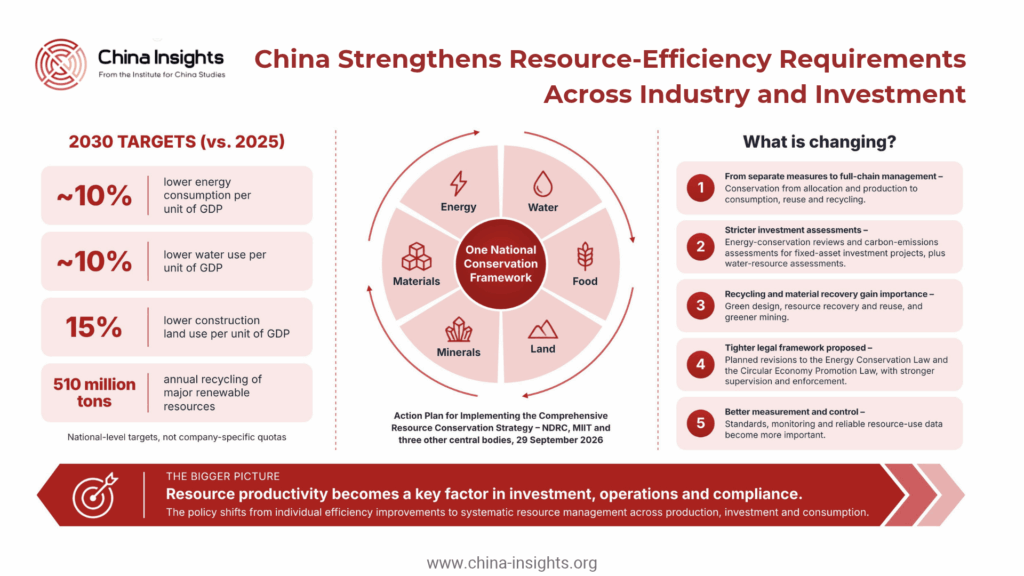
The new plan brings six resource categories under a coordinated policy approach: energy, water, food, land, minerals and materials. It calls for resource conservation throughout the economic process, from allocation and production to consumption, reuse and recycling. This reflects the government’s concern that resource constraints remain a structural challenge despite improvements during the 14th Five-Year Plan period.
The approach also changes the role of resource efficiency in industrial policy. Conservation is no longer framed only as a measure to reduce operating costs or environmental impact. It is increasingly linked to national resource security, industrial upgrading and the transition towards more efficient production and consumption models.
For businesses, this means resource use should be considered across the value chain. Companies may need to assess not only direct energy and water consumption, but also material inputs, land use, production losses and opportunities for recycling.
2030 Targets Create a Clearer Performance Framework
The plan establishes specific targets for 2030, measured against 2025. Energy consumption per unit of GDP and water use per unit of GDP are both targeted to decline by approximately 10%. Construction land use per unit of GDP is targeted to fall by 15%. The plan also aims to increase annual recycling of major renewable resources to 510 million tons.
These are national-level targets rather than direct company-specific quotas. However, they provide a framework for subsequent sectoral, regional and local implementation. Businesses should expect local authorities and relevant regulators to translate the objectives into more specific requirements, programs and performance assessments.
The implications will differ by sector. Energy- and water-intensive industries, land-intensive projects and businesses with substantial raw-material requirements are likely to face greater pressure to improve resource productivity. Companies that can demonstrate measurable efficiency gains may also be better positioned when applying for investment approvals or participating in government-supported programs.
Investment Approval and Regulatory Oversight Become More Important
One of the plan’s significant institutional measures is the emphasis on stricter implementation of existing project assessment procedures. These include energy-conservation reviews and carbon-emissions evaluations for fixed-asset investment projects. The plan also calls for water-resource assessments in relevant planning and development processes, as well as improvements to land-use planning mechanisms.
This reinforces the importance of resource availability and efficiency at the investment-planning stage. Companies developing new facilities or expanding existing operations should consider energy, carbon and water requirements early in project design. Delays or additional costs may arise if resource assessments are not adequately addressed.
The plan also proposes revisions to the Energy Conservation Law, the Circular Economy Promotion Law and regulations on energy conservation in public institutions. These proposals indicate a potential tightening of the legal framework. They should not, however, be treated as amendments already enacted. Businesses will need to monitor subsequent legislative and regulatory developments.

Recycling and Material Recovery Gain Strategic Importance
The plan places greater emphasis on reducing raw-material consumption, improving green design and manufacturing, and expanding the recovery and reuse of resources. It also seeks to improve efficiency in mineral extraction and processing, including through greener mining and more comprehensive use of mineral resources.
The target for major renewable-resource recycling highlights the scale of the intended transition. Recycling is being positioned not only as a waste-management activity but also as a means of improving resource security and reducing dependence on primary materials.
This creates opportunities for companies involved in recycling systems, material recovery, industrial waste treatment, remanufacturing and resource-efficient production technologies. Manufacturers may also face stronger incentives to redesign products and production processes to reduce material losses and improve recyclability.
Efficiency Requires Better Measurement and Control
The plan identifies standards, policy incentives, supervision, enforcement and technological innovation as important implementation mechanisms. It also calls for stronger coordination between central departments, local governments, businesses and industry associations. Implementation will be supported by more detailed targets, responsibilities and monitoring.
For companies, this points to a greater need for reliable resource-use data and internal management systems. Energy and water monitoring, production efficiency analysis and material-flow accounting can help identify inefficiencies and demonstrate progress. Digital management tools may become increasingly relevant as businesses respond to more detailed reporting and assessment requirements.
The plan does not establish a universal company-level reporting system or specify identical obligations for all industries. The practical impact will depend on subsequent sectoral rules and local implementation. Nevertheless, companies should treat resource efficiency as a strategic operational issue rather than wait for individual compliance requirements to emerge.
What This Means for Business
- Review resource productivity: Measure energy, water, land and material use across operations and identify areas where efficiency improvements are commercially viable.
- Integrate resource assessments into investment planning: Include energy, carbon and water considerations in site selection, project design and approval preparation.
- Prepare for tighter regulation: Monitor proposed amendments to energy conservation and circular economy legislation, as well as subsequent implementation rules.
- Strengthen circularity: Assess opportunities to reduce material losses, reuse production inputs and establish recycling partnerships.
- Invest in measurement and management: Improve resource-use data, monitoring systems and internal accountability to support operational decisions and future compliance.
- Monitor local implementation: Track how national targets are translated into regional and sector-specific requirements, particularly in resource-intensive industries.
- Sources
https://www.gov.cn/zhengce/202611/content_7085043.htm
Author
Dr. Richard van Ostende

Related Articles