
China Accelerates Six National Infrastructure Networks, Opening Opportunities in Energy, Computing and Logistics
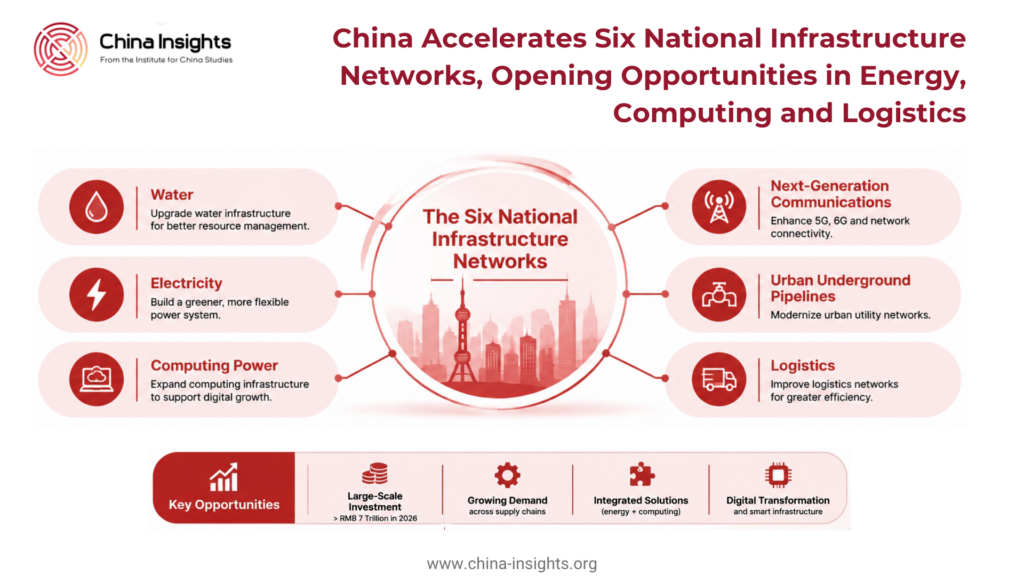
China is moving to coordinate infrastructure investment across six national networks during the 15th Five-Year Plan period (2026–2030). The networks cover water, electricity, computing power, next-generation communications, urban underground pipelines and logistics. The objective is to improve connectivity, resource allocation and operational efficiency while providing infrastructure for industrial upgrading and digital transformation.
A Xinhua report published on 30 October 2026, Strengthening Foundations and Enabling High-Quality Development: Building the Six Networks under the 15th Five-Year Plan, describes how national infrastructure priorities are moving from the overarching plan towards more detailed sectoral implementation. The government estimates that investment related to the six networks will exceed RMB 7 trillion in 2026 alone. The commercial significance lies in both the scale of infrastructure demand and the growing integration of physical networks with digital technologies.
Executive summary
- Infrastructure planning is becoming more coordinated. Six networks are being developed as an interconnected system rather than as separate sectoral projects.
- Investment priorities extend beyond traditional construction. Digital monitoring, automation, intelligent scheduling and system integration are becoming more important.
- Energy and computing infrastructure are increasingly interdependent. Power availability, computing capacity and network connectivity will need to be planned together.
- Urban renewal creates demand for intelligent infrastructure. Underground pipelines and existing municipal systems are moving towards digital monitoring and predictive maintenance.
- Large-scale investment creates opportunities across supply chains. Equipment suppliers, engineering companies, technology providers and infrastructure operators may benefit, subject to project procurement and financing arrangements.

Infrastructure policy moves from broad priorities to implementation
The 15th Five-Year Plan identifies six networks as central components of China’s modern infrastructure system. National sectoral plans are now translating this direction into more specific targets, projects and implementation priorities. The emphasis is on improving the capacity and connectivity of each network while ensuring that the systems work together.
This shift matters because infrastructure constraints increasingly affect several industries simultaneously. Reliable electricity, high-capacity communications, computing resources and efficient logistics are interconnected requirements for advanced manufacturing and digital services. Better coordination could reduce bottlenecks and improve the use of existing assets.
For suppliers, the opportunity is therefore broader than participation in individual construction projects. Demand may also arise from system integration, operational technology, maintenance and digital services throughout the infrastructure lifecycle.
Electricity and computing capacity become a joint planning priority
The National Development and Reform Commission (NDRC) and National Energy Administration (NEA) issued the 15th Five-Year Plan for the Development of the New-Type Power System on 21 July 2026. It sets a direction for a greener, more flexible electricity system. Separately, the Ministry of Industry and Information Technology (MIIT) issued the 15th Five-Year Plan for the Development of the Information and Communications Industry on 12 August 2026, including priorities for computing infrastructure, network upgrades and advanced technology development.
The two agendas increasingly intersect. Data centers and AI computing facilities require substantial, reliable electricity, while power systems need better forecasting, control and coordination as the energy mix changes. The plans encourage closer coordination between computing facilities and electricity infrastructure, including approaches that connect renewable generation, power networks, storage and demand.
This creates potential demand for power equipment, energy management systems, cooling, storage, network infrastructure and computing technologies. However, investment opportunities will depend on local grid capacity, energy costs, project economics and the applicable technical requirements.
Digital infrastructure is becoming an operating layer for physical networks
The next-generation communications and computing networks are intended to support more than connectivity. They will provide the infrastructure for real-time monitoring, intelligent scheduling and automated operations across energy, logistics, water management and urban services. The MIIT plan includes computing infrastructure, network intelligence and continued research into sixth-generation (6G) communications technology.
The policy direction suggests that digital capability will increasingly be embedded in infrastructure projects from the design stage. Sensors, connected equipment, data platforms and automated control systems can improve visibility and coordination across complex networks. Yet their value depends on interoperability, reliable data and cybersecurity, not simply on deploying additional equipment.
Technology providers should assess opportunities in integrated solutions rather than standalone products. Infrastructure operators, meanwhile, will need to consider how new digital systems connect with legacy assets and existing operational processes.
Urban renewal creates a market for intelligent municipal infrastructure
The State Council’s 15th Five-Year Plan for Urban Renewal, issued on 22 May 2026, calls for the renovation and upgrading of urban infrastructure, including underground pipelines. The plan envisages the construction or renovation of approximately 770,000 kilometers of urban underground pipelines during the period.
The emphasis is shifting from replacing ageing assets alone towards improving monitoring, maintenance and risk prevention. Digital monitoring equipment, inspection robots and integrated utility corridors can help cities manage infrastructure more systematically. Coordinated underground corridors can also accommodate multiple utilities within shared spaces, where local conditions permit.
For companies operating in construction, engineering, sensors, inspection technology and municipal services, this may support demand for both physical upgrades and digital systems. Project selection will still depend on local government priorities, funding availability, procurement arrangements and technical standards.

Network integration could improve regional efficiency
The six networks are intended to connect resources and economic activity across regions. Power transmission, computing-resource allocation, communications connectivity and logistics hubs can help match supply with demand across geographically dispersed locations. The policy direction supports more coordinated infrastructure planning and greater use of existing assets.
Logistics infrastructure is also expected to integrate more closely with communications, automation and energy systems. Warehouses, transport hubs and distribution facilities can incorporate connected equipment and intelligent management to improve throughput and operational efficiency. Similar integration is envisaged in water management and municipal infrastructure.
For businesses, better connectivity could influence decisions about factory locations, distribution networks and digital operations. These benefits will not be uniform across China. Companies should evaluate actual infrastructure capacity and service reliability at the local level rather than assuming that national network development removes regional constraints.
What this means for business
- Map opportunities across the infrastructure lifecycle. Consider construction, equipment supply, digital integration, operations and maintenance rather than focusing only on new-build projects.
- Assess energy and computing requirements together. Electricity access, network capacity and energy costs are increasingly relevant to data-intensive and advanced manufacturing investments.
- Explore intelligent infrastructure solutions. Monitoring, automation, predictive maintenance and system integration align with the direction of national plans.
- Track urban renewal procurement. Municipal pipeline renovation and digital upgrades may create opportunities for engineering, inspection and technology suppliers.
- Evaluate regional conditions carefully. Confirm local project pipelines, financing, procurement requirements and infrastructure capacity before committing resources.
- Build partnerships for integrated delivery. Projects spanning energy, communications, computing and logistics may require cooperation between equipment providers, engineering firms and technology companies.
Sources
Author
Dr. Richard van Ostende

Related Articles