China Refines Economic Support Strategy
China is adjusting its approach to economic support by placing greater emphasis on coordinated policy implementation, targeted investment and private-sector participation. At a press conference on 20 October 2026, the National Development and Reform Commission (NDRC) outlined plans to improve the effectiveness of existing measures while implementing recently announced support and preparing additional interventions if needed.
The approach reflects a more differentiated economic environment. New growth drivers, including advanced manufacturing and the digital economy, are expanding, but weak demand relative to supply and uneven sector performance continue to weigh on the recovery. For businesses, the policy direction points to more selective investment opportunities, stronger emphasis on project viability and continued efforts to improve access to infrastructure, finance and other production factors.
Executive summary
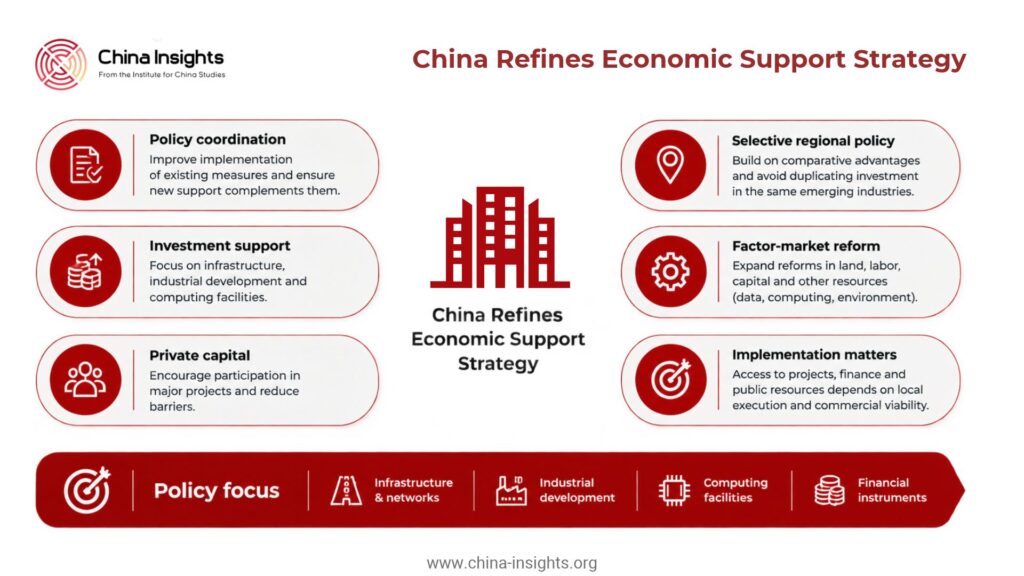
- Policy coordination takes priority. Authorities intend to improve the implementation of existing measures while ensuring that new support complements rather than duplicates them.
- Investment support is becoming more project-focused. Infrastructure, industrial development and computing facilities remain priorities, with faster project preparation and funding deployment emphasized.
- Private capital is being encouraged into major projects. Authorities are working to reduce participation barriers, improve financing support and open additional investment opportunities.
- Regional industrial policy is becoming more selective. Localities are expected to build on comparative advantages and avoid duplicating investment in the same emerging industries.
- Factor-market reform is expanding. Pilot reforms cover land, labor and capital, alongside data, computing capacity and environmental resources.
- Implementation will determine business outcomes. Access to projects, finance and public-sector resources will depend on local execution and the commercial merits of individual proposals.

Economic support shifts towards coordinated implementation
The NDRC’s October briefing highlighted a dual-track approach: improve the delivery of existing policies and introduce additional measures where necessary. Existing priorities include infrastructure construction, industrial development, computing-facility planning and the deployment of new policy-based financial instruments. Recently announced measures include lower interest rates for pledged supplementary lending, increased relending quotas, mortgage interest subsidies and financial support for the service sector.
The change is primarily one of implementation and coordination rather than a wholesale replacement of the existing policy framework. Authorities want approved measures to translate more quickly into actual investment, financing and economic activity. They also intend to retain the option of further intervention if economic conditions require it.
For companies, policy announcements alone are therefore an insufficient indicator of opportunity. The more relevant signals will be funding disbursement, project commencement, eligibility requirements and the timing of local implementation. Businesses should distinguish between measures already operational and those that remain subject to detailed rules or administrative execution.
Infrastructure and industrial projects remain central to investment support
The NDRC is pushing for faster implementation of major projects associated with the 15th Five-Year Plan and the development of six categories of infrastructure networks, often referred to as the “six networks.” Authorities also plan to accelerate the deployment of new policy-based financial instruments and improve project preparation, factor availability and approval efficiency.
Private capital is being encouraged to participate in infrastructure projects, including nuclear power, hydropower and water conservancy. Separately, existing support for priority industries and computing infrastructure is to be optimized. The direction is to turn policy priorities into viable projects while improving the efficiency with which capital and other resources are deployed.
This creates potential opportunities for engineering, equipment, technology and service providers. However, the focus on effective investment suggests that project selection and execution will matter as much as sector alignment. Suppliers and investors should assess procurement schedules, funding arrangements, approval status and commercial terms before committing resources.
Private investment receives more direct institutional support
The NDRC reported that it had publicly promoted two batches of investment projects comprising 88 opportunities, with planned private-capital participation of RMB 31.1 billion. Following their publication, companies and project owners had held more than 300 contacts and consultations. Some projects had attracted multiple expressions of interest, and several had made substantive progress.
The next phase combines project promotion with efforts to reduce barriers to participation. The NDRC intends to strengthen mechanisms for private companies to join major national projects, expand fair access to competitive infrastructure sectors, improve policy-based financial support and address overdue payments owed to private businesses. It also plans to promote access to public, industrial and major-project application scenarios.
For private companies, this is a more direct route to identifying investment opportunities and engaging with project owners. Yet project promotion is not equivalent to financing approval or contract award. Companies should conduct due diligence on project economics, payment arrangements, financing availability and the allocation of construction and operating risks.

Regional industrial policy becomes more selective
The NDRC reiterated that development of new quality productive forces should reflect local capabilities and comparative advantages. National and provincial plans for emerging pillar industries and future industries are expected to be better coordinated, with stronger oversight of city- and county-level planning. Project selection should be evidence-based, avoiding blind investment and unnecessary duplication.
The briefing also emphasized compliance with the requirements of a unified national market. Local support should be targeted and consistent with applicable rules, rather than relying on indiscriminate incentives or aggressive competition to attract investment. This reinforces the policy direction towards reducing disorderly competition and addressing excessive, duplicative industrial capacity.
For businesses, location decisions should increasingly be based on the strength of local industrial ecosystems, talent availability, infrastructure and market access. Companies considering subsidies or preferential arrangements should also examine their legal basis and durability, rather than assuming that local incentives will remain available throughout a project’s life.
Factor-market reform may improve access to resources
China is extending pilot reforms intended to improve the market allocation of production factors. The NDRC reported that the first batch of 56 reform measures had been identified for wider application across areas including land, labor, capital, environmental resources, data and computing capacity. Further experimentation will address the movement of factors between urban and rural areas and coordinated resource provision for major projects.
The reforms aim to reduce barriers that prevent resources from moving towards more productive uses. For technology and data-intensive businesses, changes to the allocation and use of computing capacity and data may be particularly relevant. However, the practical effect will depend on how pilot measures are adopted and translated into operational rules.
What this means for business
- Track implementation, not just announcements. Monitor funding deployment, project approvals and detailed eligibility rules.
- Build a pipeline of project opportunities. Engage with project owners and relevant authorities early, while conducting independent commercial due diligence.
- Prepare for private-sector participation. Strengthen financing plans, compliance processes and project proposals for infrastructure and industrial opportunities.
- Choose locations on fundamentals. Evaluate regional capabilities, suppliers, talent and infrastructure rather than relying solely on incentive packages.
- Review access to production factors. Monitor reforms affecting land, finance, data and computing capacity in relevant pilot regions.
- Stress-test investment assumptions. Account for uneven demand, sectoral competition and uncertainty over the timing of policy implementation.
Sources
https://www.gov.cn/zhengce/202610/content_7083845.htm
Author
Dr. Richard van Ostende

Related Articles