
China’s Industrial Inflation Accelerates as Consumer Price Recovery Remains Moderate
China’s September 2026 inflation data point to a widening gap between factory-gate prices and consumer prices. Industrial producer prices are rising more rapidly, supported by higher energy and commodity costs and demand from selected technology industries. Consumer prices, by contrast, continue to increase only moderately. The divergence suggests that the recovery in industrial pricing has not yet translated into broad-based consumer inflation.
Figures released by China’s National Bureau of Statistics (NBS) on 14 October 2026 indicate improving pricing conditions for some industrial producers, but also highlight the risk that higher input costs could erode margins elsewhere in the supply chain.
Executive summary
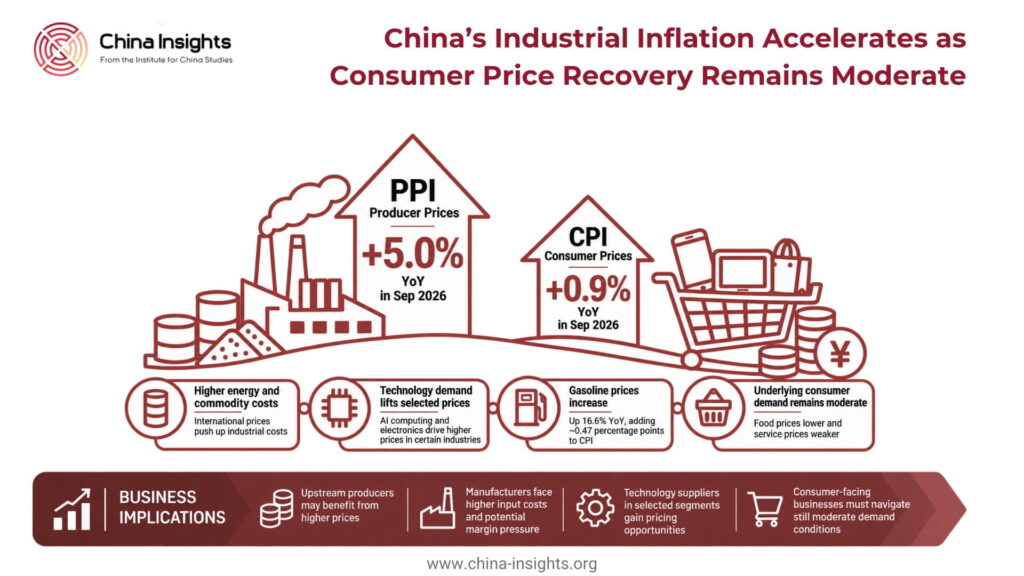
- Industrial inflation is accelerating. The Producer Price Index (PPI) rose 5.0% year on year in September, extending its recovery and recording its strongest increase since June 2022.
- Consumer inflation remains moderate. The Consumer Price Index (CPI) increased by 0.9%, while core CPI remained at 1.0%, indicating that underlying price pressures are still limited.
- Energy and commodities are major drivers. International price movements are pushing up industrial costs, while higher gasoline prices are contributing to consumer inflation.
- Technology demand is supporting selected prices. AI-related computing demand and consumer-electronics upgrades are lifting prices for certain products and industrial categories.
- Business outcomes will vary by sector. Producers with pricing power may benefit, while manufacturers unable to pass on higher input costs face potential margin pressure.

Consumer prices rise, but underlying demand remains a key question
China’s CPI rose 0.9% year on year in September, up slightly from August. Core CPI, which excludes food and energy, increased by 1.0%, unchanged from the previous month. The figures point to a gradual improvement in consumer prices rather than a broad acceleration in inflation.
The composition of the increase matters. Gasoline prices rose 16.6% year on year, contributing approximately 0.47 percentage points to overall CPI growth. Prices for selected technology products also increased substantially. Data storage devices, tablets, computers and mobile phones recorded higher year-on-year prices, reflecting stronger demand linked to AI computing and product upgrades.
These increases do not, by themselves, demonstrate a broad-based recovery in household consumption. Food prices remained lower than a year earlier, while service prices fell month on month. For consumer-facing businesses, demand conditions and customers’ willingness to pay therefore remain important constraints on pricing strategies.
Producer prices accelerate, led by energy and raw materials
The more significant shift is in industrial prices. PPI increased by 5.0% year on year and 1.2% month on month. The annual increase continued a recovery that began in March, while the monthly acceleration indicates stronger recent price momentum.
The rise reflects a combination of international commodity prices, supply-demand conditions in energy and raw-material industries, and demand from emerging sectors. Mining, raw-material processing and other upstream activities are particularly exposed to these movements. The NBS reported that production-material prices rose 6.5% year on year, while prices for consumer goods remained broadly flat.
This composition is important for assessing the quality of the recovery. Higher factory-gate prices can improve revenues for producers when selling prices rise faster than costs. However, increases driven by imported energy and commodities can also raise production expenses across manufacturing, logistics and other downstream activities. A higher PPI therefore does not automatically translate into stronger profits for the industrial sector as a whole.
Technology upgrading creates selective pricing opportunities
The September data also show that industrial upgrading is supporting demand in specific segments. The NBS identified electrical machinery, computer and communications equipment among the industries recording monthly price increases, with AI development and coordination between computing capacity and electricity demand contributing to activity.
This suggests that China’s technology transition is affecting prices as well as production volumes. Demand associated with computing infrastructure and advanced equipment can create more favorable conditions for selected suppliers, particularly where capacity, technical capabilities or product differentiation are limited.
The effect should not be generalized across the entire technology sector. Price increases in selected components or equipment do not establish that all technology manufacturers have gained pricing power. Businesses need to distinguish between demand-led increases in particular product categories and cost-driven inflation across the wider industrial base.

Input-cost pressures could limit margin recovery
The difference between producer selling prices and input prices is a critical indicator for corporate profitability. In September, the industrial producer purchase-price index rose 6.9% year on year, faster than the 5.0% increase in factory-gate selling prices. This gap signals potential pressure on companies whose input costs are rising faster than their realised selling prices.
The impact will depend on each company’s position in the value chain. Upstream commodity producers may benefit from higher selling prices, while downstream manufacturers may face more expensive fuel, metals, chemicals and other materials. Companies with stronger brands, differentiated products or longer-term supply agreements may be better placed to pass costs on to customers.
The outlook also remains exposed to external volatility. The NBS highlighted uncertainty in global geopolitical conditions and commodity markets. Domestically, industrial upgrading and efforts to address excessive, disorderly competition could support prices, but the durability of the recovery will depend on the balance between supply, demand and costs.
What this means for business
- Reassess margins by value-chain position. Track selling prices alongside input costs rather than treating rising PPI as a universal sign of improved profitability.
- Review procurement and supply contracts. Energy and commodity volatility strengthens the case for scenario planning, supplier diversification and appropriate pricing clauses.
- Identify segments with genuine pricing power. AI infrastructure and selected technology equipment show demand support, but opportunities should be assessed at product and supplier level.
- Do not assume consumer demand has broadly recovered. Moderate core inflation suggests that pricing decisions in consumer-facing sectors still require close attention to affordability and demand.
- Update forecasts for cost pass-through. Test how sustained increases in fuel, metals and other materials would affect gross margins, working capital and customer pricing.
- Monitor the persistence of industrial inflation. Further price increases driven by demand and improved market conditions would have different implications from increases driven mainly by imported costs.
Sources
Author
Dr. Richard van Ostende

Related Articles