China Pushes Technology into Commercial Applications
China is placing greater emphasis on converting technological advances into commercial applications across the domestic market. The focus is shifting beyond technology development towards practical deployment, stronger links between supply and demand, and new consumption models. This creates opportunities for technology providers and businesses in retail, manufacturing, logistics, consumer services and digital commerce.
On 13 October 2026, the Ministry of Commerce (MOFCOM) and eight other central departments issued the Opinions on Accelerating the Promotion of Technology-Driven Commerce (《关于加快推进科技兴商的意见》). The document contains 18 measures covering product consumption, services, commercial distribution and new business scenarios. The State Council Information Office discussed the measures at a press conference on 19 October.
Executive summary
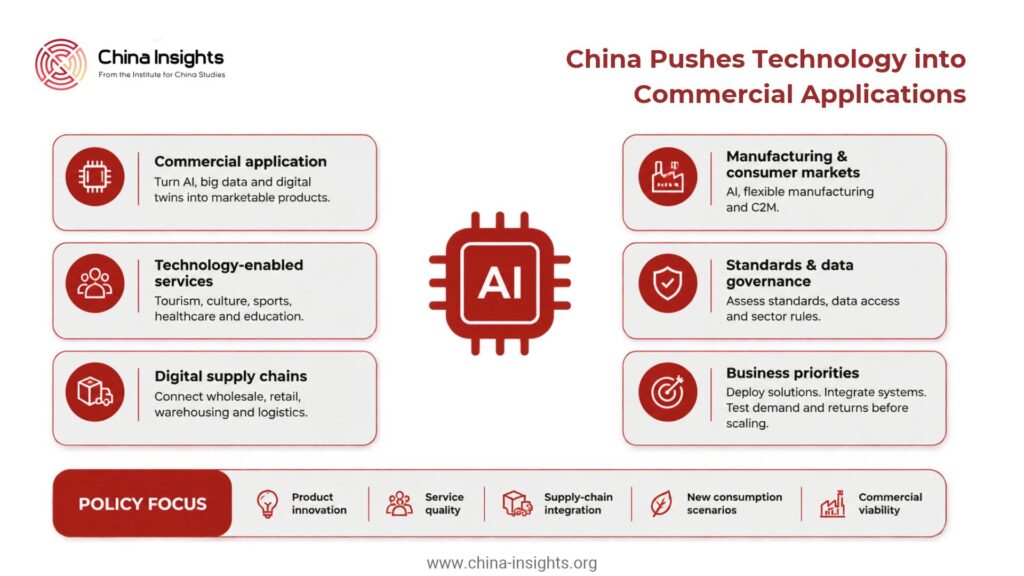
- Commercial application becomes the priority. China is seeking to translate AI, big data, digital twins and embodied intelligence into marketable products and scalable business models.
- Services receive greater attention. Technology is expected to improve basic services and expand higher-value offerings in tourism, culture, sports, healthcare and education.
- Supply chains face further digitalization. Wholesale, retail, warehousing and logistics are targeted for greater integration and operational efficiency.
- New commercial scenarios are encouraged. Policies support intelligent services, immersive consumption, green commerce and the integration of online and offline experiences.
- Implementation will depend on standards, data access and commercial viability. Companies should assess the business case and compliance requirements before scaling new technologies.

Technology policy moves closer to market demand
The new Opinions connect technology deployment more directly with domestic consumption and commercial operations. Rather than focusing only on technological development, the measures emphasize product innovation, demand matching, service quality and the efficiency of distribution channels.
The document also links technology commercialization to China’s broader objectives of expanding domestic demand and developing new quality productive forces. This gives technology-enabled commerce a role in both industrial upgrading and consumption growth. For businesses, the policy direction favors solutions that address identifiable customer needs and can be deployed beyond pilot projects.
Manufacturing and consumer markets become more closely connected
The Opinions call for deeper integration of AI into product research, design, manufacturing and marketing. They also encourage flexible manufacturing, industrial AI models and customer-to-manufacturer (C2M) approaches. These measures aim to improve the match between production and consumer demand, including through personalized products and smaller, more responsive production runs.
The policy also encourages the development and commercialization of intelligent products, including consumer electronics, household devices and robots. The Ministry of Industry and Information Technology has highlighted the need for cost-effective, replicable intelligent solutions and stronger links between production and sales.
This direction may benefit manufacturers that can combine product development with data-driven demand forecasting, flexible production and effective distribution. Technology suppliers will need to demonstrate measurable improvements in cost, quality, productivity or customer experience.
Service consumption becomes a major technology application area
The Opinions give specific attention to technology-enabled services. The proposed applications span household services, catering, elderly care, childcare, healthcare, education, tourism, culture and sports. AI, digital twins, extended reality and immersive audiovisual technologies are intended to improve service delivery and create additional consumer offerings.
The emphasis reflects the growing importance of services in China’s consumption structure. According to the Ministry of Commerce, service retail sales increased by 5% year on year in the first nine months of 2026, outpacing goods retail sales. The policy seeks to support this market through better service quality, personalized offerings and new consumption experiences.
For businesses, the opportunity is not limited to technology companies. Operators in tourism, education, healthcare and other service industries may use digital tools to differentiate their offerings. Commercial success will depend on consumer willingness to pay, integration with existing operations and the ability to deliver consistent service quality.

Digital supply chains and retail operations receive further support
The Opinions call for faster development of digital supply chains and greater use of the Internet of Things, cloud computing, intelligent warehousing, automated logistics equipment and unmanned delivery. Wholesale and retail companies are encouraged to apply digital technologies across store planning, inventory management, distribution, product traceability and after-sales services.
The policy also promotes closer coordination between digital supply chains and smaller businesses operating within them. This could create demand for integrated solutions that improve visibility and coordination across procurement, warehousing, transport and sales.
Companies should therefore assess digitalization across the full supply chain rather than treating it as a series of separate technology investments. Suppliers able to integrate systems and demonstrate operational returns may be better positioned than providers offering isolated tools.
Commercialization comes with standards and data-governance requirements
The nine departments also identify standards, digital infrastructure, talent and financing as conditions for implementation. The measures support commercial technology innovation, high-quality datasets, trusted data spaces and broader access to computing resources. They also encourage financial institutions to support technology upgrades and new consumption scenarios.
At the same time, the Opinions call for clearer boundaries governing commercial data collection, use and sharing. They envisage risk monitoring and differentiated governance for commercial AI agents, alongside controlled testing of new technologies and business models.
This combination creates both opportunities and compliance considerations. Businesses developing AI-enabled products or data-intensive services should assess applicable standards, data-handling requirements and sector-specific rules early in product development. Policy support does not remove the need to establish a viable business model or manage operational risks.
What this means for business
- Prioritize deployable solutions. Focus on technology that delivers measurable improvements in productivity, service quality, customer conversion or operating costs.
- Explore service-sector opportunities. Tourism, education, healthcare, elderly care and other service industries are identified as potential areas for technology-enabled growth.
- Review supply-chain digitalization. Assess opportunities to integrate inventory, warehousing, logistics, sales and traceability systems.
- Build partnerships across the value chain. Collaboration between technology providers, manufacturers, retailers and service operators can help connect technical capabilities with market demand.
- Factor compliance into product design. Review data governance, applicable standards and relevant regulatory requirements before commercial deployment.
- Test the economics before scaling. The policy encourages adoption, but commercial outcomes will depend on customer demand, implementation costs and demonstrable returns.
Sources
https://www.gov.cn/zhengce/202610/content_7083758.htm
Author
Dr. Richard van Ostende

Related Articles