
China Revises Outbound Investment Rules
China is revising its outbound investment management framework as overseas investment becomes more complex and exposed to geopolitical, regulatory and security risks. The new rules broaden the formal scope of investors covered and strengthen reporting arrangements for overseas reinvestment and adverse developments affecting Chinese investments.
On 22 October 2026, the National Development and Reform Commission (NDRC) published the Measures for the Administration of Outbound Investment (《对外投资管理办法》), NDRC Order No. 49 of 2026. The Measures take effect on 1 December 2026, replacing the 2017 Measures for the Administration of Overseas Investment by Enterprises. They implement the State Council’s Provisions on Outbound Investment, which took effect on 1 July 2026.
Executive summary
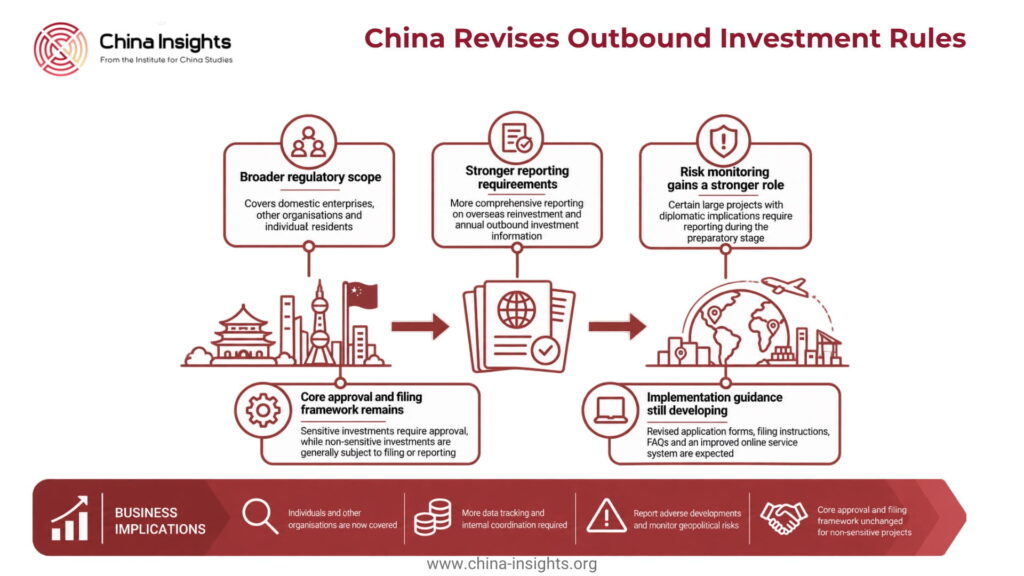
- The regulatory scope expands. The framework explicitly covers domestic enterprises, other organisations and individual residents.
- Reporting obligations become more comprehensive. The rules strengthen reporting on overseas reinvestment and introduce annual reporting on outbound investment information.
- Risk monitoring gains a stronger role. Certain large projects with diplomatic implications are subject to reporting during the preparatory stage.
- The core approval and filing framework remains. Sensitive investments require approval, while non-sensitive investments are generally subject to filing or other applicable reporting requirements.
- Implementation guidance is still developing. Revised application forms, filing instructions, FAQs and an improved online service system are expected.

A broader framework replaces the enterprise-focused rules
The 2017 Measures primarily addressed outbound investment by domestic enterprises and non-enterprise organisations. The revised framework explicitly includes individual residents and clarifies that outbound investment covers direct and indirect acquisition of overseas ownership, control, management rights and other relevant interests. Overseas reinvestment is also included.
This expansion aligns the NDRC framework with the State Council’s 2026 Provisions on Outbound Investment. It reflects the greater diversity of investors and investment structures. Individuals and other organisations should not assume that transactions fall outside the regulatory framework simply because they are not conventional corporate overseas investments.
The change does not mean that every overseas financial investment requires an NDRC project approval. The Measures maintain the distinction between investment project approval, filing and information reporting. Existing channels such as Qualified Domestic Institutional Investor schemes, Stock Connect and Cross-boundary Wealth Management Connect continue to operate under their applicable rules.
Reporting moves beyond initial project approval
The revised Measures strengthen the information-reporting framework. Investors using controlled overseas entities to make non-sensitive overseas investments must submit an overseas reinvestment report through the national online system at least 10 working days before implementing the investment. The framework also retains project completion reporting and introduces annual outbound investment information reporting.
These requirements increase the importance of monitoring investments after the initial approval or filing stage. Companies with overseas subsidiaries, holding structures or multiple investment vehicles may need to improve their internal tracking of transactions and reporting responsibilities. Investment teams should coordinate more closely with legal, finance and compliance functions to identify reportable activity and meet submission deadlines.
The NDRC has also indicated that a limited category of large projects with implications for China’s diplomatic relations will be subject to reporting on preparatory work. The precise requirements for individual transactions should be assessed against the final Measures and the relevant implementation guidance.
Overseas risk protection becomes more systematic
The new framework strengthens arrangements for reporting significant adverse developments affecting overseas investments. The NDRC has identified concerns including discriminatory measures and requirements imposed by some foreign jurisdictions involving technology, data, equity interests or assets. Investors are expected to report relevant circumstances so authorities can better understand and respond to risks.
The Measures also strengthen reporting related to overseas reinvestment and introduce additional scrutiny for selected large projects. These changes sit within a wider policy framework that seeks to balance outbound investment development with national security and the protection of overseas interests.
For companies, reporting should be treated as part of ongoing overseas risk management, rather than a task limited to the initial investment decision. Monitoring should cover changes in host-country policy, restrictions on assets or technology, political and security developments, and events that could affect ownership or operational control.
Approval and filing remain central to compliance
The revised Measures retain a differentiated regulatory approach. Sensitive outbound investments require NDRC approval before implementation. Non-sensitive investments made directly by investors are generally subject to filing, with the competent authority depending on the investor and investment amount. Investments made through controlled overseas entities may instead trigger reporting obligations.
The framework also maintains oversight through online monitoring, inquiries, inspections and corrective measures. Depending on the circumstances, authorities may require investors to rectify problems, adjust investment plans or temporarily suspend investment activities.
The practical implication is that companies should classify transactions before committing assets, providing financing or issuing guarantees. A transaction’s structure, destination, sector and investment amount can affect the applicable procedure. Firms should not assume that an overseas subsidiary’s investment is exempt from reporting simply because the subsidiary is established outside China.

Implementation will depend on clearer procedures and digital services
The NDRC has announced plans to issue revised application templates and filing guidance, update its frequently asked questions, and improve the national outbound investment management and service system. These measures are intended to clarify the materials required for approval, filing and reporting.
The transition period before 1 December 2026 gives companies an opportunity to review existing procedures and prepare for the new requirements. Businesses with active international investment pipelines should identify potentially affected transactions and check for updated forms and guidance before submitting applications or reports.
What this means for business
- Review investment structures. Check whether planned transactions by individuals, organisations or controlled overseas entities fall within the revised framework.
- Strengthen post-investment monitoring. Establish clear responsibility for overseas reinvestment, annual information and adverse-event reporting.
- Assess transactions early. Confirm whether approval, filing or reporting applies before assets, financing or guarantees are committed.
- Integrate regulatory and geopolitical risk management. Monitor host-country policy changes and restrictions that could affect ownership, assets, technology or data.
- Prepare for the implementation date. Review internal procedures and use updated NDRC templates and guidance when available.
- Avoid treating reporting as approval. Meeting a reporting obligation does not replace any separate approval, filing, foreign-exchange or other regulatory requirement that applies.
Sources
https://www.gov.cn/zhengce/202610/content_7084050.htm
Author
Dr. Richard van Ostende

Related Articles