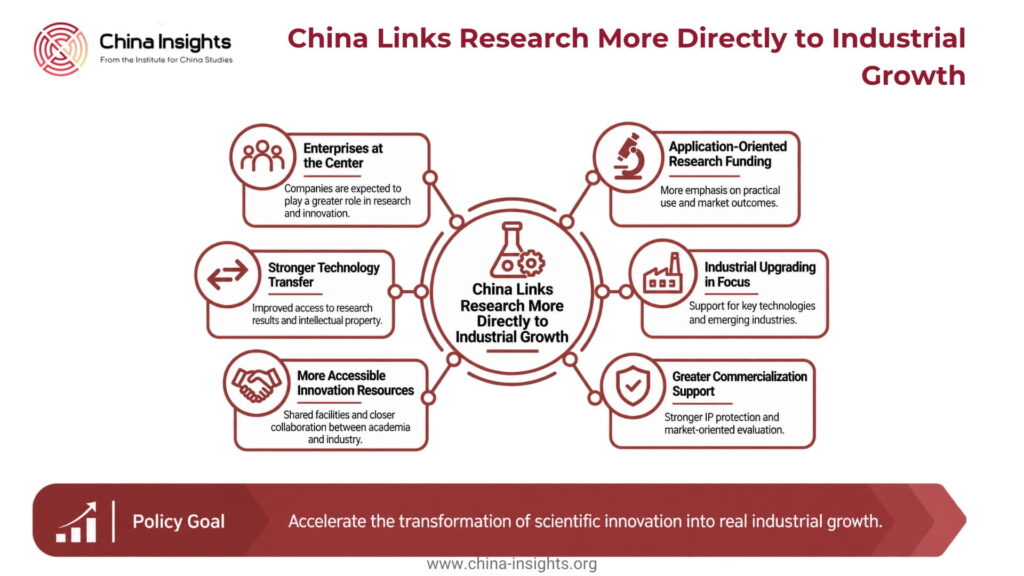
China Links Research More Directly to Industrial Growth
China is strengthening the connection between scientific research and commercial application. On 21 October 2026, the General Office of the Communist Party of China Central Committee and the General Office of the State Council released the Opinions on Promoting the Deep Integration of Scientific and Technological Innovation and Industrial Innovation (《关于推动科技创新和产业创新深度融合的意见》).
The policy signals a shift from supporting research and technological development as separate activities towards a more integrated innovation system. It places enterprises at the center of collaboration between research institutions, universities, government and capital providers. The objective is to shorten the path from scientific discovery to industrial application, strengthen domestic technology capabilities and accelerate the development of emerging industries.
For businesses, the significance lies in the stronger alignment between industrial demand, research funding, technology transfer and commercialization. The policy creates opportunities for companies that can contribute to, adopt or commercialize technologies, although its impact will depend on implementation and access to relevant programs.
Executive summary
- Enterprises gain a stronger role in innovation policy. Companies are expected to participate more directly in setting research priorities, leading projects and commercializing results.
- Research funding is becoming more application-oriented. Project evaluation will place greater emphasis on practical use and market outcomes, not only technical achievements.
- Technology transfer mechanisms are being strengthened. Reforms aim to improve access to research outputs, intellectual property and professional technology-transfer services.
- Industrial upgrading remains a central objective. Policy support covers critical technologies, emerging and future industries, and the modernization of traditional manufacturing.
- Innovation resources are intended to become more accessible. Measures include shared research facilities, pilot-scale testing platforms and closer cooperation between companies and research institutions.
- Commercialization conditions are receiving greater attention. Intellectual property protection, technical standards, financing mechanisms and regulatory experimentation are part of the wider framework.

Innovation policy shifts towards industrial application
The new Opinions address a persistent challenge: scientific and technological achievements do not automatically become commercially viable products or productive industrial capabilities. The policy seeks to connect research priorities more closely with industrial needs and to coordinate innovation across the full chain, from research and development to production and market adoption.
National science and technology programs are expected to incorporate industrial application objectives more systematically. The document calls for regular collection of enterprise needs, stronger participation by companies and investment professionals in project assessment, and evaluation mechanisms that consider both technological performance and product-market outcomes. Project management approaches will also include milestones and phased funding.
For businesses, this could create more opportunities to influence research agendas and collaborate on technologies with clearer routes to market. It also raises expectations: companies participating in publicly supported projects may need to demonstrate credible application plans and measurable commercial or industrial outcomes.
Enterprises become more central to research collaboration
The policy places enterprise innovation capacity at the center of the new system. It encourages companies to participate in national science and industrial policy development, lead innovation platforms and collaborate more closely with universities and research institutes. It also includes measures intended to increase private-sector access to research resources and improve support for technology-based small and medium-sized enterprises.
The Opinions encourage large companies to open research platforms, application scenarios and supply-chain opportunities to smaller firms. They also support innovation consortia led by technology leaders, with universities, research institutions and other enterprises contributing to coordinated research and development.
This approach could make innovation networks more commercially relevant. Smaller technology firms may gain access to testing environments, customers and industrial partners that would otherwise be difficult to reach. Large manufacturers may benefit from external technology development and a broader supplier base. The actual benefits will depend on how collaboration arrangements, intellectual property ownership and commercial returns are agreed.
Technology transfer and industrial testing receive stronger support
The Opinions seek to reduce barriers between research institutions and businesses. Measures include reforming the management of intellectual property generated through publicly supported research, encouraging researchers to participate in commercialization, strengthening technology-transfer services and expanding the national integrated technology market.
The document also supports wider use of arrangements under which universities and research institutes allow small and micro enterprises to use research results before payment. In addition, concept-validation centers and pilot-scale testing platforms are intended to help companies assess whether technologies can be scaled into commercially viable products.
These measures address important gaps between laboratory research and industrial production. Businesses developing new technologies could benefit from better access to research outputs and facilities, while research institutions may face stronger incentives to transfer knowledge into industry. However, access conditions, technology readiness, licensing terms and the cost of scaling will continue to determine whether individual projects are commercially attractive.

Industrial priorities extend from critical technologies to future industries
The policy links research and industrial innovation to China’s broader industrial-development objectives. Priority areas include integrated circuits, industrial machine tools, advanced instruments, advanced materials and biomanufacturing. It also supports the development of emerging industries, including new energy and aerospace, and promotes commercialization in future-oriented fields such as quantum technology, hydrogen energy, brain-computer interfaces, embodied intelligence and sixth-generation mobile communications.
The framework is not limited to new industries. It also calls for traditional manufacturing to be upgraded through advanced technology, industrial internet development, equipment renewal and the integration of digital and physical production systems. Local governments are encouraged to build on regional strengths and conduct pilot initiatives.
For companies, this creates a broader set of potential collaboration and investment areas. Yet the policy should not be interpreted as a guarantee of funding or demand for every technology category. Commercial viability, technical maturity, competition and local implementation will remain decisive.
What this means for business
- Build relationships with research institutions. Identify universities, laboratories and innovation platforms whose research aligns with business needs.
- Develop application-led R&D proposals. Link technical milestones to product development, manufacturing integration and credible market demand.
- Review intellectual property arrangements. Establish clear terms for ownership, licensing, commercialization rights and the sharing of returns before entering joint projects.
- Explore innovation partnerships across company sizes. Large enterprises can access external capabilities, while smaller technology firms may benefit from industrial partners and application scenarios.
- Monitor targeted programs and local pilots. Implementation details will determine eligibility, funding conditions and access to shared facilities.
- Assess opportunities selectively. Align investments with technical readiness, customer demand and commercial returns rather than relying on policy priority alone.
Sources
https://www.gov.cn/zhengce/202610/content_7083959.htm
Author
Dr. Richard van Ostende

Related Articles