China Introduces a Carbon-Control Framework for Industry, Raising the Bar for Corporate Emissions Management
China is moving industrial climate policy from an emphasis on energy conservation towards a broader system that controls both total carbon emissions and emissions intensity. The Ministry of Industry and Information Technology (MIIT) issued the Implementation Plan for Accelerating the Establishment of a Dual-Control System for Carbon Emissions in the Industrial and Information Technology Sectors (2026–2030) on 30 September 2026. The document was published on 21 October 2026.
The plan translates China’s national carbon-control objectives into an industrial implementation framework. It strengthens the role of emissions accounting, enterprise and industrial-park management, product carbon footprints, project evaluation and performance assessment. For manufacturers, the change is significant: carbon management is becoming more closely connected to industrial policy, investment decisions and product-level requirements.
Executive summary
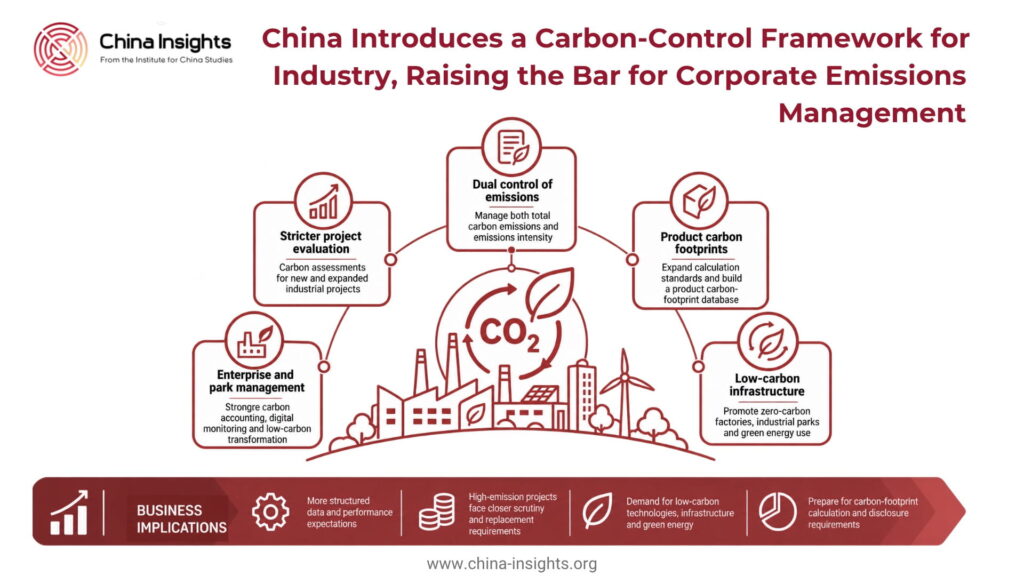
- Policy moves beyond energy efficiency alone. Industrial management will increasingly consider both total carbon emissions and emissions intensity, alongside existing energy-saving requirements.
- Corporate emissions management is becoming more systematic. Enterprises and industrial parks will face a stronger policy focus on carbon accounting, digital monitoring and low-carbon transformation.
- Product carbon footprints are gaining importance. China plans to expand calculation standards and build a database to support more consistent carbon-footprint assessment.
- Industrial investment will face closer scrutiny. Carbon-emissions assessment and replacement requirements are planned for energy-intensive, high-emission industrial projects.
- Low-carbon infrastructure is a policy priority. Zero-carbon factories, computing facilities and industrial parks are being promoted as demonstration models.
- Implementation will shape business exposure. Companies should prepare for more structured data requirements, clearer performance expectations and closer scrutiny of carbon-intensive expansion.

From energy consumption controls to carbon-emissions management
China’s established energy-conservation system has focused on energy use, efficiency standards, measurement and enforcement. The new framework retains these mechanisms but places them within a wider approach to managing carbon emissions. The objective is to control both the total volume of emissions and emissions intensity, rather than treating reductions in energy consumption as the sole proxy for progress.
The change reflects differences in energy sources and industrial structures. Improving energy efficiency remains important, but emissions outcomes also depend on the energy mix, production processes, product composition and the wider organization of industrial activity. The new framework therefore links efficiency improvements with structural adjustment, cleaner energy use and changes in production methods.
For companies, this means energy-saving initiatives will remain relevant but may not provide a complete picture of carbon performance. Businesses should assess their emissions exposure across production processes, purchased energy and, where relevant, product supply chains.
Enterprises and industrial parks become central to implementation
The MIIT plan strengthens the management of emissions at enterprise and industrial-park level. It calls for better carbon accounting, expanded energy and carbon-management services, wider application of advanced emissions-reduction technologies and stronger standards. Digital energy and carbon-management systems are identified as part of the transition.
Industrial parks are also expected to play a greater role in coordinating low-carbon infrastructure and energy use. The plan promotes green-energy applications, electrification and the development of low-carbon or zero-carbon factories, computing facilities and supply chains. These measures are intended to make emissions management more operational and measurable.
The practical implication is that companies may need to improve the quality, consistency and traceability of emissions data. Businesses operating in industrial parks should also assess whether shared energy infrastructure, renewable electricity access and park-level transformation programs could affect their operating costs or investment decisions.
Product carbon footprints move towards a more structured system
A key development is the plan to establish a more complete industrial-product carbon-footprint management system. This includes developing calculation rules and standards, building a product carbon-footprint database and expanding the practical use of carbon-footprint information.
The plan sets a target of formulating and implementing around 400 carbon-footprint accounting rules and standards for key industrial products by 2030. This signals an effort to establish a more consistent basis for measuring and comparing product emissions. The precise requirements will depend on the standards developed for individual products and industries.
For manufacturers, carbon-footprint data could become more relevant to customer procurement, supply-chain qualification and market access. Companies supplying multinational customers should review whether existing product-level data can support future reporting needs. However, the plan itself does not establish a single universal carbon-footprint disclosure obligation for every industrial product; detailed implementation will depend on subsequent standards and measures.

Carbon performance will influence industrial projects and investment
The plan calls for the development of industrial carbon-accounting mechanisms, carbon-emissions replacement and assessment for high-energy-consuming, high-emission industrial projects, and broader evaluations of progress towards carbon-peaking and carbon-neutrality objectives. This links emissions management more directly to project approval and industrial development.
By 2030, China also aims to reduce carbon dioxide emissions per unit of value added in large-scale industry by more than 17% compared with 2025, and energy consumption per unit of industrial value added by 10%. These targets establish a direction for industrial performance, although company-level obligations will depend on the applicable sectoral and local implementation arrangements.
For investors, carbon performance should therefore be considered earlier in project planning. Energy-intensive expansion may face additional assessment requirements, while projects that demonstrate credible emissions-reduction plans could be better aligned with policy priorities. Companies should monitor local rules to understand how national objectives translate into project-specific conditions.
What this means for business
- Build a reliable emissions baseline. Review energy consumption and carbon data across facilities, production lines and major energy sources.
- Integrate carbon into investment decisions. Include emissions implications, energy supply and potential assessment requirements in feasibility studies for capacity expansion.
- Prepare for product-level carbon data requests. Identify products likely to be affected by forthcoming accounting standards and improve data traceability.
- Assess low-carbon infrastructure opportunities. Evaluate renewable electricity, electrification and industrial-park programs for their potential operational and cost benefits.
- Monitor sectoral and local implementation. The national framework sets direction, but detailed requirements will depend on subsequent standards, industry measures and local enforcement.
- Treat carbon management as an operational capability. Assign clear responsibilities for data, performance monitoring and emissions-reduction planning rather than treating the issue solely as a reporting exercise.
Sources
https://www.gov.cn/zhengce/202610/content_7083958.htm
Author
Dr. Richard van Ostende

Related Articles