
China Launches New Policy to Accelerate Large-Scale Adoption of New Energy Heavy-Duty Trucks
Executive Summary
China has unveiled a new policy framework aimed at accelerating the large-scale deployment of new energy heavy-duty trucks (NEV heavy trucks) as part of its broader carbon reduction and industrial modernization agenda.
Key takeaways include:
- Eleven central government departments jointly issued the Implementation Plan for Promoting the Large-Scale Application of New Energy Heavy-Duty Trucks.
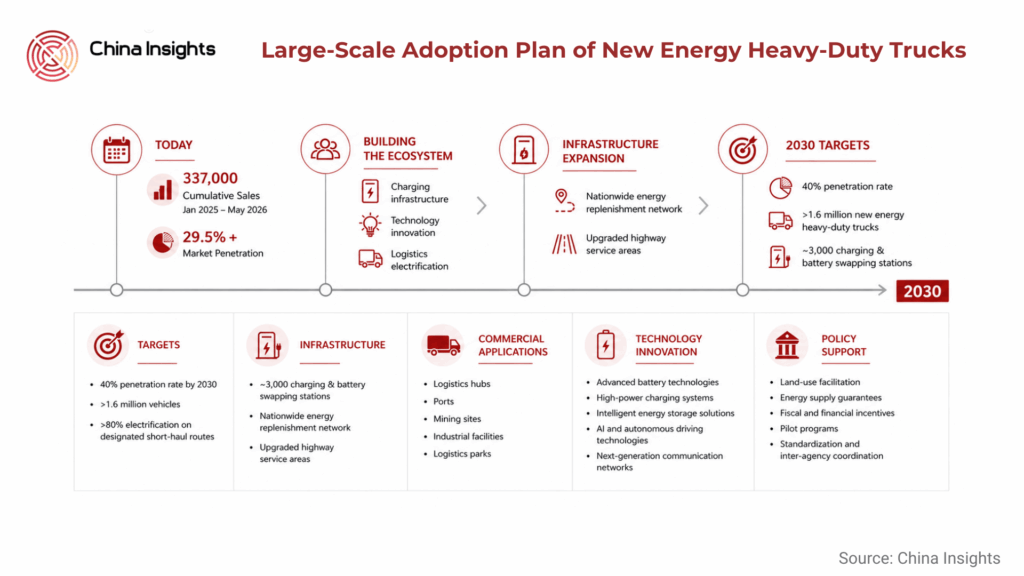
- The policy aims to increase the penetration rate of new energy heavy-duty trucks to 40% by 2030.
- China targets a fleet of more than 1.6 million new energy heavy-duty trucks by 2030.
- Approximately 3,000 charging and battery swapping stations for heavy trucks are planned nationwide.
- Major investments will be directed toward charging infrastructure, technology innovation, and logistics sector electrification.
- The policy supports China’s carbon peaking and carbon neutrality objectives while creating new opportunities across the transportation, logistics, energy, and automotive sectors.
China Steps Up Transport Decarbonization Efforts
On 18 June 2026, China’s Ministry of Transport, together with the National Development and Reform Commission and nine other central government departments, jointly issued the Implementation Plan for Promoting the Large-Scale Application of New Energy Heavy-Duty Trucks《推动新能源重卡规模化应用实施方案》.
The policy represents one of China’s most comprehensive efforts to date to accelerate the electrification of heavy freight transportation. While passenger electric vehicles have already achieved significant market penetration, heavy-duty trucking remains one of the most challenging sectors to decarbonize due to high energy consumption, long-distance operations, and infrastructure requirements.
According to the Ministry of Transport, the transport sector accounts for approximately 10% of China’s total carbon emissions, with heavy-duty trucks contributing around 40% of transport-related emissions. As a result, the electrification of freight transport is considered a critical component of China’s broader “dual carbon” strategy.
Rapid Market Growth Creates Momentum
The policy builds on a period of strong market expansion. According to official data cited by the Ministry of Transport, cumulative sales of new energy heavy-duty trucks reached 337,000 units between January 2025 and May 2026, pushing market penetration above 29.5%.
Several factors have contributed to this growth. Improvements in battery technology, increasing vehicle reliability, and government incentives have significantly enhanced the commercial attractiveness of electric heavy trucks. Operating costs have also become increasingly competitive compared to traditional diesel-powered vehicles.
Industry estimates cited in the policy announcement suggest that pure electric heavy trucks incur energy costs of approximately RMB 1.2 to RMB 1.5 per kilometer, compared with RMB 2.8 to RMB 3.0 per kilometer for diesel trucks. Based on annual mileage of 120,000 kilometers, fleet operators could potentially save more than RMB 150,000 per vehicle annually in energy costs alone.
In addition, subsidy programs introduced in recent years continue to support fleet replacement and modernization. In April 2026, the Ministry of Transport and the National Development and Reform Commission issued a notice supporting the scrappage and replacement of older commercial trucks, with incentives favoring electric truck adoption.
Addressing Infrastructure Bottlenecks
Despite the rapid growth, policymakers acknowledge that several structural barriers continue to limit large-scale adoption.
The new implementation plan identifies insufficient charging and battery swapping infrastructure, limited coordination between regional development plans, incomplete technical standards, and inadequate resource support as key obstacles to industry development.
To address these challenges, China plans to establish a nationwide energy replenishment network along major freight corridors and logistics routes. New charging and battery swapping facilities will be integrated into national transport infrastructure projects, while existing highway service areas will be upgraded to accommodate heavy-duty truck charging requirements.
Particular emphasis is being placed on eliminating infrastructure gaps along inter-regional transport routes. Policymakers view nationwide infrastructure coverage as essential for expanding electric truck operations beyond localized and short-distance applications.
Ambitious 2030 Targets
The implementation plan establishes a number of measurable targets for 2030.
The most notable objective is achieving a new energy heavy-duty truck market penetration rate of 40%. In addition, China aims to increase the national fleet of new energy heavy-duty trucks to more than 1.6 million vehicles, representing approximately 20% of the total heavy truck fleet.
The policy also calls for electrification rates exceeding 80% on designated short-haul transportation routes in key regions such as the Beijing-Tianjin-Hebei economic cluster and the Fenwei Plain region.
Supporting infrastructure development will be equally ambitious, with authorities targeting the construction of approximately 3,000 heavy-duty truck charging and battery swapping stations nationwide.
These objectives align closely with the priorities outlined in China’s 15th Five-Year Plan framework, which emphasizes low-carbon transportation, freight electrification, and increased use of green fuels.
Expanding Commercial Applications
A central element of the policy is expanding the use of new energy heavy-duty trucks across a wider range of operational scenarios.
Authorities are encouraging deployment at logistics hubs, ports, mining sites, industrial facilities, and logistics parks, where operational patterns are particularly well suited to electric vehicles. These environments typically feature fixed routes, predictable mileage, and centralized charging opportunities.
The policy also encourages major logistics providers, express delivery companies, and large-scale freight operators to take a leading role in adopting electric heavy-duty trucks for highway transportation.
By targeting large fleet operators first, policymakers aim to create demonstration effects that encourage broader adoption throughout the freight transportation ecosystem, including among small and medium-sized operators.
Technology Innovation Remains a Priority
Beyond vehicle deployment, the implementation plan places significant emphasis on technological innovation.
Authorities intend to leverage national science and technology programs across transportation, energy, and equipment manufacturing sectors to accelerate research and development. Key focus areas include advanced battery technologies, high-power charging systems, intelligent energy storage solutions, and integrated transportation-energy systems.
The policy further promotes the convergence of new energy heavy-duty trucks with artificial intelligence, autonomous driving technologies, and next-generation communication networks.
This reflects China’s broader industrial strategy of integrating transportation, energy, digital infrastructure, and intelligent manufacturing into a unified innovation ecosystem often described as the “vehicle-cargo-road-energy-cloud” model.
Industry observers view technological innovation as essential for addressing ongoing challenges such as battery degradation, charging efficiency, vehicle range, and total cost of ownership.
Implementation and Policy Support
The success of the policy will ultimately depend on effective implementation and coordination among government agencies, industry stakeholders, and infrastructure providers.
According to the Ministry of Transport, authorities will combine government guidance with market-driven mechanisms while strengthening standardization efforts and inter-agency coordination.
Supporting measures will include land-use facilitation, energy supply guarantees, fiscal and financial incentives, and pilot programs designed to accelerate commercialization and identify best practices.
This coordinated approach reflects China’s increasingly integrated industrial policy framework, where transportation modernization, energy transition, and economic development objectives are pursued simultaneously.
What This Means for Business
The new implementation plan signals that China’s transition toward low-carbon freight transportation is entering a new phase characterized by large-scale deployment rather than pilot experimentation.
For vehicle manufacturers, battery producers, charging infrastructure providers, and energy companies, the policy creates substantial long-term growth opportunities. Demand for heavy-duty charging solutions, battery swapping technologies, energy management systems, and fleet electrification services is expected to increase significantly.
Logistics operators and freight companies should closely monitor infrastructure developments and incentive programs, as operating cost advantages could increasingly strengthen the business case for fleet electrification.
Foreign companies active in commercial vehicle technology, battery systems, charging infrastructure, autonomous driving, smart logistics, and industrial software may also find opportunities to participate in China’s evolving transportation ecosystem, particularly through partnerships with domestic industry players.
While infrastructure challenges and operational constraints remain, the policy demonstrates China’s commitment to accelerating freight transport electrification and establishing new energy heavy-duty trucks as a core component of the country’s green transportation future.
Sources
Author
Dr. Richard van Ostende

Related Articles