
China’s 15th Five-Year Energy Investment Outlook: Over RMB 20 Trillion Allocated to Energy Infrastructure and New Business Models
On 29 June 2026, the Chinese Government reported that China’s energy system under the “15th Five-Year Plan” framework will mobilize more than RMB 20 trillion in combined investment for key energy projects and emerging business models. The scale indicates a continued expansion of China’s energy transition agenda, with investment directed toward system modernization, supply security, and new energy-related industrial formats. The policy direction reflects a structural shift in China’s energy system. Energy is increasingly treated as a strategic infrastructure domain linked to industrial competitiveness, technological upgrading, and macroeconomic stability.
Executive Summary
- China’s 15th Five-Year energy plan targets over RMB 20 trillion in total investment.
- Investment covers both traditional energy infrastructure and emerging energy business models.
- Energy policy is positioned as a driver of industrial restructuring and innovation.
- System modernization and energy security remain core policy priorities.
- New energy formats and digitalized energy systems are expected to expand rapidly.
- The policy supports integration between energy infrastructure and industrial value chains.
- Market opportunities are expected across generation, grids, storage, and energy services.
Policy Positioning: Energy as a System-Level Economic Driver
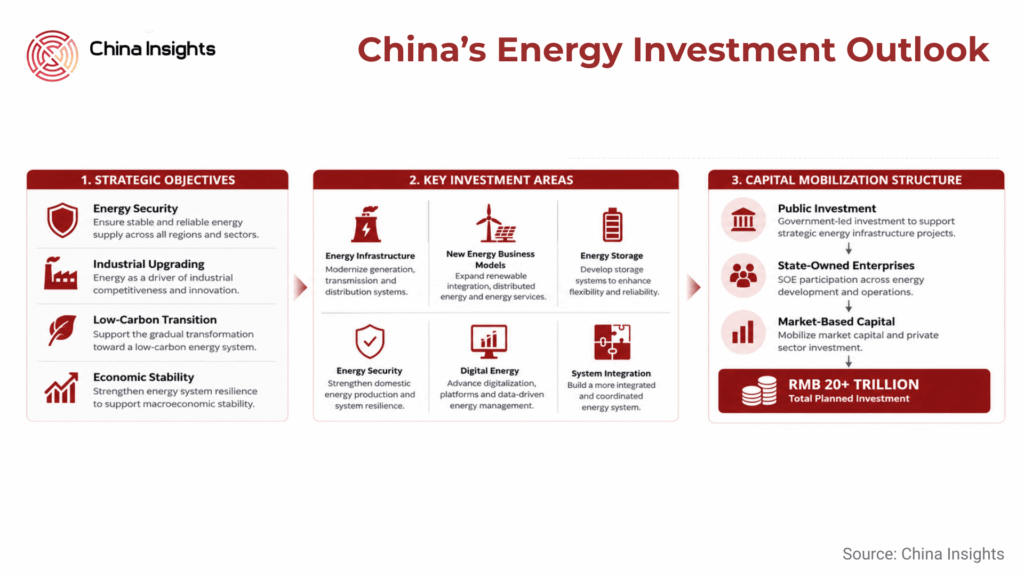
The scale of planned investment highlights the continued elevation of energy policy within China’s macroeconomic framework. Energy is no longer treated solely as an input sector but as a foundational system supporting industrial transformation and technological development. The investment framework under the 15th Five-Year period is designed to strengthen both supply security and structural modernization. This dual objective reflects the need to balance energy stability with decarbonization and efficiency improvements. Energy policy is therefore closely aligned with broader development priorities, including industrial upgrading and innovation-driven growth.
Investment Scale and Capital Mobilization Structure
The reported investment scale exceeding RMB 20 trillion reflects a multi-channel capital mobilization approach. Funding is expected to come from a combination of public investment, state-owned enterprise participation, and market-based capital formation. The structure indicates a long-term infrastructure cycle rather than short-term stimulus measures. Investment will be distributed across core energy systems and new energy-related business formats. This includes both physical infrastructure development and the expansion of service-oriented and digitalized energy business models. The scale suggests sustained demand for capital-intensive energy projects throughout the planning period.
Energy System Modernization and Infrastructure Expansion
A core component of the investment program is the continued modernization of China’s energy infrastructure system. This includes strengthening the overall energy supply network, improving system efficiency, and enhancing reliability across generation, transmission, and distribution systems. The policy direction emphasizes the need for a more integrated and resilient energy system capable of supporting industrial and urban demand growth. System-level coordination between different energy sources is expected to become increasingly important.
Expansion of New Energy Business Models
A significant portion of investment is directed toward emerging energy business models. These include new formats built around renewable energy integration, distributed energy systems, and digital energy services. The development of these new models reflects a broader transformation in how energy is produced, distributed, and consumed. Energy systems are increasingly shifting from centralized structures toward more flexible and networked configurations. This transition is expected to create new commercial opportunities across energy services, platform-based management systems, and integrated energy solutions.
Energy Security and Supply Stability
Energy security remains a central policy objective within the 15th Five-Year framework. The investment strategy reflects a continued focus on ensuring stable and reliable energy supply across all regions and sectors of the economy. This includes strengthening domestic energy production capacity and improving system resilience under external uncertainty. Energy security considerations are closely linked to industrial stability and macroeconomic risk management.
Structural Transition Toward Low-Carbon Systems
Although the policy emphasizes security, it is also embedded within China’s broader low-carbon transition framework. Energy investment is expected to support the gradual transformation of the energy structure, including the expansion of cleaner energy sources and improved system efficiency. The integration of new energy technologies into existing systems is a key structural priority. This transition is expected to reshape long-term energy supply composition and investment patterns.
Digitalization and System Integration
Energy system modernization is increasingly linked to digital transformation. The policy direction indicates growing integration between energy infrastructure and digital technologies, enabling improved system coordination and operational efficiency. Digital platforms are expected to play a greater role in energy management, optimization, and distribution. This reflects a broader trend toward data-driven energy system governance.
Industrial Linkages and Downstream Demand Effects
The scale of energy investment has significant implications for upstream and downstream industrial sectors. Capital-intensive industries such as equipment manufacturing, engineering services, and infrastructure construction are likely to benefit from sustained demand. At the same time, energy system upgrades are expected to support broader industrial efficiency improvements. Energy modernization therefore functions as both a standalone investment program and a cross-sector enabling framework.
Regional and Structural Allocation Effects
Energy investment under the 15th Five-Year framework is expected to have strong regional distribution effects. Infrastructure development and energy system upgrades are likely to be uneven across regions, reflecting differences in resource endowment, industrial base, and demand patterns. This creates differentiated opportunities across provincial-level energy markets. Regional energy planning will therefore remain a key determinant of investment allocation.
Market Structure and Private Sector Participation
Although state-led investment remains central, the scale of the program suggests expanded participation opportunities for private capital and enterprises. Private sector involvement is expected in areas such as equipment supply, engineering services, digital energy platforms, and specialized energy solutions. The development of new energy business models also creates entry points for technology-driven firms. This reflects a gradual diversification of actors within China’s energy system.
What this means for business
The RMB 20 trillion energy investment program creates a multi-layered opportunity structure for firms operating in China’s energy and industrial ecosystem.
Large-scale infrastructure investment will sustain demand for engineering, construction, and equipment manufacturing.
- New energy business models will create opportunities in digital platforms, energy services, and system integration.
- Companies in renewable energy, storage, and grid modernization will benefit from continued policy support.
- Energy digitalization will increase demand for data analytics, software, and system management solutions.
- Supply chain integration between energy and industrial sectors will deepen.
- Regional differentiation will require tailored market entry and investment strategies.
- Long-term policy stability in energy investment will support multi-year planning cycles for enterprises.
Source
https://www.gov.cn/zhengce/202606/content_7073503.htm
Author
Dr. Richard van Ostende

Related Articles