
China Targets 40 Million Charging Points by 2030: Accelerating EV Infrastructure Expansion and System Integration
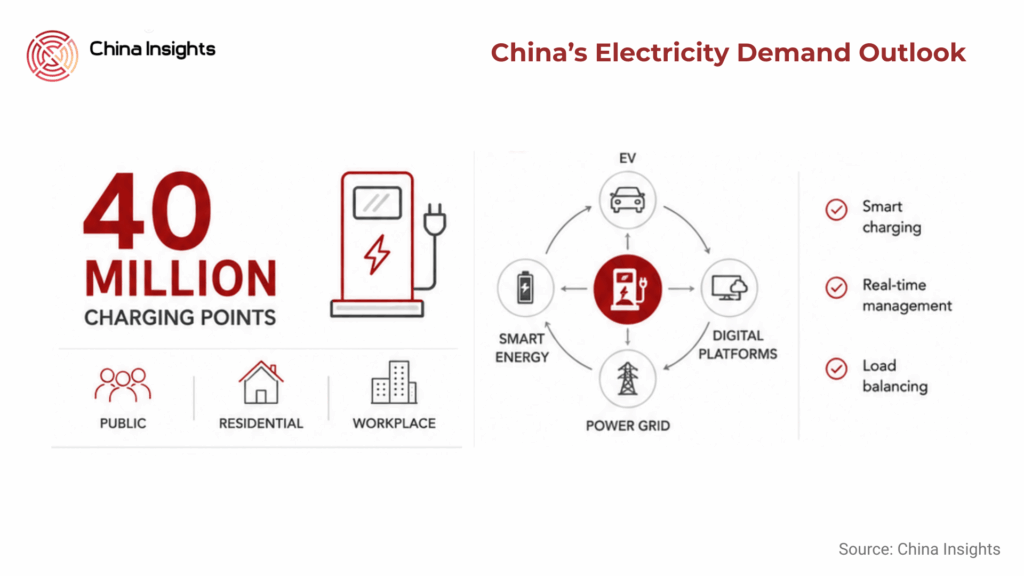
On 29 June 2026, China’s State Council outlined China’s long-term development plan for electric vehicle (EV) charging infrastructure. By 2030, China’s total number of charging facilities will reach approximately 40 million units, reflecting a continued expansion of the national electric mobility ecosystem.
The policy direction signals a transition from early-stage infrastructure deployment to large-scale system optimization. Charging infrastructure is increasingly positioned as a core component of urban planning, energy systems, and transportation networks.
Executive Summary
- China plans to reach 40 million EV charging facilities by 2030.
- Charging infrastructure is becoming a core component of national transport and energy systems.
- Policy focus is shifting from deployment scale to system efficiency and accessibility.
- Urban and highway charging networks will be further integrated.
- Public-private coordination is expected to support infrastructure expansion.
- Smart charging and digital management systems are becoming standard requirements.
- The EV ecosystem is moving toward full lifecycle infrastructure coverage.
Policy Context: From Expansion to System Integration
China’s EV charging infrastructure has entered a new phase of development. After years of rapid expansion, the policy focus is shifting toward system integration, service efficiency, and network optimization. The target of 40 million charging points by 2030 reflects both continued demand growth and the need to support large-scale electric vehicle adoption. Charging infrastructure is no longer treated as a standalone sector. It is increasingly embedded within broader energy, transport, and urban development systems.
Read more about the earlier phase of expansion.
Infrastructure Scale and Long-Term Deployment Strategy
The projected expansion to 40 million charging facilities represents a significant scaling of national infrastructure capacity. This includes a mix of public charging stations, private residential charging points, and workplace charging systems. The development path suggests a multi-layered deployment strategy combining high-density urban coverage with expanded intercity and rural access. The scale of expansion indicates continued policy support for electric mobility as a long-term structural transformation in the transport sector.
Urban Network Expansion and Accessibility Improvements
Urban areas remain the primary focus of charging infrastructure development. The policy direction emphasizes improving accessibility, reducing charging time, and increasing coverage density in high-demand zones. Charging infrastructure is increasingly integrated into urban planning frameworks, including residential complexes, commercial districts, and public parking systems. The objective is to ensure that charging services are widely available within short-distance access ranges for users.
Highway and Intercity Charging Network Integration
A key component of the expansion strategy is strengthening intercity and highway charging networks. This is intended to support long-distance EV travel and improve connectivity between major urban clusters. The policy highlights the importance of reducing range anxiety and improving reliability of charging services along transportation corridors. This reflects the integration of charging infrastructure into national transport planning systems.
Smart Charging and Digital Infrastructure Development
Charging infrastructure development is increasingly linked to digital management systems. Smart charging technologies are expected to optimize energy distribution, reduce peak load pressure, and improve operational efficiency. Digital platforms are being used to coordinate charging demand, monitor system performance, and enable real-time service management. This reflects the convergence of energy systems, transportation infrastructure, and digital technologies.
Public-Private Coordination in Infrastructure Deployment
The expansion of charging infrastructure is supported by a mixed investment model involving both public and private sector participation. Private enterprises are expected to play a significant role in construction, operation, and service provision. Public sector involvement focuses on planning coordination, standard setting, and network integration. This hybrid model is intended to accelerate deployment while maintaining system consistency and service standards.
Energy System Integration and Grid Interaction
Charging infrastructure is increasingly treated as part of the broader energy system rather than a standalone transport service. The integration between EV charging networks and the power grid is becoming more important as charging demand increases. Smart charging systems are expected to contribute to grid stability by managing load distribution and enabling demand-side flexibility. This reflects the growing interdependence between transportation electrification and energy system management.
Standardization and Service Quality Improvement
As infrastructure scales, policy emphasis is shifting toward standardization and service quality improvement. This includes technical standards for charging equipment, interoperability between systems, and user service consistency. The objective is to ensure that infrastructure expansion is accompanied by improved usability and operational reliability. Standardization also supports the integration of fragmented charging networks into unified platforms.
Market Structure and Industry Development
The expansion of charging infrastructure is expected to reshape the structure of the EV services market. New business models are emerging around charging operations, platform management, and integrated mobility services. Companies operating in the sector are increasingly moving toward platform-based service models rather than isolated infrastructure ownership. This reflects a broader shift toward ecosystem-based competition in the EV industry.
Strategic Implications for Transport Electrification
The 40 million charging point target reinforces the long-term trajectory of transport electrification in China. It supports continued growth in electric vehicle adoption across passenger and commercial segments. The availability of charging infrastructure is becoming a key determinant of EV market penetration and user behavior. This creates a reinforcing cycle between vehicle adoption and infrastructure expansion.
What this means for business
The expansion of China’s EV charging infrastructure creates significant opportunities across the mobility, energy, and digital infrastructure sectors.
- Charging infrastructure development will drive demand for equipment manufacturing and installation services.
- Operators can expand into large-scale charging network management and platform services.
- Digital solutions for smart charging and energy management will see increased adoption.
- Energy companies will benefit from deeper integration with EV charging networks.
- Urban developers will increasingly incorporate charging infrastructure into planning and design.
- Standardization requirements will favor companies with scalable, interoperable technologies.
- The market will shift toward integrated mobility-energy service ecosystems.
Source
https://www.gov.cn/zhengce/202606/content_7073491.htm
Author
Dr. Richard van Ostende

Related Articles