
China Launches Three-Year Energy Efficiency and Carbon Reduction Upgrade Program for Key Industries
China has intensified its efforts to improve industrial energy efficincy and reduce carbon emissions through the release of a new policy framework targeting key industrial sectors. On 15 June 2026, the National Development and Reform Commission (NDRC) published an official interpretation of the Notice on Launching a Three-Year Action Program for Energy Conservation and Carbon Reduction Upgrades in Key Industries.
Executive Summary
- The National Development and Reform Commission (NDRC), together with relevant government departments, issued the Notice on Launching a Three-Year Action Program for Energy Conservation and Carbon Reduction Upgrades in Key Industries.
- The policy was released in June 2026 under document reference Fa Gai Huan Zi [2026] No. 698.
- The program targets sectors including steel, electrolytic aluminum, cement, flat glass, oil refining, ethylene, synthetic ammonia, methanol, and coal-fired power generation.
- By the end of 2028, the share of production capacity meeting national energy-efficiency benchmark standards is expected to increase significantly across targeted industries.
- Authorities aim to generate cumulative energy savings exceeding 100 million tonnes of standard coal equivalent and reduce carbon dioxide emissions by more than 200 million tonnes.
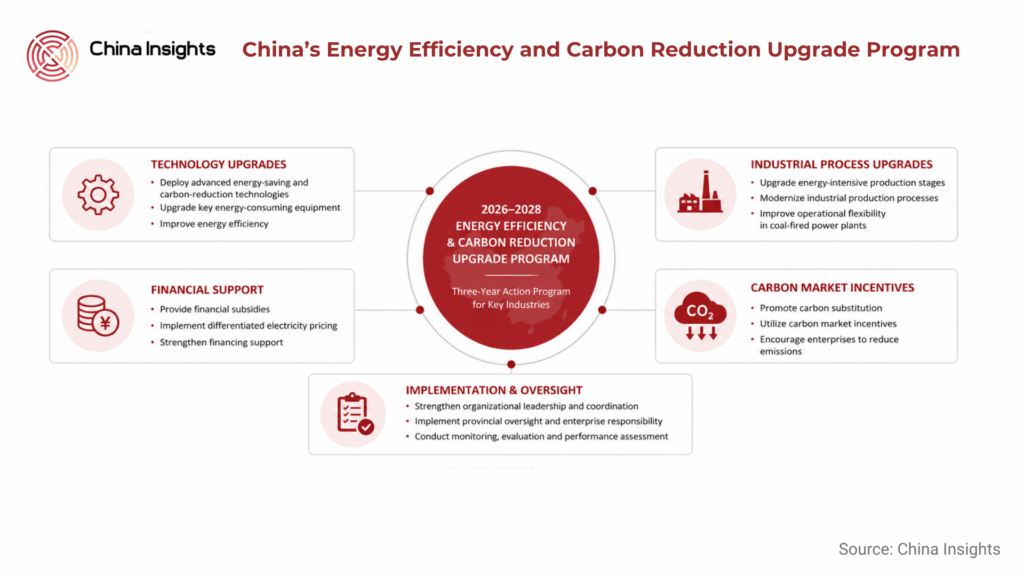
- Financial subsidies, differentiated electricity pricing, carbon market incentives, and stricter efficiency standards will be used to drive implementation.
Why the Policy Was Introduced
Many of China’s heavy industries continue to operate with substantial differences in energy performance across production facilities. Official assessments indicate that in sectors such as steel, electrolytic aluminum, cement clinker, and flat glass, less than 30 percent of production capacity currently achieves benchmark energy-efficiency levels.
Against this backdrop, the new action program aims to accelerate industrial upgrading and unlock additional energy-saving potential while supporting China’s long-term climate commitments.
The policy establishes clear and measurable objectives to be achieved by the end of 2028.
Authorities aim to increase the share of production capacity by meeting current national energy-efficiency benchmark standards by an average of 20 percentage points across major industrial sectors, including steel, aluminum, cement, flat glass, refining, ethylene, synthetic ammonia, and methanol production.
For the coal-fired power sector, the target is to increase benchmark-level capacity by approximately 15 percentage points.
At the same time, production capacity operating below baseline energy-efficiency standards is expected to be largely eliminated.
Collectively, these measures are projected to generate energy savings exceeding 100 million tonnes of standard coal equivalent and reduce carbon dioxide emissions by more than 200 million tonnes over the implementation period.
These targets demonstrate the scale of the government’s ambitions and highlight the critical role that industrial decarbonization will play in China’s climate strategy.
Accelerating Technology Adoption
A central pillar of the program involves the deployment of advanced energy-saving and carbon-reduction technologies.
The notice encourages the wider adoption of technologies such as high-ratio pellet smelting in blast furnaces, advanced aluminum electrolysis cells, oxygen-enriched combustion systems for industrial kilns, and high-efficiency catalytic cracking flue gas turbines.
In addition, enterprises are encouraged to replace or upgrade key energy-consuming equipment, including boilers, motors, pumps, fans, compressors, transformers, and steam turbines.
By accelerating technology deployment, policymakers aim to improve operational efficiency while reducing energy consumption and emissions intensity across industrial value chains.
The policy also creates opportunities for equipment manufacturers, engineering service providers, and industrial technology suppliers specializing in energy efficiency solutions.
Upgrading Industrial Processes and Facilities
Beyond equipment replacement, the action plan emphasizes the modernization of industrial production processes.
The policy identifies energy-intensive production stages as priority areas for intervention. In the steel sector, blast furnaces and converters will be targeted for upgrades. Aluminum producers are expected to improve electrolysis operations, while glass manufacturers will focus on modernizing furnace technologies.
Coal-fired power plants are also included within the program. Authorities will encourage upgrades that improve operational flexibility, including fast-ramping, deep-load adjustment, and wider load-range capabilities.
These improvements are designed not only to reduce emissions but also to support the growing integration of renewable energy into China’s power system by enabling more flexible thermal generation.
The focus on process optimization suggests that policymakers view industrial transformation as extending beyond individual equipment upgrades toward broader operational modernization.
Promoting Green Energy Consumption
The action program also seeks to accelerate the transition toward cleaner energy use within industrial operations.
Authorities encourage the recovery and utilization of waste heat, residual pressure, and by-product gases generated during industrial processes. Technologies such as waste heat power generation and energy cascade utilization are expected to play a larger role in future industrial operations.
The policy further promotes low-carbon fuel substitution and the electrification of industrial energy systems where technically feasible.
Certain coal-fired power facilities may also be encouraged to implement low-carbon transformation measures, reflecting the government’s efforts to reduce emissions from sectors that are likely to remain part of China’s energy mix for the foreseeable future.
By addressing both energy efficiency and energy sources, the policy adopts a comprehensive approach to industrial decarbonization.
Financial and Regulatory Support Measures
Recognizing the significant investment required for industrial upgrades, the government has introduced several support mechanisms.
Projects that meet qualifying criteria may receive financial support equivalent to up to 20 percent of approved project investment costs. Priority will be given to projects capable of achieving benchmark energy-efficiency levels following implementation.
Local governments are encouraged to utilize existing funding channels to support qualifying projects, while financial institutions are expected to provide diversified financing solutions.
The policy also introduces electricity pricing reforms. Regions may consolidate existing differentiated, tiered, and punitive electricity pricing systems into a unified differentiated pricing framework. Under this mechanism, electricity prices for inefficient facilities may be increased by up to RMB 0.10 per kilowatt-hour above market rates.
These measures are intended to strengthen economic incentives for upgrading while increasing operating costs for inefficient production capacity.
Strengthening the Link Between Carbon Markets and Industrial Upgrades
An important feature of the policy is its integration with China’s broader carbon management framework.
Industrial enterprises that reduce emissions through approved energy-saving upgrades may be able to generate carbon reduction capacity that can support the development of new high-energy-consuming projects within the same region through carbon substitution mechanisms.
In addition, enterprises participating in China’s national emissions trading system may benefit from improved carbon allowance positions if their emissions intensity performs better than established benchmarks.
This approach further strengthens the business case for investing in energy efficiency improvements and aligns industrial policy with carbon market development.
Implementation and Accountability
The National Development and Reform Commission emphasized that effective implementation will require close cooperation among central government departments, local authorities, state-owned enterprises, industry associations, and specialized service providers.
Provincial governments are expected to incorporate energy-saving upgrades into annual policy priorities and strengthen project supervision and implementation monitoring.
Enterprises operating in targeted sectors will bear primary responsibility for developing and executing upgrade plans. Central state-owned enterprises are expected to play a leading demonstration role.
The government also intends to strengthen ongoing assessment and evaluation mechanisms to ensure that targets are achieved within the designated timeframe.
What This Means for Business
The three-year action program represents a significant acceleration of China’s industrial decarbonization agenda and signals that energy efficiency will remain a strategic priority through the remainder of the 15th Five-Year Plan period.
For companies operating in energy-intensive industries, the policy increases both opportunities and obligations. Businesses that proactively invest in efficiency improvements may gain access to financial support, lower operating costs, and potential benefits within China’s evolving carbon market framework. Companies that fail to upgrade could face higher electricity costs and increasing regulatory pressure.
For suppliers of industrial equipment, engineering services, automation systems, energy management technologies, waste heat recovery solutions, and low-carbon technologies, the policy is likely to create substantial market opportunities over the next three years.
Foreign companies with expertise in industrial efficiency, process optimization, emissions reduction technologies, and advanced manufacturing equipment may also find new opportunities for cooperation with Chinese industrial enterprises seeking to meet increasingly stringent efficiency standards.
More broadly, the policy demonstrates that China’s green transition is increasingly moving from target-setting toward implementation, with measurable performance standards, financial incentives, and regulatory mechanisms designed to accelerate industrial transformation.
Sources
https://www.gov.cn/zhengce/202606/content_7072156.htm
Author
Dr. Richard van Ostende

Related Articles