
China’s Electricity Demand Outlook: Annual Power Consumption Growth Expected to Reach 600 TWh Increment
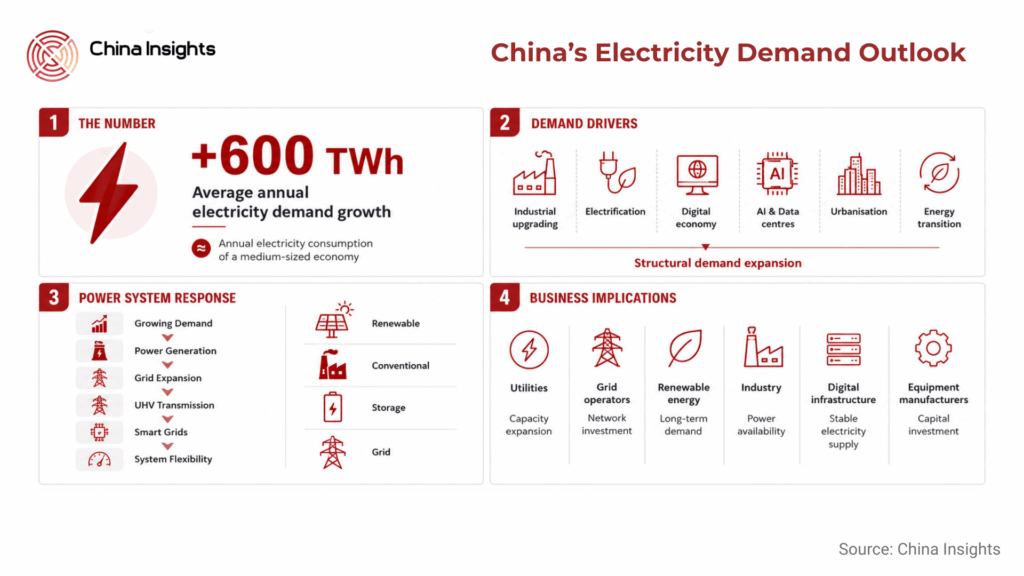
On 29 June 2026, a policy interpretation published by the State Council on China’s medium- to long-term electricity demand trajectory estimates that national electricity consumption will increase by an average of approximately 600 billion kWh (600 TWh) per year, equivalent to the annual electricity usage of a medium-sized economy. The projection underscores the structural expansion of China’s power system demand base, driven by industrial upgrading, electrification trends, and the growth of new economy sectors.
Executive Summary
- China’s annual electricity demand growth is projected at around 600 TWh per year.
- This increase is comparable to the annual consumption of a medium-sized economy.
- Demand growth is driven by industrial upgrading and electrification of end-use sectors.
- Emerging industries and digital economy sectors are key contributors to new demand.
- Power system expansion will require continued investment in generation and grid infrastructure.
- Energy transition policies are reshaping the structure of electricity consumption.
- Electricity demand growth reinforces long-term energy security and infrastructure priorities.
Policy Context: Structural Expansion of Electricity Demand
China’s electricity demand continues to expand at a structurally high level. The projected annual increment of 600 TWh reflects sustained economic activity combined with deep structural transformation. The increase is not solely volume-driven but reflects a shift in the composition of energy consumption across sectors. Electricity is increasingly replacing fossil fuels in end-use applications, reinforcing long-term demand growth.
Industrial Upgrading and Demand Intensification
A key driver of electricity demand growth is industrial upgrading. Manufacturing sectors are moving toward higher value-added and more energy-intensive production processes, particularly in advanced manufacturing and automation-driven systems. This transition increases electricity intensity per unit of output in certain industrial segments. At the same time, efficiency improvements partially offset total energy intensity, creating a more complex demand structure.
Electrification of End-Use Sectors
Electrification of transport, heating, and industrial processes is a major structural driver of electricity demand. Electric vehicles, heat pumps, and electrified industrial equipment are increasing direct electricity consumption across multiple sectors. This shift replaces traditional fossil fuel-based energy consumption with grid-based electricity demand. As electrification deepens, electricity becomes a more dominant final energy carrier in the economy.
Digital Economy and Emerging Demand Sources
New economy sectors are contributing significantly to incremental electricity demand. Data centers, cloud computing infrastructure, and artificial intelligence applications require substantial and continuous power supply. These sectors are characterized by high and stable electricity consumption profiles. The expansion of digital infrastructure is therefore becoming a structural driver of long-term electricity demand growth.
Regional and Structural Demand Distribution
Electricity demand growth is not evenly distributed across regions. Industrial hubs, coastal economic zones, and digital infrastructure clusters are expected to experience higher incremental demand. Resource-rich inland regions also contribute through energy-intensive industrial activity. This uneven distribution places pressure on interregional transmission and grid balancing systems.
Power System Expansion Requirements
Sustained demand growth at this scale requires continued expansion of power generation and transmission infrastructure. Both conventional and renewable generation assets will need to scale in parallel with demand growth. Grid infrastructure must also expand to support increased load complexity and regional distribution imbalances. This includes investment in ultra-high voltage transmission and smart grid systems.
Energy Transition and Demand Structure Shift
Electricity demand growth is closely linked to China’s energy transition strategy. The substitution of coal and oil-based energy with electricity is reshaping the structure of final energy consumption. This transition supports decarbonization objectives while increasing reliance on the power system. As a result, electricity demand growth is not only quantitative but also structural in nature.
System Balancing and Flexibility Requirements
Higher electricity demand increases the importance of system flexibility. Balancing supply and demand becomes more complex as variable renewable energy sources account for a larger share of generation. Energy storage, demand-side response, and flexible generation capacity are increasingly important system components. This reflects a shift toward more dynamic and responsive grid operation models.
Macroeconomic Implications
The projected electricity demand growth reflects underlying macroeconomic expansion and structural upgrading. Electricity consumption is increasingly correlated with industrial modernization, digital economy development, and urbanization trends. The scale of growth also indicates sustained investment requirements in energy infrastructure over the medium term. Energy demand therefore remains a key indicator of economic transformation intensity.
What this means for business
The projected expansion in electricity demand has broad implications for energy-intensive industries, infrastructure providers, and technology firms.
- Power generation companies will face sustained capacity expansion requirements.
- Grid operators will need to invest in transmission and distribution infrastructure upgrades.
- Renewable energy developers will benefit from long-term demand growth fundamentals.
- Industrial firms should expect continued energy availability constraints in high-growth regions.
- Digital infrastructure providers will see rising demand for stable and large-scale power supply.
- Energy efficiency and management solutions will become increasingly important for cost control.
- Equipment manufacturers across the power sector will benefit from sustained capital investment cycles.
Source
https://www.gov.cn/zhengce/202606/content_7073472.htm
Author
Dr. Richard van Ostende

Related Articles