
China Air Transport Association Approves Its 15th Five-Year Development Plan (2026–2030)
The China Air Transport Association (CATA) has approved its 15th Five-Year Development Plan (2026–2030), outlining the strategic priorities that will guide the Association and support the development of China’s aviation sector over the next five years. The plan highlights key focus areas including the low-altitude economy, digital transformation, aviation safety, green development, industry standards, and international cooperation. It also provides valuable insight into the policy direction and business opportunities expected to shape China’s aviation industry through 2030.
Executive Summary
- On 12 May 2026, the Sixth First Member Representative Conference of the China Air Transport Association (CATA) approved the Association’s 15th Five-Year Development Plan (2026–2030).
- The plan builds upon achievements made during the 14th Five-Year Plan period and outlines the roadmap for transforming CATA into a world-class industry association by 2030.
- Key priorities include aviation safety, digital transformation, low-altitude economy development, green aviation, industry standards, talent development, and international cooperation.
- The plan reflects broader Chinese government priorities, including high-quality development, technological innovation, sustainable growth, and the modernization of the civil aviation sector.
- The low-altitude economy emerges as one of the most significant strategic focus areas, highlighting growing opportunities in drones, urban air mobility, and related aviation services.
- The implementation of digital platforms, industry standards, and carbon reduction initiatives is expected to reshape the operating environment for aviation stakeholders in China.
Background: Approval of the 15th Five-Year Development Plan
On 12 May 2026, the First Meeting of the Sixth Member Representative Conference of the China Air Transport Association (CATA) approved the Association’s 15th Five-Year Development Plan (2026–2030). The announcement was subsequently published by the China Air Transport Association on 15 May 2026.
The plan serves as the strategic blueprint for the association’s development over the next five years and aligns closely with national objectives concerning the development of China’s civil aviation sector, transportation modernization, industry association reform, and high-quality economic development.
According to the Association, the 15th Five-Year period represents a critical stage in achieving strategic breakthroughs and advancing the organization’s ambition to become a world-class industry association that is trusted by government, valued by enterprises, internationally influential, and operationally strong.
Opportunities and Challenges Facing China’s Aviation Sector
The plan identifies a complex operating environment for China’s aviation industry over the coming five years.
Internationally, geopolitical uncertainty, supply chain disruptions, and volatile energy prices are expected to continue creating challenges for airlines and aviation service providers. Rising operating costs and external economic pressures may affect profitability across the industry.
Domestically, however, demand fundamentals remain positive. The Association expects continued growth in passenger and cargo transportation demand as China’s economy continues to develop and consumer mobility increases.
Read more about the 2025 growth in the aviation sector.
A particularly important opportunity identified in the plan is the emergence of “AI + Civil Aviation.” The integration of artificial intelligence and digital technologies is expected to accelerate the industry’s transition toward intelligent operations, data-driven management, and enhanced service delivery.
Read more about AI and Civil Aviation.
At the same time, competition from China’s expanding high-speed rail network remains a significant challenge, particularly on shorter domestic routes where rail offers strong convenience and environmental advantages.
Strategic Vision for 2030
The overarching objective of the plan is to establish CATA as a world-class industry association by 2030.
The Association intends to strengthen its role as an industry think tank, expand its influence in low-altitude economy development, improve member services, enhance digital platform adoption, and increase China’s voice in international aviation governance.
The strategy is guided by five core principles:
- Strengthening Party leadership and integration with industry activities.
- Maintaining a service-oriented approach.
- Promoting innovation and reform.
- Encouraging cooperation and resource sharing.
- Enhancing governance and regulatory compliance.
These principles are intended to support the broader modernization goals of China’s civil aviation sector while reinforcing the Association’s institutional capabilities.
Low-Altitude Economy Becomes a Strategic Priority
One of the most notable aspects of the new plan is the prominent emphasis on the low-altitude economy.
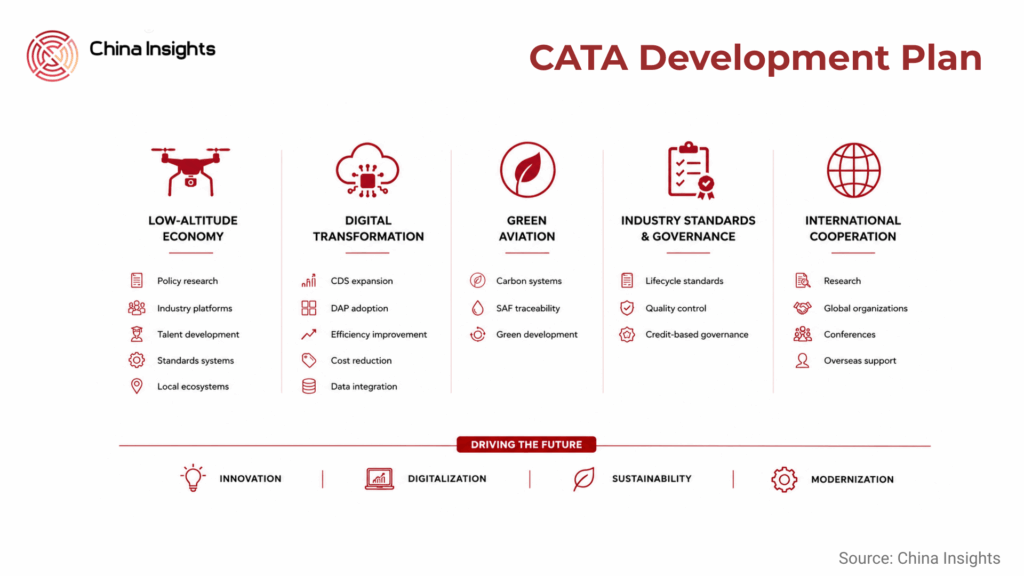
The Association plans to strengthen policy research, establish industry platforms, support talent development, improve standards systems, and assist local governments in developing low-altitude economic ecosystems.
The low-altitude economy has become a major national policy priority in China in recent years.
It encompasses activities such as unmanned aerial vehicles (UAVs), drone logistics, aerial tourism, emergency response services, agricultural aviation, and future urban air mobility solutions.
By positioning itself as a key facilitator in this emerging sector, CATA aims to play a central role in shaping standards, governance frameworks, and industry development pathways.
For companies operating in aviation technology, drone manufacturing, software solutions, and aerospace services, this focus area may create significant opportunities for market expansion and industry collaboration.
Read more about the low-altitude economy.
Digital Transformation and Industry Standards
Digitalization remains a core pillar of the Association’s strategy.
The plan calls for further development and expansion of the CDS platform and broader adoption of the DAP system across the aviation ecosystem. These initiatives are intended to improve operational efficiency, reduce costs, strengthen data integration, and support industry modernization.
Alongside digital transformation, the Association plans to strengthen industry standards development. Future efforts will focus on full lifecycle management of standards, enhanced quality control mechanisms, and the creation of a governance model that combines quality assurance with credit management.
Such initiatives are expected to support greater market transparency and improve operational consistency across the industry.
Green Aviation and Sustainable Development
Environmental sustainability represents another major focus area.
The Association plans to support the development of carbon reduction management systems and promote the traceability and adoption of Sustainable Aviation Fuel (SAF). Additional efforts will focus on implementing green development measures across the aviation value chain.
These objectives align with China’s broader carbon neutrality ambitions and the increasing global focus on reducing aviation-related emissions.
As international aviation markets place greater emphasis on sustainability reporting and carbon management, these initiatives could help Chinese aviation stakeholders improve competitiveness while supporting national environmental objectives.
Read more about Green Transition and Carbon Reduction in the aviation sector.
Strengthening International Cooperation
The plan also emphasizes expanding international engagement.
CATA intends to strengthen international research activities, deepen cooperation with international organizations, promote industry exhibitions and conferences, and support Chinese aviation enterprises pursuing overseas opportunities.
This reflects China’s broader objective of increasing participation in global aviation governance and strengthening the international competitiveness of its aviation industry.
The Association’s flagship events, including the CATA Aviation Conference, are expected to play an increasingly important role in facilitating international dialogue and industry cooperation.
What This Means for Business
The approval of CATA’s 15th Five-Year Development Plan provides valuable insight into the future direction of China’s aviation sector through 2030.
Several themes stand out for businesses:
- The low-altitude economy is emerging as a major growth area, creating opportunities for drone technology providers, aerospace manufacturers, software developers, and infrastructure companies.
- Digital transformation initiatives will continue to drive demand for aviation technology, artificial intelligence applications, data management solutions, and cybersecurity services.
- Green aviation policies are likely to create opportunities in sustainable aviation fuel, carbon management, environmental consulting, and related technologies.
- Industry standards and regulatory frameworks will continue to evolve, requiring companies to maintain close monitoring of compliance requirements.
- International aviation cooperation may create new opportunities for foreign companies seeking partnerships with Chinese aviation stakeholders.
Overall, the plan signals continued modernization of China’s aviation ecosystem, with innovation, sustainability, digitalization, and low-altitude economic development expected to be the primary drivers of growth during the 2026–2030 period.
Author
Dr. Richard van Ostende

Related Articles