
China Launches New Employment Stabilization and Expansion Action Plan
China has introduced a new policy package aimed at stabilizing employment, expanding job creation, and improving labor market quality amid ongoing economic restructuring and external market pressures. For businesses operating in China, the measures signal continued policy support for manufacturing, technology-driven industries, vocational training, and labor-intensive sectors, while also reinforcing expectations around workforce development and employment stability.
Executive Summary
- China’s State Council Employment Promotion and Labor Protection Leading Group released the “Action Plan for Stabilizing Employment, Expanding Capacity, and Improving Quality” on 19 May 2026.
- The policy focuses on stabilizing employment in key industries, supporting entrepreneurship, and improving workforce quality.
- Manufacturing, strategic emerging industries, modern services, and technology-driven sectors are identified as key employment drivers.
- Authorities aim to strengthen vocational training, labor protections, and employment services.
- The policy reflects Beijing’s broader objective of supporting domestic economic resilience and social stability.
- Foreign-invested enterprises operating in labor-intensive or advanced manufacturing sectors may benefit indirectly from workforce support measures and local implementation incentives.
Policy Background
On 19 May 2026, the State Council Employment Promotion and Labor Protection Leading Group (国务院就业促进和劳动保护工作领导小组) issued the “Action Plan for Stabilizing Employment, Expanding Capacity, and Improving Quality” (《稳岗扩容提质行动方案》
The policy was introduced against the backdrop of continued economic transition, shifting global trade dynamics, technological upgrading, and domestic employment pressures. Chinese authorities have increasingly linked employment stability to broader economic and social stability objectives, particularly as industries undergo digitalization, automation, and green transformation.
The action plan forms part of China’s wider effort to maintain stable economic growth while promoting high-quality development. In recent years, employment policy has become closely integrated with industrial policy, regional development strategies, and support for innovation-driven sectors.
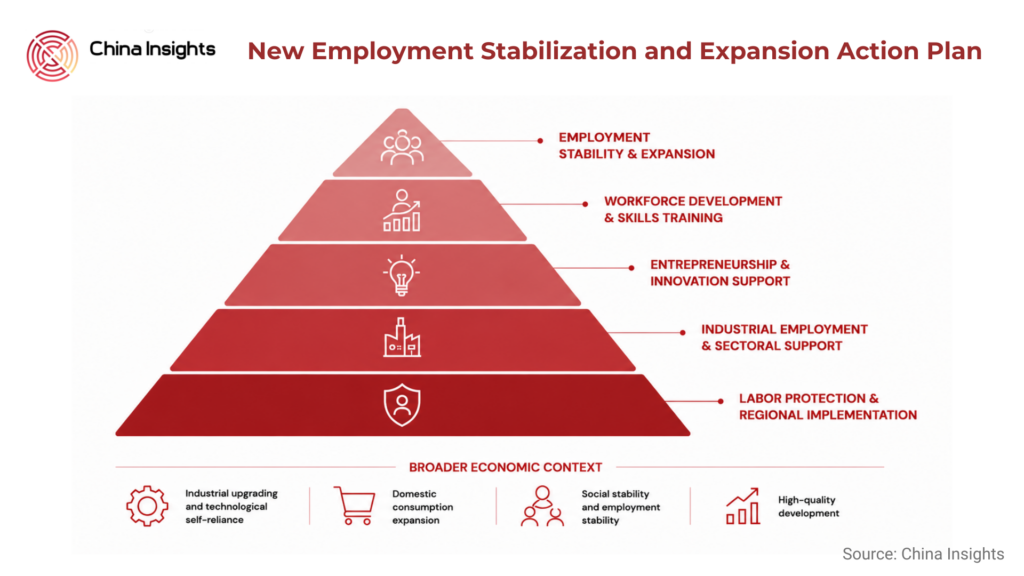
Focus on Manufacturing and Industrial Employment
One of the core priorities of the action plan is supporting employment absorption capacity within manufacturing and industrial supply chains. The document specifically highlights the importance of developing advanced manufacturing industries and strengthening high-quality industrial chain development.
China’s leadership continues to position manufacturing as a strategic pillar for economic resilience and technological self-sufficiency. The new measures encourage regions to develop industries according to local strengths while creating additional employment opportunities.
For businesses, this signals continued policy support for sectors such as advanced equipment manufacturing, electric vehicles, renewable energy, aerospace, semiconductors, industrial automation, and digital manufacturing. Local governments may further expand incentive programs linked to hiring, vocational training, and industrial investment.
The emphasis on manufacturing employment also reflects broader concerns regarding youth employment and the need to absorb workers affected by structural economic changes.
Support for Industries Affected by External Pressures
The action plan also includes measures aimed at supporting industries impacted by external economic conditions. Although the policy does not exclusively target export-oriented industries, it acknowledges the role of external market uncertainties in affecting employment stability.
Authorities aim to strengthen support for sectors capable of generating significant employment while encouraging the development of new service-oriented business models and consumption-driven industries.
This approach reflects China’s ongoing strategy of balancing external trade exposure with stronger domestic economic circulation. Businesses operating in export-oriented sectors may therefore see additional policy support from local governments seeking to stabilize regional employment.
At the same time, companies may face increased expectations to maintain workforce stability during periods of operational adjustment.
Entrepreneurship and Innovation Support
The policy further highlights entrepreneurship as an important channel for employment generation. Chinese authorities continue to encourage innovation-driven business creation, particularly in technology-intensive industries, strategic emerging sectors, and future-oriented industries.
The action plan calls for increased support for entrepreneurship in areas linked to scientific innovation and industrial upgrading. This includes support for startups, small and medium-sized enterprises, and innovation ecosystems capable of generating new employment opportunities.
For foreign businesses and investors, the policy demonstrates China’s continued commitment to fostering domestic innovation ecosystems while integrating employment objectives into industrial modernization.
Technology parks, innovation zones, and regional development clusters may increasingly align investment attraction policies with employment-generation targets.
Workforce Development and Skills Training
A major component of the action plan focuses on improving workforce quality through vocational education and skills upgrading.
Chinese authorities have repeatedly emphasized the need to align workforce capabilities with industrial upgrading requirements. The new policy therefore prioritizes vocational skills development, labor market services, and workforce training programs linked to key industries.
The policy particularly emphasizes strengthening employment service systems and improving labor market matching mechanisms. This includes support for training programs tailored to advanced manufacturing, digital technologies, and modern services.
For employers, especially those in technically advanced sectors, this could improve access to skilled labor over the medium term. Companies may also benefit from local subsidies or incentives related to workforce training initiatives.
At the same time, businesses should expect increasing policy attention on workforce development obligations, training participation, and labor compliance.
Labor Protection and New Employment Models
The action plan also addresses labor protections, particularly for workers engaged in new forms of employment.
China’s labor market has seen rapid growth in platform-based work, flexible employment, and gig economy services. Authorities are increasingly seeking to strengthen regulatory oversight while balancing labor flexibility with social protections.
The document calls for stronger protection of workers’ rights and interests, including for individuals employed through emerging employment models.
For companies operating digital platforms, logistics services, delivery networks, or flexible workforce models, this trend indicates continued regulatory scrutiny over employment practices, social insurance participation, and labor protections.
Businesses should therefore monitor local implementation measures carefully, as provincial and municipal authorities may introduce additional compliance requirements.
Regional Implementation and Local Government Role
As with many national policy initiatives in China, implementation responsibility will largely fall to provincial and local governments.
Regional authorities are expected to adapt the policy framework according to local economic structures, labor market conditions, and industrial priorities. This means implementation measures could vary significantly across provinces and municipalities.
Manufacturing-heavy provinces, technology clusters, and regions facing higher employment pressures may introduce more aggressive support measures, including hiring subsidies, training incentives, financing support, and industrial development programs.
Foreign-invested enterprises should therefore monitor regional policy announcements closely, particularly in areas where they maintain major production or operational facilities.
Broader Economic Context
The action plan aligns with China’s broader economic priorities for 2026, including industrial upgrading, technological self-reliance, domestic consumption expansion, and social stability.
Employment policy has become an increasingly important macroeconomic tool for Chinese policymakers. Maintaining stable employment levels is viewed as critical to sustaining consumer confidence, supporting domestic demand, and mitigating social risks during economic transition.
The policy also reinforces China’s ongoing emphasis on “high-quality development,” where economic growth objectives are increasingly linked to innovation, productivity, sustainability, and workforce quality rather than purely quantitative expansion.
For international businesses, the policy highlights the extent to which labor and employment considerations are becoming integrated into China’s industrial and economic planning framework.
What This Means for Business
The new action plan reinforces China’s commitment to employment stability as a core policy priority. Businesses operating in China should expect continued government support for sectors capable of generating employment, particularly advanced manufacturing, modern services, and innovation-driven industries.
Foreign-invested enterprises may benefit indirectly from regional hiring incentives, workforce training subsidies, and broader industrial support measures. Companies operating in labor-intensive sectors or advanced manufacturing may find additional opportunities to engage with local governments on workforce development initiatives.
At the same time, businesses should anticipate growing policy expectations around workforce stability, employee training, labor protections, and social responsibility.
The policy also suggests that labor considerations will remain closely linked to industrial policy, investment promotion, and regional economic planning. Companies with long-term operations in China may therefore benefit from aligning workforce strategies with local development priorities and government-supported industrial initiatives.
Source
https://www.gov.cn/zhengce/zhengceku/202605/content_7069390.htm
Author
Dr. Richard van Ostende

Related Articles