
China Intensifies Efforts to Eliminate Discriminatory Government Procurement Practices Against Foreign-Invested Enterprises
China is reinforcing its commitment to creating a more level playing field for foreign-invested enterprises (FIEs) participating in government procurement. Recent policy guidance and enforcement measures indicate that Chinese authorities are continuing efforts to remove discriminatory procurement practices that differentiate between domestic and foreign-invested companies.
The initiative aligns with broader national objectives to improve the business environment, attract foreign investment, and support the development of a unified national market. It also reflects China’s ongoing efforts to address concerns frequently raised by foreign chambers of commerce regarding market access and equal treatment in public procurement.
Executive Summary
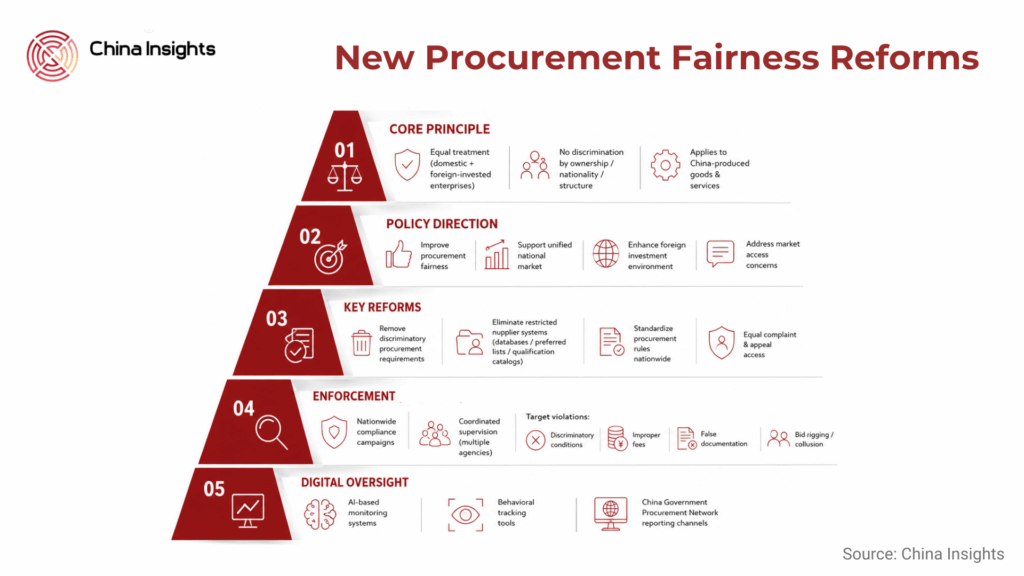
- Chinese authorities continue to strengthen enforcement against discriminatory government procurement practices affecting foreign-invested enterprises.
- The Ministry of Finance (MOF) has reiterated that equal treatment of domestic and foreign-invested enterprises remains a fundamental principle of China’s government procurement system.
- Authorities are focusing on removing procurement requirements that discriminate based on ownership structure, investor nationality, or corporate background.
- Government agencies are required to eliminate supplier qualification databases, preferred vendor lists, and other mechanisms that restrict fair competition.
- Ongoing nationwide enforcement campaigns target procurement-related violations, including exclusion of foreign-invested enterprises.
- The measures support China’s broader efforts to improve the investment environment and enhance foreign investor confidence.
Policy Background
On 22 June 2026, officials from the Ministry of Finance provided further clarification regarding measures to ensure equal participation of foreign-invested enterprises in government procurement activities. The announcement followed the release of the Action Plan for Stabilizing and Improving Foreign Investment Utilization (《利用外资固稳促优行动方案》), jointly issued by the Ministry of Commerce (MOFCOM), the National Development and Reform Commission (NDRC), and the Ministry of Finance in June 2026. The action plan emphasizes the full implementation of national treatment for foreign-invested enterprises.
The latest policy statements build upon a series of earlier reforms aimed at creating a unified and competitive procurement market. Chinese authorities have increasingly positioned government procurement reform as part of the country’s broader economic opening agenda and efforts to improve the business environment.
Read more about Government Procurement and Domestic Product Standards.
Equal Treatment as a Core Procurement Principle
The Ministry of Finance has repeatedly emphasized that government procurement activities must treat domestic and foreign-invested enterprises equally when products or services are produced within China. This principle was formally reinforced through the Ministry of Finance’s Notice on Implementing Policies for Equal Treatment of Domestic and Foreign-Invested Enterprises in Government Procurement Activities (《关于在政府采购活动中落实平等对待内外资企业有关政策的通知》), issued on 13 October 2021 and published on 1 March 2022.
Under the notice, government procurement entities are prohibited from imposing discriminatory conditions based on ownership structure, organizational form, shareholder composition, investor nationality, or product branding. Except for projects involving national security or state secrets, products manufactured within China must be treated equally regardless of whether the supplier is a domestic or foreign-invested enterprise.
The policy also requires procurement authorities to provide equal access to complaint and appeal mechanisms for all suppliers and to avoid discriminatory treatment during dispute resolution processes.
Removal of Discriminatory Procurement Practices
A key focus of the current reform effort is the elimination of practices that restrict competition and create barriers for foreign-invested enterprises.
According to Ministry of Finance officials, authorities at all levels continue to review and remove procurement rules that unfairly distinguish between domestic and foreign-invested companies. Particular attention is being given to the establishment of supplier databases, qualification lists, preferred supplier catalogues, and similar mechanisms that may limit market access and distort competition.
Local governments and procurement agencies have been instructed to identify and correct such practices. Similar implementation notices were issued by provincial and municipal finance authorities following the release of the 2021 Ministry of Finance notice, demonstrating nationwide enforcement efforts.
Strengthened Enforcement and Market Supervision
The policy initiative is being supported by broader enforcement campaigns targeting irregularities in government procurement.
According to the Ministry of Finance, from 2024 through 2026 authorities have conducted nationwide special enforcement actions focused on four major categories of violations:
- Discriminatory procurement conditions imposed by procuring entities.
- Improper fee charging by procurement agencies.
- Submission of false documentation by suppliers.
- Bid rigging and collusion among bidders.
Discrimination against foreign-invested enterprises has been identified as one of the key enforcement priorities within these campaigns. The objective is to remove barriers that prevent foreign-invested enterprises from participating fairly in government procurement opportunities.
The Ministry of Finance is conducting these enforcement efforts in cooperation with other government bodies, including public security and market regulation authorities, reflecting a coordinated approach to improving procurement governance.
Alignment with China’s Unified National Market Agenda
The procurement reforms are closely linked to China’s broader strategy of building a unified national market. Policymakers view fragmented local procurement practices and discriminatory treatment of suppliers as obstacles to efficient resource allocation and market integration.
Recent policy measures therefore seek not only to improve conditions for foreign-invested enterprises but also to enhance competition among all market participants. By standardizing procurement rules and reducing local protectionism, authorities aim to create a more transparent and predictable procurement environment.
The reforms also support China’s ongoing efforts to align domestic procurement practices with international economic and trade standards. Ministry of Finance officials have highlighted the importance of benchmarking against high-standard international trade rules as part of government procurement reform.
Digital Oversight and Transparency Measures
Chinese authorities are increasingly using digital tools to strengthen procurement oversight.
According to the Ministry of Finance, technologies such as artificial intelligence and behavioral monitoring systems are being introduced to improve supervision of key procurement processes. These systems are intended to enhance transparency, identify irregular procurement activities, and improve regulatory enforcement.
In parallel, the government continues to expand complaint reporting channels through the China Government Procurement Network, providing suppliers with additional avenues to report violations and seek remedies when procurement rules are not properly applied.
What This Means for Business
The continued removal of discriminatory government procurement practices signals China’s intention to improve market access conditions for foreign-invested enterprises operating in the country.
For multinational companies with manufacturing, technology, healthcare, engineering, or service operations in China, the reforms may create additional opportunities to participate in public procurement projects. Companies that manufacture products locally are likely to benefit most directly from the reaffirmation of equal treatment principles.
At the same time, enforcement remains a critical factor. While the regulatory framework increasingly emphasizes equal treatment, implementation can vary across regions and procurement authorities. Businesses should therefore continue monitoring procurement requirements carefully, document potential discriminatory practices, and utilize available complaint mechanisms when necessary.
The broader direction of policy suggests that government procurement reform will remain an important component of China’s foreign investment strategy and unified national market agenda during the 15th Five-Year Plan period.
Source
https://www.gov.cn/zhengce/202606/content_7020114.htm
Author
Dr. Richard van Ostende

Related Articles