China’s Financing Mix Shifts Beyond Bank Lending as Capital Markets Gain Ground
China’s financial data for the first three quarters of 2026 point to a change in how businesses and other parts of the real economy obtain funding. Bank lending remains important, but bonds and equity financing are taking a larger role. Credit is also increasingly directed towards technology, green development and smaller businesses, while borrowing costs remain low.
Data released by the People’s Bank of China (PBOC) on 14 October 2026 suggest that the key development is not simply continued growth in financing. It is a shift in the composition of funding. For businesses, this creates opportunities to diversify financing sources, but access will depend on creditworthiness, market conditions and the ability to meet investor requirements.
Executive summary
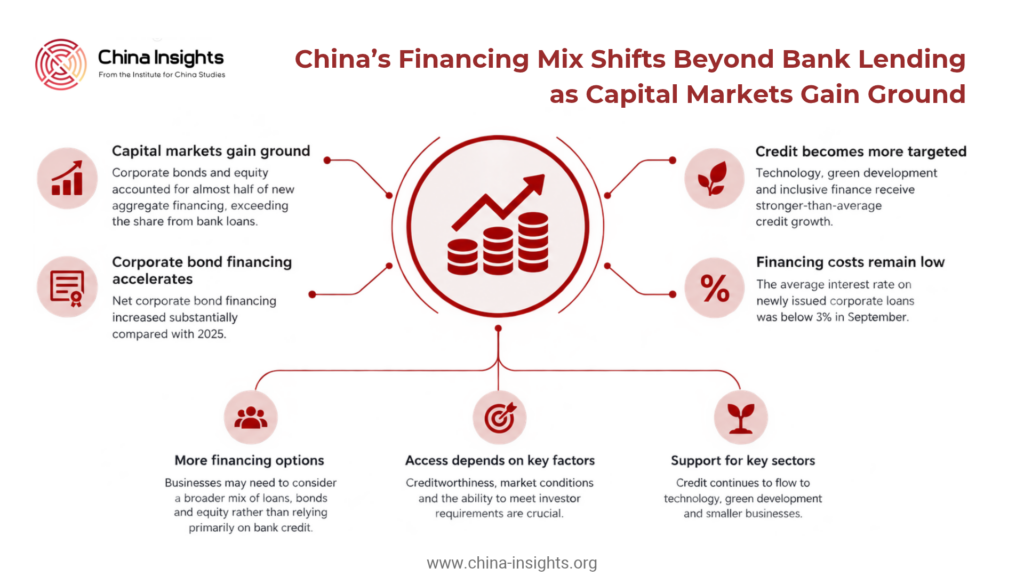
- Capital-market financing is gaining importance. Corporate bonds and equity accounted for almost half of new aggregate financing to the real economy during the first nine months, exceeding the share contributed by bank loans.
- Corporate bond financing has accelerated. Net corporate bond financing increased substantially compared with the same period in 2025.
- Credit allocation is becoming more targeted. Technology, green development and inclusive finance continue to receive stronger-than-average credit growth.
- Financing costs remain relatively low. The average interest rate on newly issued corporate loans was below 3% in September.
- Access to finance is becoming more differentiated. Businesses may need to consider a broader mix of loans, bonds and equity rather than relying primarily on bank credit.

Financing growth remains stable, but its composition is changing
At the end of September, outstanding aggregate financing to the real economy reached RMB 468.17 trillion, an increase of 7.1% year on year. Broad money supply (M2) grew by 7.2%. The figures indicate that overall financial conditions remain supportive, although aggregate growth alone does not reveal how effectively funds are reaching individual companies or sectors.
The more significant development is the changing mix of financing. During the first three quarters, net corporate bond financing reached RMB 2.75 trillion, while domestic equity financing by non-financial enterprises totaled RMB 535.9 billion. Bond and equity financing together represented almost half of the increase in aggregate financing, exceeding the contribution from bank loans.
This shift partly reflects changing demand across the economy. Credit demand from property-related activities and local-government financing platforms has weakened, while technology and other growth sectors are using a wider range of funding channels. The result is a financing system in which capital markets increasingly complement bank lending.
Bonds and equity offer alternatives to conventional credit
Corporate bond financing has become a more significant source of funding. Outstanding corporate bonds grew by 9.3% year on year at the end of September. The increase suggests that bond markets are playing a larger role in corporate funding, rather than serving only as a supplementary channel for a limited group of large issuers.
For businesses, bonds can provide access to longer-term funding and reduce dependence on bank credit. Equity financing can support expansion, research and development, or investment where companies prefer not to increase debt. These instruments are not interchangeable: bonds require repayment and interest servicing, while equity financing dilutes ownership and may involve greater disclosure and governance requirements.
The practical opportunity is therefore to match financing instruments to business needs and maturity. Companies with predictable cash flows may be better positioned to service debt, while businesses with high growth potential but uncertain near-term earnings may find equity more suitable. However, capital-market access is not automatic, and smaller or less-established companies may still depend heavily on bank lending.
Credit is increasingly directed towards strategic and underserved sectors
Bank lending continues to support corporate investment. Enterprise and institutional loans increased by RMB 12.55 trillion in the first nine months, including RMB 6.53 trillion in medium- and long-term lending. This provides funding for investment and operating activities, although the aggregate figures do not establish how much of the lending has translated into new productive capacity.
The composition of credit is also changing. Lending to technology, green development and inclusive-finance activities continued to grow faster than overall loans. At the end of September, outstanding loans to micro and small businesses under the inclusive-finance category reached RMB 38.50 trillion, while medium- and long-term loans to the service sector excluding real estate reached RMB 62.81 trillion. Both grew faster than total outstanding loans.
This pattern reflects the use of targeted monetary-policy instruments to steer financing towards designated priorities. For companies operating in technology, advanced manufacturing, green industries and eligible small-business segments, these conditions may improve access to credit. Nevertheless, policy priorities do not guarantee funding: lenders will continue to assess repayment capacity, collateral, business models and risk.

Low borrowing costs support investment, but do not guarantee demand
The average weighted interest rate on newly issued corporate loans was slightly below 3% in September, approximately 0.2 percentage points lower than a year earlier. The average rate on newly issued personal housing loans was around 3.1%, broadly unchanged year on year. Low rates reduce the cost of new borrowing and can ease debt-service burdens for eligible borrowers.
Policy coordination is also becoming more prominent. The Ministry of Finance, PBOC and National Financial Regulatory Administration issued the Notice on Implementing the Interest Subsidy Policy for Residential Mortgage Loans on 29 September 2026, extending fiscal interest support to eligible commercial mortgages for home purchases. Separately, the PBOC has adjusted structural monetary-policy tools to expand or strengthen support for selected activities, including technology enterprises and equipment renewal.
For businesses, the benefit will depend on whether lower financing costs translate into viable investment and stronger demand. Cheaper credit can improve project economics, but it cannot compensate for weak sales, excess capacity or poor cash flow. Companies should assess borrowing decisions against expected returns rather than interest rates alone.
What this means for business
- Broaden financing strategies. Assess bank loans, corporate bonds and equity against the company’s growth stage, cash flow and capital structure.
- Prepare for capital-market scrutiny. Companies considering bonds or equity should strengthen financial reporting, governance and investor communications.
- Check eligibility for targeted credit. Technology, green development and qualifying small businesses should review relevant financing programs with lenders.
- Use low interest rates selectively. Prioritize projects with credible demand, measurable returns and manageable repayment obligations.
- Monitor funding conditions beyond loan growth. Bond issuance, equity financing and aggregate social financing provide a fuller picture of financial conditions.
- Do not equate liquidity with commercial opportunity. The availability of funding does not remove underlying market, execution or credit risks.
Sources
https://www.gov.cn/zhengce/202610/content_7083269.htm
Author
Dr. Richard van Ostende

Related Articles