China’s 15th Five-Year Plan Links Consumption Growth with Trade and Investment
China’s Ministry of Commerce is setting out a broader commercial agenda for the 15th Five-Year Plan period (2026–2030). The priorities combine stronger domestic consumption with trade diversification, digital and services trade, and more targeted efforts to attract foreign investment. For businesses, the direction points to a market strategy that increasingly connects domestic demand, international expansion and investment in higher-value activities.
At a State Council Information Office press conference on 22 October 2026, Vice Minister of Commerce Jiang Chenghua and department officials outlined the ministry’s priorities for high-quality commercial development during the 15th Five-Year Plan. The announcements signal policy direction rather than a single new regulation. Their implementation will depend on subsequent measures, pilot programs and negotiations.
Executive summary
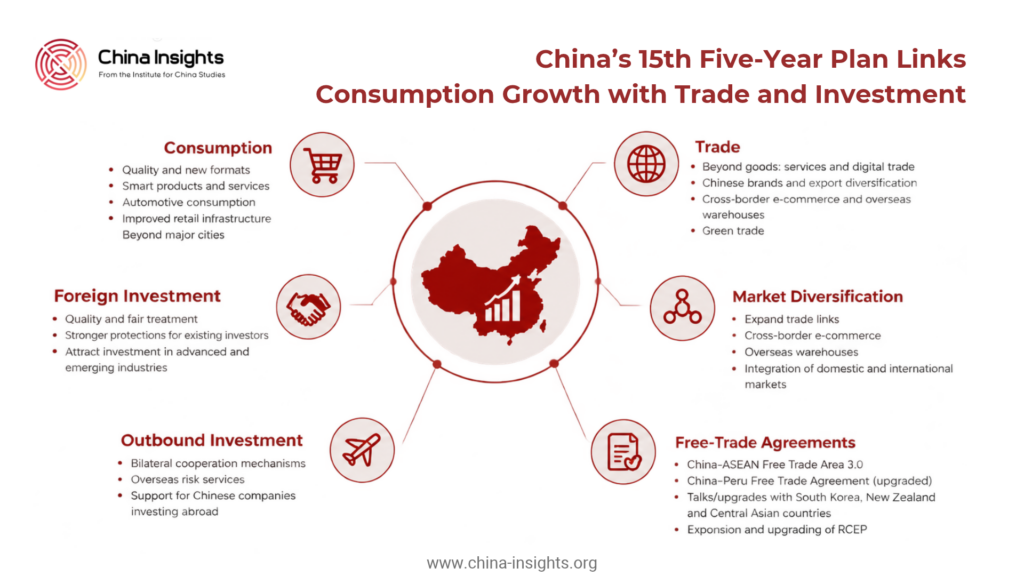
- Consumption policy moves towards quality and new formats. Priorities include smart products, services, automotive consumption and improved retail infrastructure beyond major cities.
- Trade policy broadens beyond goods. Services and digital trade are positioned alongside merchandise trade as core growth areas.
- Market diversification gains importance. China intends to expand trade links, cross-border e-commerce, overseas warehouses and integration between domestic and international markets.
- Foreign investment policy emphasizes quality and fair treatment. The government plans to strengthen protections for existing investors while attracting investment into advanced and emerging industries.
- Outbound investment support becomes more structured. Bilateral cooperation mechanisms and overseas risk services are intended to support Chinese companies investing abroad.

Consumption policy shifts towards quality, services and wider geographic reach
The Ministry of Commerce (MOFCOM) intends to stimulate consumption through better supply, new retail and service scenarios, and improved commercial infrastructure. Priorities include expanding automotive consumption across the value chain, promoting smart products, improving service consumption and upgrading commercial facilities in cities and counties.
The agenda also links domestic consumption with efforts to attract international shoppers. China plans to strengthen the “Shopping in China” brand and improve the shopping experience for foreign visitors. The expansion of tax-refund shopping facilities and increased departure-tax-refund sales indicate that inbound shopping is becoming a more visible part of consumption policy.
For consumer-facing companies, the opportunity is not limited to selling more products. Demand may also develop around service quality, smart consumer goods, retail experience and distribution beyond major urban centers. Businesses will need to distinguish policy priorities from actual demand in their target customer segments.
Trade policy places greater weight on services and digital exports
MOFCOM’s stated trade agenda treats merchandise, services and digital trade as three connected pillars. For goods, priorities include developing Chinese brands, diversifying export destinations and import sources, and improving links between domestic and international markets. Cross-border e-commerce, overseas warehouses and green trade are identified as areas for further development.
The services agenda places more emphasis on exports of research and development, design, testing and maintenance, as well as cultural and travel services. Digital trade priorities include digital services, cloud computing and international data services, alongside the overseas distribution of digital content.
This direction creates a broader set of potential opportunities for foreign firms. Demand may arise from partnerships with Chinese exporters, digital-service providers and companies seeking to internationalize their offerings. However, growth in digital and services trade will remain subject to relevant market-access rules, data regulations and requirements in destination markets.
Free-trade agreements are expected to cover more areas
China intends to advance negotiations and upgrades involving partners in Asia and other regions. Priorities include moving forward with the China–ASEAN Free Trade Area 3.0, the upgraded China–Peru Free Trade Agreement, and negotiations or upgrades involving South Korea, New Zealand and Central Asian countries. MOFCOM also aims to promote the expansion and upgrading of the Regional Comprehensive Economic Partnership (RCEP).
The proposed agenda extends beyond tariff reduction. China wants future trade arrangements to address areas such as the digital economy, green development and government procurement, alongside further liberalization of goods, services and investment.
For companies, this makes trade-agreement monitoring relevant to sourcing, market-entry and regional supply-chain decisions. The business impact will depend on the final terms, implementation dates and sector coverage of each agreement. Announced negotiations should not be treated as immediate changes in market access.

Foreign investment policy prioritizes retention, expansion and higher-value projects
China’s approach to inward investment combines support for existing foreign-invested enterprises with efforts to attract new projects. MOFCOM has pledged to implement national treatment for foreign-invested companies in areas including government procurement, tendering and standards development, while strengthening intellectual property protection and fair competition.
The ministry also plans to deepen opening-up pilots in selected services sectors, including cloud computing, biotechnology and wholly foreign-owned hospitals. It intends to implement a tax-credit policy for foreign investors who reinvest distributed profits directly in China, and to guide investment towards emerging and future industries through the Catalogue of Encouraged Industries for Foreign Investment.
The shift is towards improving the quality and composition of investment, not simply increasing its volume. Foreign companies already operating in China should monitor the implementation of equal-treatment commitments and reinvestment incentives. Potential entrants should assess the relevant sector rules and local implementation conditions before committing capital.
Outbound investment support combines cooperation and risk management
MOFCOM also intends to strengthen the support system for Chinese companies investing overseas. Priorities include bilateral investment cooperation mechanisms, sector-specific coordination in areas such as digital technology and green energy, and more comprehensive services for overseas projects and personnel.
The stated approach reflects a need to support international expansion while managing political, security and operational risks. For overseas partners, this may create opportunities to cooperate with Chinese firms seeking market access, local expertise, technology or project development capabilities. It also means that commercial partnerships should be evaluated against the wider regulatory and geopolitical context in both home and host markets.
What this means for business
- Track consumption opportunities by segment. Smart products, automotive-related services, service consumption and retail upgrades are policy priorities, but demand and profitability must be validated locally.
- Look beyond goods trade. Digital services, professional services and cultural exports feature more prominently in China’s international trade agenda.
- Review regional trade strategies. Monitor free-trade negotiations and upgrades, but rely on enacted provisions rather than announcements when making sourcing or investment decisions.
- Assess foreign-investment incentives carefully. Review sector-specific opening measures, reinvestment tax-credit eligibility and the implementation of national-treatment commitments.
- Consider partnerships with Chinese internationalizes. Their overseas expansion may create opportunities in distribution, services, technology and project support.
- Separate policy direction from implementation. Many priorities require follow-up measures, pilot arrangements or negotiated agreements before their commercial effects become clear.
Sources
https://www.gov.cn/zhengce/202610/content_7084058.htm
Author
Dr. Richard van Ostende

Related Articles