China Standardizes Ecosystem Value Accounting, Strengthening the Basis for Green Investment and Ecological Compensation
China is moving its Gross Ecosystem Product (GEP) accounting framework from experimental regional assessments towards a more consistent national methodology. The revised rules are intended to improve the comparability, reliability and practical application of ecosystem value measurements. This matters because GEP is increasingly being used to connect environmental protection with regional development, ecological compensation and the commercial use of natural resources.
The National Development and Reform Commission (NDRC), Ministry of Natural Resources and National Bureau of Statistics (NBS) jointly issued the GEP Accounting Standard (《生态产品总值核算规范》), document 发改环资〔2026〕1487号, on 14 October 2026. The NDRC published the document and its accompanying policy explanation on 4 November. The NBS provided further details on the revision in a Q&A published on 10 November 2026. The new standard replaces the 2022 trial version.
Executive Summary
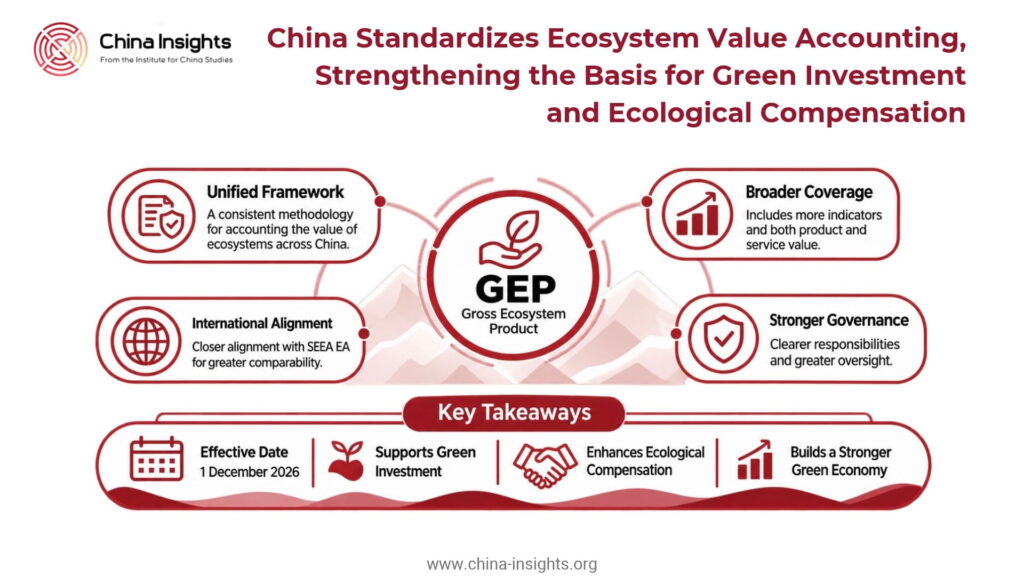
- A more consistent methodology: The revised standard reduces differences in regional calculations by clarifying statistical definitions, data sources and valuation methods.
- Closer alignment with international standards: The framework is brought into closer alignment with the UN System of Environmental-Economic Accounting – Ecosystem Accounting (SEEA EA).
- A broader accounting framework: It introduces a classification based on ecosystem products and services alongside the existing ecosystem-type approach.
- More reliable data: Authorities will establish a dedicated statistical system and periodic ecosystem product surveys to improve the quality and availability of underlying data.
- Greater policy application: GEP results are expected to inform regional planning, ecological compensation, green finance and the allocation of certain government transfers.
- A stronger basis for commercial valuation: More consistent ecosystem assessments could support the development of ecological products and services, although GEP figures should not be interpreted as market prices or directly realizable revenue.

From Regional Experiments to a More Standardized System
Since the trial methodology was introduced in 2022, more than 100 provincial, municipal and county-level jurisdictions have conducted GEP calculations. These exercises generated practical experience but exposed weaknesses. Data availability varied, calculation methods differed and regional results were often difficult to compare. This limited their usefulness for policy decisions and practical applications.
The revised standard addresses these issues by defining more consistent accounting concepts, statistical boundaries and data requirements. It also establishes clearer procedures for data collection, calculation, verification and reporting. The intention is to make GEP accounting a more regular and reliable part of public administration rather than an isolated assessment exercise.
For businesses, the change is relevant because regional environmental performance is becoming more measurable. More consistent data may help companies assess the environmental context of investment locations, understand local ecological priorities and engage with regional green development initiatives.
International Alignment Improves Comparability
A major change is the closer alignment with the UN’s System of Environmental-Economic Accounting – Ecosystem Accounting (SEEA EA), formally adopted as an international statistical standard in 2021 and published in 2024. The revised Chinese standard adopts concepts and accounting logic consistent with this framework, including the distinction between intermediate and final ecosystem products.
This distinction is important. It reduces the risk of counting the same ecological contribution more than once when calculating total value. The revised methodology also clarifies the treatment of ecosystem services and improves consistency across different categories of ecological products.
The framework now supports two complementary approaches: accounting by ecosystem product category and accounting by ecosystem type. This provides greater flexibility while retaining a common methodology. For international businesses and investors, alignment with an established international framework should make China’s ecosystem assessments easier to interpret and compare, although differences in national data and implementation will remain relevant.
Expanded Indicators and More Practical Valuation Methods
The revised standard changes the structure and scope of GEP accounting. It adds chapters organised around categories such as material supply, cultural services and regulating services. It also introduces additional indicators, including water supply and education and research services. Some existing categories have been redefined or consolidated to improve conceptual consistency.
The calculation methods for material supply and cultural services have also been simplified. Rather than requiring a separate physical quantity calculation before valuation, the revised framework allows value calculations to use relevant underlying economic data directly. For regulating services, the methodology more clearly applies the final-product principle.
These adjustments are intended to improve usability and reduce methodological differences between regions. They may also provide a more consistent basis for evaluating activities linked to ecological products, including nature-based tourism, water-related services and ecological restoration. However, GEP remains an accounting measure of ecosystem contributions, not a direct measure of commercial market value.
Data Governance Becomes Central to Implementation
The revised standard recognizes that consistent methodology alone cannot ensure reliable results. The NDRC, Ministry of Natural Resources and NBS will strengthen coordination across government departments and establish a dedicated GEP statistical system. This will clarify data sources, parameters, statistical definitions and reporting requirements.
Authorities will also improve existing environmental monitoring and statistical surveys. Periodic ecosystem product surveys are planned to address data gaps and support revisions to historical GEP calculations. Regional authorities are expected to supplement existing data where coverage is insufficient.
The standard also introduces stronger quality-control expectations. Calculation procedures must be traceable and verifiable, and results must be supported by reliable data. National authorities may assess the quality of regional calculations and correct irregularities. This is important for businesses using regional GEP figures in investment assessments, sustainability reporting or project proposals: the underlying methodology and data quality will matter as much as the headline valuation.

GEP Results Move Closer to Economic and Financial Decisions
The most consequential development is the explicit emphasis on applying GEP results. The revised standard identifies regional development planning, ecological compensation, ecological product development, green finance and audits of officials’ natural-resource management responsibilities as areas where the results should be used.
The standard also allows qualified regions to explore incorporating GEP results into evaluation systems. GEP calculations may serve as a reference for allocating central government transfer payments to key ecological function areas. This creates a stronger institutional link between ecological performance and public-sector resource allocation.
For businesses, this could influence regional investment priorities and the development of environmental services and ecological products. It may also create opportunities for companies involved in environmental monitoring, data services, ecological restoration and green finance. Actual commercial opportunities will depend on how local governments translate the accounting results into specific programs, financing arrangements and market mechanisms.
What This Means for Business
- Reassess regional investment conditions: More consistent GEP data may provide additional insight into the environmental priorities and ecological assets of potential investment locations.
- Monitor green finance developments: Track how financial institutions and local authorities use GEP results in financing decisions and environmental project assessments.
- Identify ecological service opportunities: Consider potential demand for environmental monitoring, ecological restoration, water management and nature-based services.
- Strengthen environmental data capabilities: Companies involved in green projects should maintain reliable data on resource use, environmental performance and project outcomes.
- Distinguish ecological value from commercial value: GEP is an accounting measure, not an automatic basis for revenue, asset valuation or investment returns.
- Follow regional implementation: The practical implications will depend on local data quality, government application and the development of supporting market mechanisms.
China’s revised GEP standard is an important step towards making ecosystem value more measurable and usable in economic governance. Its immediate impact is primarily institutional: improving the consistency of regional accounting and strengthening the basis for public decision-making. Over time, the wider application of GEP could influence ecological compensation, green finance and investment in environmental services. Businesses should monitor how these mechanisms develop at provincial and local levels.
Sources
Author
Dr. Richard van Ostende

Related Articles