China’s New Quality Productive Forces Agenda Shifts Towards Industrialization and Commercial Application
China is translating its ambition to develop new quality productive forces into a more coordinated program of technological upgrading and industrial transformation. Under the 15th Five-Year Plan (2026–2030), national sectoral plans increasingly connect critical technology development with manufacturing capabilities, enterprise-led innovation and commercial deployment.
The direction was outlined in Xinhua’s 28 October 2026 report, Moving Towards Innovation and Competing on Quality: Prospects for Developing New Quality Productive Forces under the 15th Five-Year Plan. It follows the Central Committee of the Communist Party of China and State Council’s Opinions on Developing New Quality Productive Forces, issued on 9 October 2026, and the rollout of sector-specific plans. The emerging framework places greater emphasis on converting technological capabilities into industrial competitiveness.
Executive summary
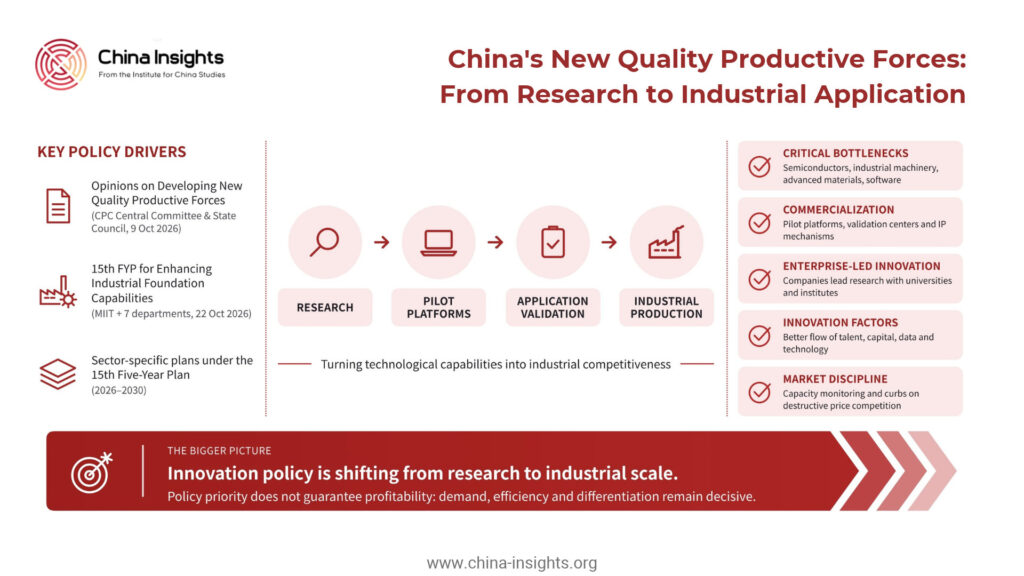
- Technology development is becoming more closely linked to industrial priorities. Policy targets critical bottlenecks in semiconductors, industrial machinery, advanced materials, software and other foundational technologies.
- Commercialization receives greater attention. Pilot platforms, application validation and intellectual property mechanisms are intended to accelerate the transition from research to production.
- Enterprises are expected to play a stronger innovation role. Policies encourage companies to lead research projects and cooperate with universities and research institutes.
- Access to innovation factors is a reform priority. Measures address the movement of talent, capital, data and technology between research institutions and businesses.
- Industrial policy also targets market discipline. Capacity planning, competition oversight and improved regulation are intended to support more sustainable development.

Industrial policy focuses on critical technology bottlenecks
The new policy framework places technological self-reliance and industrial capability at the center of productivity growth. The Ministry of Industry and Information Technology (MIIT) and seven other departments issued the 15th Five-Year Plan for Enhancing Industrial Foundation Capabilities on 22 October 2026. It targets weaknesses in foundational products, core technologies and industrial capabilities that underpin manufacturing competitiveness.
The plan combines efforts to close existing technology gaps with investment in emerging technologies. Priorities include integrated circuits, industrial machinery, advanced materials and other foundational components. The objective is to improve the domestic supply of critical industrial products while creating a stronger base for future innovation.
For businesses, this points to sustained policy attention and potential demand in selected technology-intensive sectors. It may also increase pressure on manufacturers to improve the quality, performance and domestic availability of key components. Foreign suppliers should assess both opportunities to participate in these supply chains and the implications of stronger domestic substitution efforts.
Commercialization becomes a central link between research and production
The Opinions on Developing New Quality Productive Forces, issued by the Central Committee of the Communist Party of China and the State Council on 9 October 2026, place technological innovation alongside industrial innovation. The policy calls for faster breakthroughs in core technologies and more effective conversion of research results into productive applications.
Sector-specific plans support this objective through pilot production platforms, application validation centers and mechanisms to improve the use of intellectual property. These measures address a recurring challenge: promising technologies may not reach industrial scale because they lack testing facilities, commercial partners or a clear path from prototype to production.
This approach creates opportunities for companies that can bridge research and deployment. Equipment providers, engineering firms, testing services and technology integrators may benefit where they can demonstrate industrial performance and commercial viability. For investors, the key consideration is whether a technology has progressed beyond laboratory results to repeatable production and paying customers.
Enterprises gain a stronger role in organizing innovation
The policy agenda seeks to make enterprises more central to research priorities, investment decisions and the commercial application of results. Sectoral plans encourage companies to lead or participate in national research projects and collaborate with universities, research institutes and other industrial partners.
This reflects an effort to reduce the distance between research objectives and market requirements. Businesses can help identify technical bottlenecks, validate products and direct research towards practical applications. Stronger collaboration may also improve the flow of knowledge between established manufacturers and emerging technology developers.
For companies operating in China, this creates a reason to review partnerships with research institutions and industry platforms. However, collaboration requires clear arrangements on intellectual property ownership, data access, funding, commercialization rights and the protection of proprietary technology.

Talent, finance and data are treated as industrial inputs
The new framework also targets the allocation of resources needed to turn innovation into productive capacity. Measures across sectoral plans seek to improve the movement of research personnel into enterprise projects, strengthen financing for technology companies and facilitate data sharing and technical cooperation.
The People’s Bank of China’s planning agenda includes developing financial mechanisms suited to technological innovation, while intellectual property policy addresses cooperation and information exchange. These initiatives aim to reduce barriers that can prevent promising research or technology from reaching industrial users.
For businesses, access to skilled personnel, patient capital and usable data may become as important as access to equipment. Companies should assess their ability to attract technical talent, finance development cycles and protect intellectual property when entering technology-intensive markets or establishing research partnerships in China.
Industrial upgrading is accompanied by stronger market discipline
The policy direction is not solely about expanding investment in emerging industries. It also addresses industrial capacity, market order and the risks of poorly coordinated development. The industrial foundation plan aims to improve the quality and competitiveness of foundational products, while sectoral policies call for capacity monitoring and measures against destructive price competition in selected industries.
This introduces a more selective dimension to industrial policy. Government support is intended to strengthen productive capabilities, but indiscriminate investment and the duplication of capacity are also recognized as risks. The broader guidance calls for development to reflect local conditions rather than pursuing new industries regardless of market demand.
Companies should therefore distinguish between policy priority and commercial attractiveness. A sector’s strategic importance does not guarantee profitability. Demand, production efficiency, technological differentiation and regulatory conditions remain decisive factors.
What this means for business
- Review technology exposure. Identify critical components, materials and software where domestic capability development could change supplier competition.
- Prioritize commercial validation. Assess whether technologies can move from research to reliable production at commercially viable costs.
- Develop targeted innovation partnerships. Cooperation with Chinese firms and research institutions may provide access to expertise and application environments, subject to clear intellectual property safeguards.
- Monitor financing and talent mechanisms. Changes in technology finance and researcher mobility may affect the feasibility of local research and development.
- Assess industrial policy alongside market fundamentals. Policy attention can create opportunities, but it does not guarantee demand or returns.
- Track sector-specific implementation. Detailed plans and subsequent measures will determine how broad objectives translate into funding, standards, procurement and market opportunities.
Sources
https://www.gov.cn/yaowen/liebiao/202610/content_7084427.htm
Author
Dr. Richard van Ostende

Related Articles