China Tightens Long-Term Energy Supply Contract Rules, Raising Compliance and Delivery Requirements
China is strengthening the regulatory framework governing long-term energy supply contracts as it seeks to improve supply security and manage risks across its energy system. The National Development and Reform Commission (NDRC) issued the Administrative Measures for Medium- and Long-Term Energy Supply Security Contracts (Trial) (国家发展改革委令2026年第50号) on 19 October 2026. The NDRC published its accompanying policy explanation on 23 October. The measures will take effect on 1 December 2026.
The new rules establish a unified framework for medium- and long-term supply security contracts covering thermal coal, electricity and natural gas. They clarify contractual responsibilities, strengthen performance supervision and introduce more explicit accountability for non-compliance. For energy producers, suppliers, buyers and infrastructure operators, the change increases the importance of formal contract management and reliable delivery.
Executive Summary
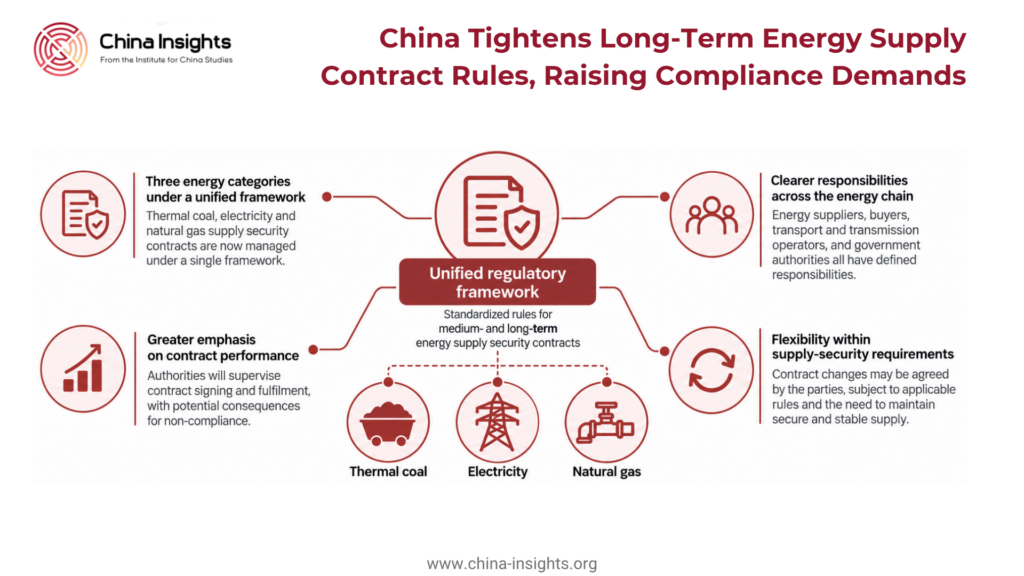
- Three energy categories now fall under a unified framework. The measures standardize the management of supply security contracts for thermal coal, electricity and natural gas while retaining category-specific requirements.
- Contract performance receives greater regulatory emphasis. Authorities will supervise contract signing and fulfilment, with potential consequences for parties that fail to meet their obligations.
- Commercial negotiation remains important but operates within supply-security requirements. Contract changes may be agreed by the parties, subject to the applicable rules and the need to maintain secure and stable supply.
- Government oversight extends beyond individual counterparties. Relevant authorities and energy transport or transmission operators have defined responsibilities in supporting contractual performance.
- Implementation begins on 1 December 2026. Companies should review their existing contracting, delivery and compliance arrangements ahead of the effective date.

A Unified Framework for Three Energy Markets
The most significant change is the consolidation of thermal coal, electricity and natural gas supply security contracts under a single regulatory framework. The NDRC’s six-chapter, 45-article Administrative Measures for Medium- and Long-Term Energy Supply Security Contracts (Trial) establishes common principles while setting category-specific rules for contract signing, performance, adjustment and supporting services.
The framework responds to the need for more stable and predictable relationships between energy suppliers and buyers. It also reflects the NDRC’s stated objective of improving coordination across energy production, storage, transportation and consumption. The rules do not eliminate differences between energy markets. Instead, they establish common governance principles while accounting for the distinct operating requirements of each energy source.
Contractual Responsibilities Become More Explicit
The measures clarify the respective responsibilities of energy suppliers, buyers, transport and transmission operators, and government authorities. Energy companies are expected to assume responsibility for secure and stable supply, while contracting parties must negotiate or trade on a market-oriented basis and conclude and perform contracts in accordance with applicable requirements.
The framework also strengthens the role of government supervision. The NDRC is responsible for national-level management, while relevant departments of local governments oversee implementation within their jurisdictions. Railway operators, power grid companies and natural gas pipeline operators are expected to provide the services needed to support contractual performance. This creates a clearer chain of responsibility across supply and delivery.
Contract Performance Moves Higher on the Compliance Agenda
The measures specify responsibilities relating to contract signing, required contract volumes, pricing mechanisms and fulfilment. They also establish potential consequences for failures to comply. Depending on the circumstances, authorities may require corrective action and issue warnings or public criticism. Serious cases affecting energy supply security may trigger further accountability under applicable laws and regulations.
Contract performance may also be reflected in corporate credit records and reports. The measures further provide that contract-signing and performance records may inform state-owned enterprise evaluations, the release of advanced coal production capacity, arrangements for interprovincial and interregional electricity transmission, and railway transport capacity allocation. These provisions make contract compliance relevant beyond the immediate commercial relationship.

Flexibility Is Retained Within Supply-Security Constraints
The new framework does not make long-term contracts entirely inflexible. It permits adjustments through agreement between the relevant parties, subject to the applicable requirements and the need to maintain secure and stable energy supply. The rules therefore seek to balance contractual certainty with the operational flexibility needed to respond to changes in supply and demand.
The detailed provisions differ by energy category. For electricity, the measures address contract periods, electricity delivery profiles and pricing arrangements, including encouragement of price-adjustment mechanisms linked to relevant market and cost factors. For natural gas, the rules address adjustment arrangements, balancing of contractual volumes and responsibilities for peak-demand management. The practical scope for flexibility will therefore depend on the energy category and the terms of the contract.
Implementation and Regulatory Oversight
The measures take effect on 1 December 2026. The NDRC has stated that it will work with relevant authorities, energy companies and trading centers to support implementation, monitor compliance and address problems arising during enforcement.
The regulation establishes the framework, but its operational impact will depend partly on implementation by local authorities and the relevant market participants. Companies should therefore distinguish between the general obligations set out in the measures and the category-specific rules applicable to their individual contracts and operations.
What This Means for Business
• Review existing contracts. Energy suppliers and buyers should assess whether their contract terms, delivery commitments and performance procedures align with the new framework before it takes effect.
• Strengthen performance monitoring. Companies should improve internal tracking of contracted volumes, delivery schedules, pricing provisions and outstanding obligations. Documentation of performance and agreed changes will become increasingly important.
• Assess supply-chain dependencies. Businesses reliant on coal, electricity or natural gas should review how contractual arrangements and delivery-service dependencies affect operational continuity, particularly where energy supply interruptions would have significant consequences.
• Build flexibility into contract design. Where commercially appropriate, parties should examine whether contract-adjustment mechanisms adequately address changes in demand, market conditions and operational requirements while remaining consistent with supply-security obligations.
• Include infrastructure and delivery responsibilities in risk assessments. Energy contracts depend on transport, transmission and pipeline services. Businesses should consider whether relevant service arrangements, responsibilities and escalation procedures are clearly defined.
• Monitor implementation and enforcement. Companies should follow further guidance from the NDRC and relevant local authorities, particularly where sector-specific requirements or local implementation practices affect their contractual obligations.
Overall, the measures strengthen the regulatory role of long-term energy supply contracts in China’s energy security system. For businesses, the immediate priority is to assess contractual exposure, improve performance controls and ensure that supply arrangements can meet both commercial requirements and the applicable regulatory obligations.
Sources
https://www.gov.cn/zhengce/202610/content_7084348.htm
Author
Dr. Richard van Ostende

Related Articles