
China Repositions Electronic Information Manufacturing Around AI, Resilience and Advanced Technology
China is raising the strategic importance of electronic information manufacturing under its 15th Five-Year Plan. On 10 September 2026, the Ministry of Industry and Information Technology (MIIT) and National Development and Reform Commission (NDRC) jointly issued the Electronic Information Manufacturing Industry Development 15th Five-Year Plan. MIIT published the official policy interpretation on 15 September 2026.
The new plan moves the sector beyond its traditional role as a large-scale manufacturing base. It places greater emphasis on artificial intelligence, advanced computing, core components, energy electronics, intelligent terminals and the integration of hardware, software and standards. Supply-chain resilience and international cooperation are also given greater weight.
Executive summary
- China is shifting electronic information manufacturing from scale expansion toward technology-led industrial upgrading.
- Artificial intelligence is becoming a central driver of demand for chips, computing infrastructure, intelligent terminals and supporting hardware.
- Supply-chain resilience is being strengthened across semiconductors, electronic components, materials, equipment and advanced computing.
- Hardware and software integration is receiving greater policy attention, including standards and intellectual property.
- Energy electronics, spatial information and AI hardware are identified as important new growth areas.
- Foreign-invested enterprises are explicitly included in the plan’s commitment to improving industrial openness and implementing national treatment.
AI changes the structure of industrial priorities
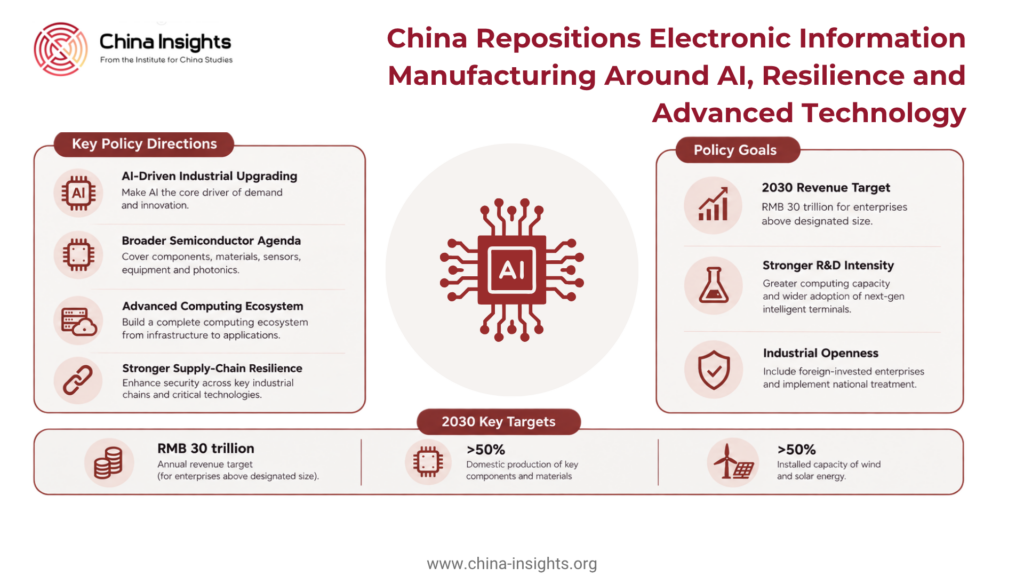
The most important change is the position given to artificial intelligence. The plan calls for China to strengthen the hardware foundation for AI and accelerate innovation across the electronic information manufacturing value chain. AI is therefore treated not only as an application market but as a driver of demand for chips, advanced computing, sensors and intelligent terminals.
The plan sets a 2030 target for annual revenue of above RMB 30 trillion for enterprises above designated size in the sector. It also targets stronger R&D intensity, greater computing capacity and wider adoption of next-generation intelligent terminals. These targets indicate that future industrial support will increasingly be linked to technological capability and productivity rather than production volume alone.
The semiconductor agenda becomes broader
The policy does not limit strategic technology development to integrated circuits. It calls for improvements across the wider industrial foundation, including electronic components, electronic materials, intelligent sensors, specialized electronic equipment, measurement instruments and photonics.
This broader approach matters because semiconductor competitiveness depends on a much larger industrial ecosystem. Equipment, materials, components and testing capabilities are increasingly treated as part of industrial security. For suppliers, this expands the relevant market beyond chip manufacturing and creates opportunities in upstream technologies and specialized industrial equipment.
Advanced computing becomes an industrial ecosystem
The plan gives advanced computing a dedicated development priority. The objective is to strengthen the computing ecosystem rather than focus solely on individual hardware products. This includes closer integration between computing infrastructure, electronic systems and emerging AI applications.
The direction is consistent with the wider national push to expand computing capacity and improve its allocation across regions. For manufacturers, this increases the importance of performance, energy efficiency and compatibility with China’s evolving computing infrastructure. For technology suppliers, demand is likely to extend across processors, servers, storage, networking and supporting components.
Supply-chain resilience moves deeper into the industrial base
Supply-chain security is another major policy priority. The plan calls for stronger resilience in key industrial chains and for technological breakthroughs in areas where China identifies strategic weaknesses. The emphasis covers both core technologies and the industrial capabilities needed to manufacture them.
This represents a broader approach than simply increasing domestic production. The policy links resilience with innovation and the development of competitive technologies and products. Companies operating in strategically important parts of the electronics value chain should therefore expect continued attention to localization, technology capability and supplier security.
New growth areas receive dedicated policy support
The plan identifies several areas as potential sources of new growth. These include energy electronics, spatial information technologies, AI chips and intelligent terminals, alongside digital and intelligent applications across industries.
Energy electronics is particularly relevant to the wider industrial transition because electronic components and systems are increasingly integrated into power generation, storage, transmission and consumption. Spatial information technologies also receive greater attention, reflecting the growing industrial role of satellite-based and positioning technologies.
Hardware and software become more closely integrated
The plan places greater emphasis on cooperation between hardware, software, standards and intellectual property. This is an important change for an industry historically organized around manufacturing segments and individual product categories. The policy seeks a more integrated industrial ecosystem in which hardware development is increasingly linked to software and standards.
For businesses, this can affect technology partnerships, product development and market access. Competitiveness will increasingly depend on interoperability and ecosystem participation. Companies supplying individual components may therefore need to consider their position within broader technology platforms.
Openness remains part of the industrial strategy
Despite the stronger emphasis on resilience and strategic technologies, the plan also calls for continued industrial opening and international cooperation. The policy interpretation specifically refers to implementing national treatment for foreign-invested enterprises and improving the framework for international cooperation.
This creates a mixed operating environment for international companies. China is seeking greater control over critical capabilities while continuing to attract investment and technology cooperation. Market opportunities therefore remain, but companies will need to distinguish between commercially open segments and areas subject to stronger strategic policy priorities.
What this means for business
- Technology suppliers: Opportunities are expanding across AI hardware, advanced computing, sensors, photonics, electronic materials and specialized equipment.
- Semiconductor companies: Competitive positioning increasingly depends on the wider supply chain rather than chip technology alone.
- Foreign investors: China continues to signal openness to foreign-invested enterprises, while strategic technology segments will receive stronger domestic policy support.
- Product strategy: Hardware-software integration, standards and ecosystem compatibility are becoming more important to market positioning.
- Supply-chain planning: Companies should assess exposure across critical components, materials, equipment and technology dependencies.
- Investment priorities: AI, advanced computing, energy electronics and intelligent terminals are positioned as important areas of industrial development through 2030.
Sources
- https://jxt.hubei.gov.cn/bmdt/rdjj/202609/t20260915_6013920.shtml
- https://policy.mofcom.gov.cn/claw/clawContent.shtml?id=106836
Author
Dr. Richard van Ostende

Related Articles