
China Raises the Innovation and Resilience Bar for Its Pharmaceutical Industry
China has raised the strategic position of the pharmaceutical industry under its 15th Five-Year Plan. On 18 September 2026, the Ministry of Industry and Information Technology (MIIT), together with nine other ministries and agencies, published the Pharmaceutical Industry Development 15th Five-Year Plan. The document, issued under MIIT document No. 工信部联规〔2026〕210号, was dated 28 August 2026. It sets the policy direction for the sector through 2030.
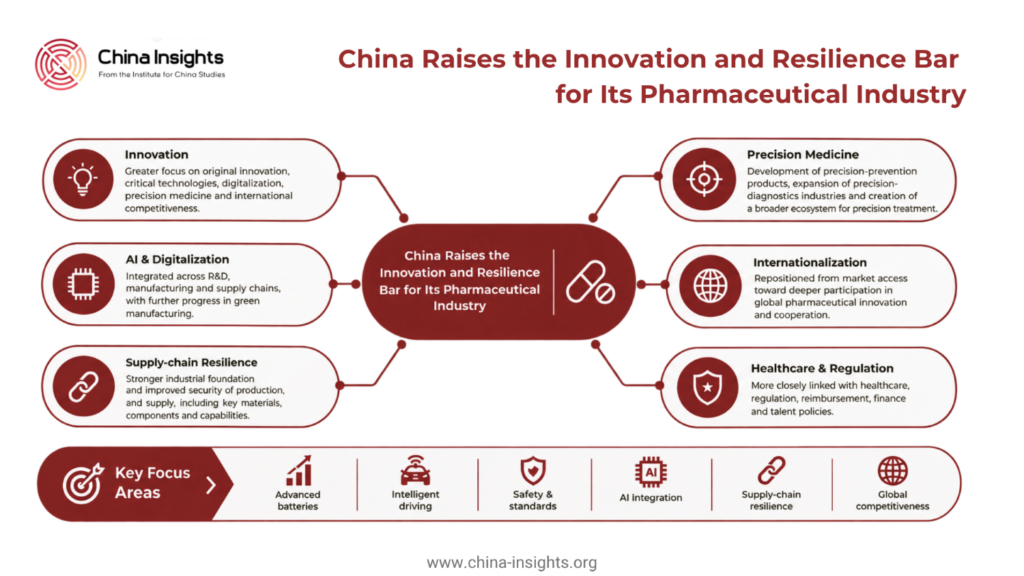
The new plan moves beyond expanding pharmaceutical production. It places greater emphasis on original innovation, critical technologies, digitalization, precision medicine, supply-chain resilience and international competitiveness. It also links industrial policy more closely with healthcare, regulation, reimbursement, finance and talent policies.
Executive summary
- China is shifting pharmaceutical industrial policy from capacity development toward innovation, productivity and strategic resilience.
- Innovative drugs and medical devices receive greater policy priority, with stronger emphasis on original technologies and first-in-class products.
- Artificial intelligence and digital technologies are being integrated across pharmaceutical R&D, manufacturing and supply chains.
- Supply-chain security is being broadened to include pharmaceutical materials, equipment, components and production capabilities.
- Precision prevention, diagnosis and treatment are becoming distinct areas of industrial development.
- Internationalization is being repositioned from market access toward deeper participation in global pharmaceutical innovation and cooperation.
Innovation becomes the primary growth engine
The central change is the stronger focus on innovation as the driver of pharmaceutical industrial development. The plan calls for greater original innovation and faster development of innovative drugs and medical devices. It also identifies frontier technologies and products as areas for further industrial investment.
The targets reflect this shift. By 2030, China expects innovative drug industry growth to average more than 20% annually. It also aims for first-in-class drugs to account for at least 25% of the global total and for innovative medical device approvals to exceed 200. These are policy targets rather than guaranteed market outcomes, but they indicate where government support and industrial resources are likely to be concentrated.
AI and digitalization move into the production system
Digital transformation is no longer treated as a supporting activity. The plan establishes digital and intelligent transformation as one of its eight major task areas. It calls for deeper application of artificial intelligence and digital technologies across the pharmaceutical value chain, together with further progress in green manufacturing.
This expands the addressable market for technology providers. Demand is likely to extend beyond laboratory applications into manufacturing, quality management, supply-chain coordination and production efficiency. For pharmaceutical companies, digital capability is increasingly linked to industrial competitiveness rather than simply operational improvement.
Supply-chain resilience becomes an industrial priority
The new plan also strengthens the resilience dimension of pharmaceutical policy. It calls for a stronger industrial foundation and improved security of production and supply. The policy framework includes pharmaceutical materials, auxiliary materials, reagents, consumables, medical-device materials and core components as areas where domestic capabilities have been strengthened and further development is required.
The implication is a broader definition of pharmaceutical security. It is not limited to finished medicines. Manufacturing inputs and industrial capabilities are also part of the strategic supply chain. This may encourage further investment in domestic production capacity and qualified suppliers for critical pharmaceutical and medical-device inputs.
Precision medicine creates new industrial segments
Another change is the explicit industrialization of precision prevention, diagnosis and treatment. The plan calls for development of precision-prevention products, expansion of precision-diagnostics industries and creation of a broader ecosystem for precision treatment.
This connects pharmaceutical industrial policy more closely with diagnostics, medical devices and data-driven healthcare. The distinction between pharmaceutical manufacturing and other healthcare technology segments is therefore becoming less pronounced. Companies operating across these interfaces may find greater scope for integrated R&D and commercial models.
Faster translation from research to commercial production
The plan also addresses a persistent industrial bottleneck: converting scientific and clinical innovation into scalable products. It calls for more efficient clinical translation, improved engineering and scale-up capabilities, and stronger coordination across the industrial ecosystem.
This indicates a policy focus not only on discovery but also on industrialization. Contract development and manufacturing capabilities, engineering services, specialized equipment and technology platforms may therefore become increasingly important parts of China’s pharmaceutical innovation ecosystem.
Internationalization becomes more strategic
The plan gives international cooperation a separate policy pillar. The objective is to strengthen industrial competitiveness, raise the level of international cooperation and improve the attractiveness of China’s pharmaceutical industry. It also aims to deepen China’s participation in global pharmaceutical innovation networks.
This represents a broader approach than simply increasing pharmaceutical exports. International cooperation is increasingly linked to innovation, industrial capabilities and integration into global R&D networks. For multinational companies, China therefore remains relevant not only as a sales market but also as a potential location for R&D, manufacturing and technology cooperation.
Policy coordination becomes more important
Implementation will involve closer coordination between industrial policy and other parts of the healthcare system. MIIT states that implementation will coordinate industrial, technology, regulatory, healthcare, medical insurance, financial and talent policies. The plan also calls for improvements to review and approval mechanisms and policies covering pricing, reimbursement and product use.
For businesses, this means that pharmaceutical strategy in China cannot be assessed solely through the industrial-policy lens. Regulatory approval, reimbursement, clinical adoption and manufacturing policy are increasingly interconnected. Companies will need to consider these interfaces when evaluating investments and product strategies.
What this means for business
- R&D investment: Innovation, first-in-class products and frontier technologies are moving further toward the center of China’s pharmaceutical industrial strategy.
- Technology providers: AI, digital manufacturing, diagnostics and advanced production technologies should benefit from the broader digitalization agenda.
- Supply chains: Critical pharmaceutical inputs and manufacturing capabilities will receive continued policy attention, increasing the importance of local supply-chain resilience.
- Market access: Regulatory approval, reimbursement and clinical adoption will need to be assessed together rather than as separate market-entry issues.
- Partnerships: Collaboration with Chinese pharmaceutical, biotechnology and technology companies may become more relevant across R&D, manufacturing and commercialization.
- International operations: China is positioning its pharmaceutical industry for deeper integration into global innovation networks, creating opportunities alongside increased competitive pressure.
Sources
https://policy.mofcom.gov.cn/claw/clawContent.shtml?id=106836
Author
Dr. Richard van Ostende

Related Articles