
China Strengthens National Coordination of Its Computing Power Network
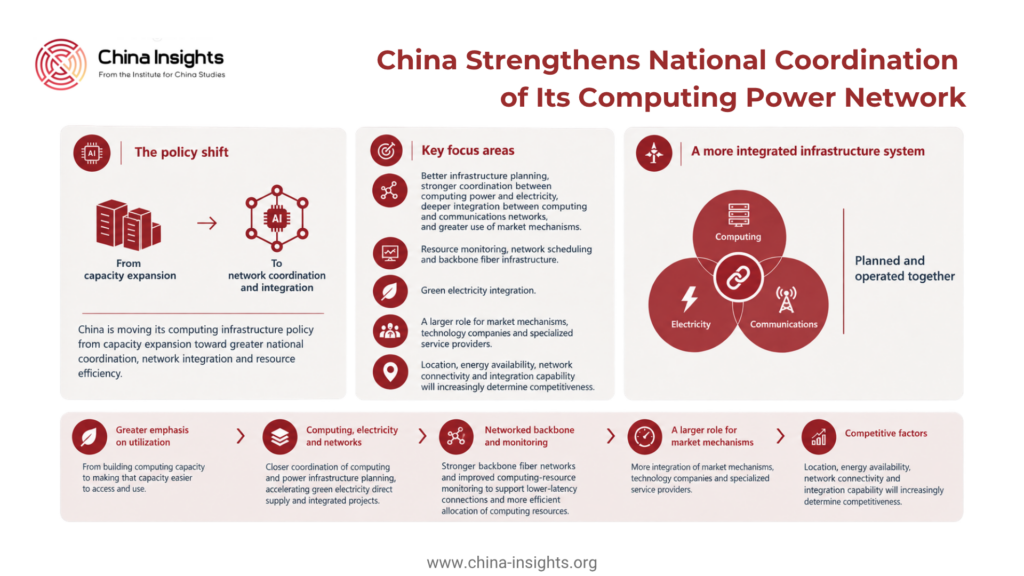
China is moving its computing infrastructure policy from capacity expansion toward greater national coordination, network integration and resource efficiency. On 11 September 2026, the State Council Executive Meeting, chaired by Premier Li Qiang, reviewed work on the development of the national computing power network. The meeting called for better infrastructure planning, stronger coordination between computing power and electricity, deeper integration between computing and communications networks, and greater use of market mechanisms.
The decision comes as computing power becomes a critical infrastructure layer for artificial intelligence and the wider digital economy. It also reinforces the direction established during the opening year of the 15th Five-Year Plan, under which computing power networks have been elevated alongside other major national infrastructure networks.
Executive summary
- The State Council is shifting the focus of computing infrastructure from capacity growth toward coordinated national deployment and utilization.
- Computing, electricity and communications infrastructure will be planned and operated more closely together.
- Resource monitoring, network scheduling and backbone fiber infrastructure are becoming more important as computing demand becomes geographically distributed.
- Green electricity integration is moving closer to the center of data-center and computing infrastructure planning.
- The government is signaling a larger role for market mechanisms, technology companies and specialized service providers.
- For investors and technology companies, location, energy availability, network connectivity and integration capability will increasingly determine competitiveness.
From capacity expansion to network coordination
The main policy change is a stronger emphasis on networked computing rather than standalone computing facilities. China has already established a national spatial framework centered on eight national computing hubs, ten national computing clusters and three computing-power-and-electricity coordination areas. The latest State Council meeting indicates that the next stage will focus on improving how these resources operate as an integrated system.
This represents an important shift for infrastructure developers. Capacity alone will become less decisive if resources cannot be efficiently connected, monitored and allocated. The policy direction favors a multi-level system linking national hubs, regional resources and edge computing capacity, supported by stronger data and network infrastructure.
Computing, electricity and networks become a single planning issue
The meeting places greater emphasis on the interaction between computing infrastructure and electricity supply. It calls for closer coordination of computing and power infrastructure planning, while accelerating green electricity direct supply and integrated projects based on source-grid-load-storage systems.
This is commercially relevant because electricity is becoming a strategic constraint on large-scale AI infrastructure. The integration of computing and energy planning could influence where future data-center capacity is developed, particularly in regions with abundant renewable electricity. It also creates opportunities for companies providing power-management, energy-storage, green-energy and data-center optimization technologies.
The same principle applies to communications infrastructure. Stronger backbone fiber networks and improved computing-resource monitoring are intended to support lower-latency connections and more efficient allocation of computing resources across regions. The result should be a closer integration of computing, telecommunications and energy infrastructure.
Greater emphasis on utilization and resource allocation
China’s policy direction is also moving from building computing capacity to making that capacity easier to access and use. Earlier national initiatives already called for improved interconnection, cross-regional scheduling and more flexible computing services. The September meeting reinforces this direction by calling for stronger monitoring and scheduling of computing resources and better matching of supply and demand.
This could gradually change the commercial model of the sector. Instead of competing primarily through installed capacity, operators may increasingly compete through availability, connectivity, flexibility, service quality and cost. Platforms capable of aggregating heterogeneous computing resources could therefore become more important as the market develops.
Market mechanisms gain a clearer role
The State Council also called for greater use of market mechanisms and encouraged enterprises to undertake technological innovation, resource integration and application development.
This suggests that the next stage of China’s computing infrastructure build-out will not rely exclusively on direct infrastructure investment. Commercial operators, technology companies, telecom providers, energy companies and specialized computing-service providers are expected to play a larger role in connecting supply with demand.
The direction is consistent with recent efforts by the National Development and Reform Commission to establish coordination mechanisms linking power-grid companies, telecom operators and computing-related enterprises. In August 2026, the NDRC established a “2+3+N” coordination mechanism covering two major power-grid companies, three telecom operators and computing-related enterprises.
Implications for investment and technology suppliers
The policy direction creates a broader market than traditional data-center construction. Demand is likely to extend across high-performance computing equipment, networking, optical communications, energy systems, storage, cooling, computing-resource management and green-energy integration.
At the same time, infrastructure projects are likely to face greater requirements for coordination with national and regional planning. Location decisions will increasingly need to consider electricity availability, network connectivity, computing demand, industrial ecosystems and integration with national computing hubs rather than simply land and construction costs.
What this means for business
- Data-center investment: Project selection will increasingly depend on alignment with national and regional computing-network planning.
- Energy strategy: Access to reliable and increasingly green electricity will become a more important competitive factor for computing infrastructure.
- Technology suppliers: Opportunities will extend from servers and chips to networking, energy management, cooling, storage and computing-resource orchestration.
- Digital services: Companies able to aggregate and efficiently allocate heterogeneous computing resources may benefit from the shift toward networked computing.
- Market entry: Foreign technology providers should assess how their products fit China’s evolving computing, communications, energy and data infrastructure ecosystem.
- Infrastructure partnerships: Cross-sector cooperation between computing, telecom and energy companies is likely to become increasingly important.
Sources
https://www.gov.cn/zhengce/202609/content_7080805.htm
Author
Dr. Richard van Ostende

Related Articles