
China Moves Digital Rural Development from Connectivity to Integrated Transformation
China is broadening its digital rural development agenda from infrastructure access to the digital transformation of agriculture, rural industries, public services and governance. On 11 September 2026, the Cyberspace Administration of China (CAC), Ministry of Agriculture and Rural Affairs (MARA) and Ministry of Industry and Information Technology (MIIT) jointly issued the Digital Rural High-Quality Development Action Plan (2026–2030). The plan provides the implementation framework for digital rural development during the 15th Five-Year Plan period.
The change is significant for technology providers, agricultural companies and infrastructure investors. Rural digitalization is no longer treated primarily as a connectivity program. The new framework links digital infrastructure with agricultural productivity, logistics, data resources, AI, rural consumption, healthcare, education and governance.
Executive summary
- China is moving from closing the rural digital divide toward deeper digital transformation of the rural economy.
- AI, data, sensors, robotics and intelligent agricultural equipment are becoming explicit technology priorities.
- Rural digital infrastructure is being expanded beyond broadband to include satellite connectivity, smart grids, digital logistics and low-altitude applications.
- Agricultural and rural data are being positioned as strategic resources, with greater emphasis on data platforms, high-quality datasets and trusted data spaces.
- The policy creates a broader role for technology companies and agricultural enterprises in developing digital rural applications.
- Data security, personal information protection and the security of rural digital infrastructure are becoming integral to market participation.
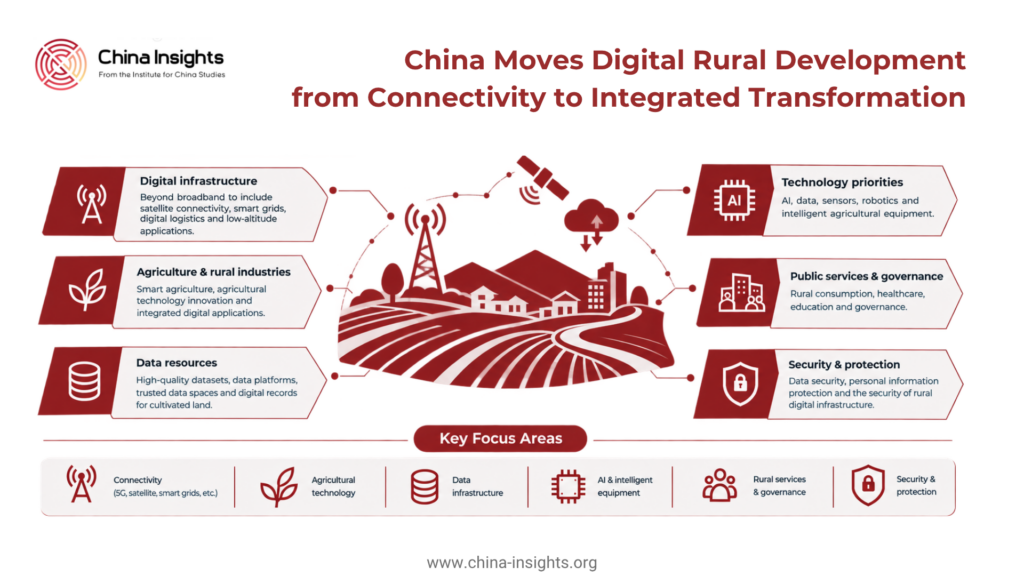
From connectivity to digital transformation
The most important change is the broader definition of what constitutes a digital village. During the 14th Five-Year Plan period, policy efforts focused strongly on connectivity and reducing the urban-rural digital divide. The new plan retains infrastructure development but places greater weight on how digital technologies improve productivity, services and governance.
The plan sets eight measurable development indicators for 2030. These cover not only rural internet penetration but also agricultural technology progress, rural e-commerce, logistics infrastructure, smart governance, digital healthcare, rural cultural services and digital skills. This indicates a shift from measuring digital access toward measuring the economic and social outcomes generated by digitalization.
Agriculture becomes a major digital technology market
The plan gives greater policy weight to smart agriculture and agricultural technology innovation. It calls for deeper integration of digital technologies with agricultural production and identifies agricultural sensors, specialized chips, core algorithms, robots and intelligent breeding tools as areas requiring technological breakthroughs. It also supports intelligent agricultural machinery and unmanned farming trials.
This creates a more defined market opportunity for suppliers of agricultural technology. The emphasis is not simply on deploying existing digital tools. The policy also calls for integrated innovation covering basic research, applied research, development and manufacturing. This could support domestic technology development while creating demand for specialized equipment and software.
Rural data becomes strategic infrastructure
A second important shift is the stronger focus on agricultural and rural data. The action plan calls for improving the national agricultural and rural big-data system, developing high-quality datasets and establishing mechanisms for developing and using public agricultural data. It also proposes trusted data spaces and digital records for cultivated land.
For businesses, this means data management will become increasingly relevant to participation in rural digitalization projects. Agricultural companies are encouraged to strengthen their own data capabilities, while the policy also promotes data-management standards. The commercial value will increasingly depend on the ability to integrate operational data across production, logistics, sales and public services.
Infrastructure expands beyond telecommunications
The new framework also broadens the infrastructure agenda. Rural 5G and gigabit networks remain priorities, but the plan additionally supports high-throughput satellite and low-orbit satellite internet for remote areas. It also promotes digitalization of rural power networks, smart cold-chain logistics, integrated rural delivery services and selected low-altitude logistics applications.
This creates a wider infrastructure market. Digital rural development will increasingly require coordination between telecommunications, energy, logistics, agriculture and transport systems. Suppliers with cross-sector capabilities may therefore be better positioned than providers offering isolated digital products.
A larger role for private-sector participation
The plan explicitly calls for greater participation by technology companies and agricultural enterprises. It encourages companies to develop and deploy solutions in smart agriculture, rural e-commerce, cultural and tourism integration and information services. It also supports digital upgrading across agricultural supply chains and the development of open application scenarios.
The approach is consistent with the Action Plan for Promoting High-Quality Development of Internet Information Enterprises (2026–2030) issued by the Central Cyberspace Affairs Commission on 21 August 2026. That plan specifically identifies digital rural development as an area where internet information companies can contribute technology, products and services.
Security becomes part of the digital rural market
The expansion of digital infrastructure and data use also increases regulatory requirements. The action plan calls for stronger cybersecurity protection, improved security management of rural digital infrastructure, and stricter management of data collection, storage and use. Personal information and important agricultural data are specifically included in the security framework.
For technology providers, compliance will therefore become part of product and project design. Solutions that handle agricultural, land, logistics or personal data will need to address security and data-governance requirements from the outset.
What this means for business
- Agricultural technology: Demand is likely to expand for AI, sensors, robotics, intelligent machinery and digital farming solutions.
- Data services: High-quality agricultural datasets, data management and trusted data environments are becoming strategic capabilities.
- Infrastructure: Opportunities extend beyond telecoms into energy, logistics, cold chain, satellite connectivity and rural digital services.
- Market entry: Foreign technology providers should assess local application requirements and partnerships with agricultural and technology companies.
- Integrated solutions: Cross-sector platforms connecting production, logistics, data and services may have stronger market potential than standalone products.
- Compliance: Cybersecurity, data governance and personal information protection should be incorporated into rural digital projects from the design stage.
Sources
https://www.gov.cn/zhengce/202609/content_7080847.htm
Author
Dr. Richard van Ostende

Related Articles