
China Tightens NEV Market Governance as Product Safety Moves Higher Up the Agenda
China is tightening governance of the new energy vehicle (NEV) industry as rapid technological change, intense competition and increasingly complex vehicle systems create new safety and quality risks. The policy direction is shifting from supporting rapid market expansion toward stronger control over product development, testing, market entry and production consistency.
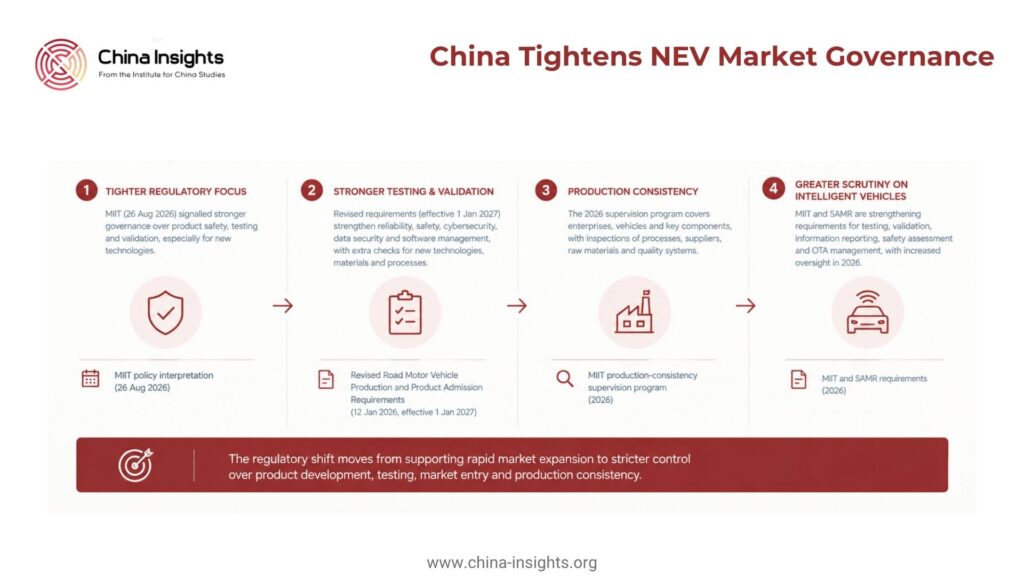
The Ministry of Industry and Information Technology (MIIT) outlined the direction on 26 August 2026 in its policy interpretation, “MIIT: Improve New Energy Vehicle Industry Governance and Strictly Prohibit Products Without Sufficient Testing and Validation from Entering the Market”. The announcement signals a stronger regulatory focus on product safety, testing and validation, particularly for vehicles incorporating rapidly developing technologies.
Executive summary
- China is moving toward stricter pre-market validation of NEV products and new technologies.
- Product innovation will increasingly be assessed against safety, reliability and production-consistency requirements.
- Regulatory attention is extending beyond vehicle approval to design, development, manufacturing and market performance.
- Intelligent driving and other technology-intensive functions face greater scrutiny.
- Manufacturers will carry greater responsibility for identifying and managing product risks before commercialization.
- The direction could increase development costs but also favor companies with stronger engineering, testing and quality-management capabilities.
From rapid innovation to controlled innovation
The central change is the regulatory response to what MIIT describes as rapid innovation in the automotive industry. Companies are being pushed to balance speed of product development with sufficient testing and validation. Products and technologies that have not been adequately verified should not be brought to market.
This represents a change in the regulatory emphasis. Earlier industry policy placed considerable weight on expanding NEV production, encouraging technological innovation and supporting market growth. The current approach places greater weight on whether innovation can be demonstrated to be safe, reliable and suitable for mass-market deployment.
Testing becomes a stronger market-entry requirement
MIIT is strengthening requirements for testing and validation of vehicle products and new technologies. This is particularly relevant where new designs, materials, software or intelligent functions introduce risks that may not be adequately addressed by existing testing procedures.
The direction is already reflected in the revised Road Motor Vehicle Production Enterprise Admission Review Requirements and Road Motor Vehicle Product Admission Review Requirements, issued by MIIT on 12 January 2026 and effective from 1 January 2027. The revised requirements strengthen reliability testing, safety requirements for key components, cybersecurity, data security and software-upgrade management. They also introduce additional evaluation and testing requirements for products using new technologies, materials and processes.
Production consistency is moving higher up the agenda
The regulatory focus is also shifting from whether a vehicle passes approval to whether mass-produced vehicles continue to match the approved product. MIIT’s 2026 production-consistency supervision program covers enterprises, vehicles and key components. Inspections include production processes, suppliers, raw materials, manufacturing equipment and quality-management systems.
Products are also being sampled for testing against national standards and production-consistency requirements. Companies that fail to maintain the required conditions can face measures including public notification, suspension of relevant product announcements and suspension of applications for new products.
This makes manufacturing controls and supplier management more important. Product approval can no longer be treated as the end of the compliance process.
Intelligent vehicles face greater scrutiny
Intelligent driving is a particular regulatory focus because software and advanced driver-assistance functions can introduce risks that evolve after a vehicle has entered production. MIIT and the State Administration for Market Regulation previously strengthened requirements for intelligent connected vehicles, including testing, validation, technical information reporting, safety assessment and software OTA management.
The direction has become more operational in 2026. In July, MIIT instructed vehicle manufacturers to strengthen testing and validation of innovative designs, assess safety risks before introducing new technologies and improve safeguards covering functional safety, expected functional safety, cybersecurity, data security and software upgrades. (
Regulatory enforcement is becoming more visible
The policy direction is being supported by more active supervision. In July, MIIT conducted on-site inspections at several major vehicle manufacturers, examining intelligent-connected vehicle safety capabilities, design and development capabilities, production consistency and compliance of sampled vehicles and power batteries.
The broader governance objective is also linked to efforts to address disorderly competition in the NEV market. In March, MIIT, the National Development and Reform Commission and the State Administration for Market Regulation announced measures to strengthen industry competition, product quality and safety, while improving market governance and accelerating work on the regulatory system for vehicle production access.
Business impact: higher barriers but greater predictability
The immediate effect will be higher compliance requirements for manufacturers and technology suppliers. Companies will need stronger evidence that products are adequately tested before commercial launch. Development processes will increasingly need to integrate regulatory validation rather than treating testing as a final-stage exercise.
At the same time, stricter enforcement may reduce some of the risks associated with rapid, low-cost product launches. Companies with established engineering, testing, supplier-management and quality-control capabilities may benefit as regulatory requirements become more demanding.
What this means for business
- Product development timelines may lengthen: Testing and validation will become more important before market launch.
- Engineering evidence will matter more: Companies should maintain documented validation of safety, reliability and new technology applications.
- Supplier controls need strengthening: Production consistency requirements extend into key components and supplier management.
- Software requires continuous governance: OTA upgrades, intelligent-driving functions, cybersecurity and data security are increasingly part of product compliance.
- Quality capability becomes a competitive factor: Strong testing and manufacturing systems may become more important to market access.
- Regulatory risk should be assessed earlier: Companies should integrate Chinese approval and testing requirements into product-development and investment decisions from the beginning.
Source
- https://www.gov.cn/zhengce/202608/content_7079235.htm
- https://www.miit.gov.cn/jgsj/zbys/qcgy/art/2026/art_e335721b642044d8afe60e12b04630d2.html
- https://www.miit.gov.cn/jgsj/zbys/wjfb/art/2026/art_c5d2317ef3dc4147b0e076e44e56aecf.html
- https://www.miit.gov.cn/jgsj/zbys/qcgy/art/2026/art_9b5b1e465c6742f6980a9ad90db3162a.html
- https://www.miit.gov.cn/jgsj/zbys/wjfb/art/2025/art_fa604619ed45484386f37422d01f5527.html
- https://wap.miit.gov.cn/jgsj/zbys/qcgy/art/2026/art_509316d987ce4364b692cdbf8469684.html
Author
Dr. Richard van Ostende

Related Articles