
China Signals More Targeted Fiscal Support for Growth in H2 2026
China is preparing to increase the effectiveness of fiscal policy in the second half of 2026. The emphasis is shifting from simply maintaining fiscal support toward accelerating implementation, strengthening domestic demand and improving the efficiency of public funds.
The Ministry of Finance (MOF) outlined the priorities at a State Council Information Office press conference on 21 August 2026. In its policy interpretation, “MOF: Fiscal Policy to Focus on Three Areas in the Second Half of the Year, with Practical Incremental Policies to Be Formulated in a Timely Manner”, MOF signaled that additional fiscal measures will be considered according to economic developments. The approach combines faster deployment of existing resources with possible new measures.
Executive summary
- Fiscal policy is shifting toward faster implementation and higher capital efficiency.
- More than RMB 2 trillion of local government special bonds and ultra-long special treasury bonds remain available for issuance and use in the second half of the year.
- Fiscal and financial policies will be used more closely together to support consumption and private investment.
- New incremental measures will be introduced if economic conditions require additional support.
- Fiscal reform and debt-risk management will receive greater attention alongside stimulus.
- Businesses should prepare for opportunities linked to infrastructure, consumption, investment and financing support.
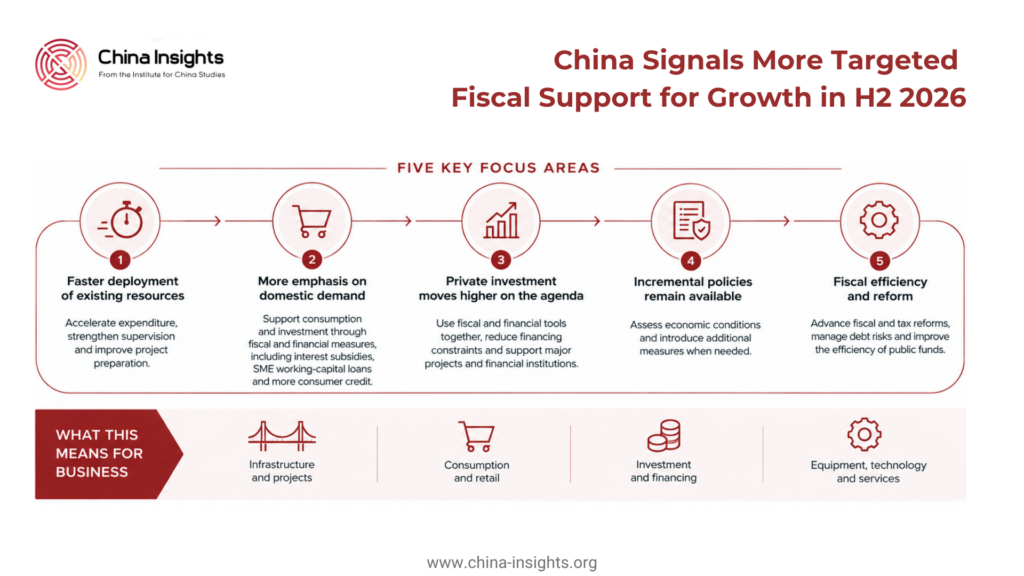
Faster deployment of existing fiscal resources
The immediate priority is to improve the speed at which already-approved fiscal resources reach the economy. MOF plans to accelerate expenditure and strengthen supervision of regions where spending remains slow. Local governments will also be guided to improve project preparation so that bond-funded projects can move more quickly into construction.
This changes the short-term policy emphasis. Rather than relying primarily on new fiscal allocations, the government is seeking greater economic impact from resources already available. For companies, this could translate into faster implementation of public investment projects and earlier demand for related goods and services.
More emphasis on domestic demand
The second priority is stronger support for domestic demand. MOF will continue to optimize the package of fiscal and financial measures supporting consumption and investment. The measures include expanded interest subsidies for eligible loans and broader access to the financial institutions implementing these programs.
The policy has also been adjusted to include newly issued working-capital loans for eligible SMEs and additional consumer credit categories. This indicates a broader approach to supporting both business financing and household consumption. The objective is to improve the transmission of fiscal support into actual economic activity rather than simply increasing headline fiscal expenditure.
Private investment moves higher on the agenda
The stronger focus on private investment is commercially significant. Fiscal policy is being used together with financial instruments to reduce financing constraints and encourage companies to invest. The government is also continuing to use policy-oriented financial tools to support major projects and strengthen financial institutions’ capacity to serve the real economy.
This creates potential opportunities beyond traditional government-led infrastructure. Companies supplying equipment, technology and services to private investment projects may benefit if financing conditions improve. The effect will depend on how quickly the measures translate into actual project approvals and corporate investment decisions.
Incremental policies remain available
A key signal is that the government is keeping additional fiscal measures in reserve. MOF stated that it will assess economic conditions during the second half of the year and formulate practical incremental policies when necessary. The approach is intended to combine existing measures with additional support rather than replacing one with the other.
This creates greater policy flexibility. For businesses, it also means that the current policy package should not necessarily be viewed as the final fiscal position for 2026. Companies exposed to domestic demand should monitor subsequent announcements, particularly where they affect consumption, investment or financing costs.
Fiscal efficiency becomes a policy objective
The third priority is fiscal reform and management. MOF will continue implementing reforms to the fiscal and taxation system, promote zero-based budgeting and strengthen budget-performance management. At the same time, authorities will continue efforts to prevent and resolve local government debt risks and prevent new hidden debt.
This creates an important counterweight to fiscal expansion. China is seeking to maintain policy support while improving the quality of spending and controlling fiscal risks. The implication for businesses is that not all projects or sectors will benefit equally. Public spending is likely to become more closely linked to measurable economic and policy objectives.
Policy support will be more targeted
The overall direction is therefore not a simple increase in government spending. It is a move toward more targeted fiscal intervention. Existing resources are to be deployed faster, financial and fiscal tools are to be coordinated more closely, and additional measures can be introduced where economic conditions justify them.
This approach is consistent with the broader 2026 fiscal strategy, which emphasizes expanding domestic demand, improving the structure of spending, supporting technological and industrial upgrading, and increasing the efficiency of fiscal resources.
What this means for business
- Monitor public investment pipelines: Faster use of bond funding could accelerate infrastructure and other government-supported projects.
- Assess financing opportunities: Expanded interest-subsidy programs may reduce financing costs for eligible SMEs and other market participants.
- Track consumer-support measures: Broader fiscal-financial coordination could support demand in selected consumption categories.
- Do not assume current policy is final: Additional measures may be introduced as economic conditions evolve.
- Expect greater selectivity: Fiscal resources are likely to favor projects with clear economic, strategic or social returns.
- Build policy monitoring into planning: Companies should track central and local implementation because the commercial impact will depend heavily on execution speed and eligibility.
Sources
- https://www.gov.cn/zhengce/202608/content_7078851.htm
- https://www.ln.gov.cn/web/ywdt/rdgz/2026082207143521604/index.shtml
- https://www.ndrc.gov.cn/xwdt/xwfb/202608/t20260826_1407198.html
- https://bgt.mof.gov.cn/zhuantilanmu/rdwyh/czyw/202603/t20260306_3984742.htm
- https://www.jcgov.gov.cn/dtxx/gwyyw/202608/t20260824_2383467.shtml
Author
Dr. Richard van Ostende

Related Articles