
China Accelerates Next-Generation Communications Network Deployment
China is moving into a new phase of communications infrastructure development. The focus is shifting from expanding basic connectivity toward building higher-capacity, lower-latency and more intelligent networks. This reflects the growing role of connectivity infrastructure in artificial intelligence, industrial digitalization and the wider digital economy.
On 22 August 2026, the State Council Executive Meeting reviewed and adopted measures for accelerating the construction of next-generation communications networks. The meeting was chaired by Premier Li Qiang. The policy direction places greater emphasis on coordinated network development, technological upgrading and the integration of communications infrastructure with emerging digital applications.
Executive summary
- China is accelerating investment in next-generation communications infrastructure as part of its broader digital transformation agenda.
- Network development is shifting from coverage expansion toward capacity, intelligence and application integration.
- AI and other emerging technologies are becoming important drivers of communications infrastructure investment.
- Greater coordination between networks, computing resources and industrial applications is expected.
- Equipment suppliers and technology companies may benefit from continued infrastructure investment, but competition will increase.
- Foreign companies should assess opportunities across network equipment, components, software, services and industrial applications.
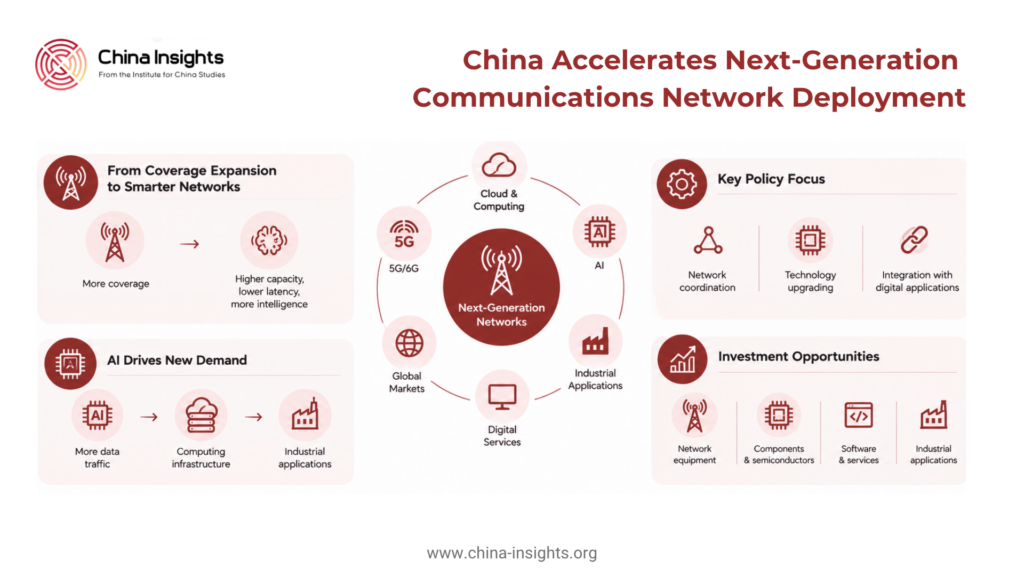
Network development enters a new phase
The latest State Council direction indicates a change in the role of communications infrastructure. Earlier network investment focused heavily on expanding coverage and accelerating the deployment of mobile and broadband networks. The next phase is more closely connected to the requirements of AI, advanced computing and industrial digitalization.
The objective is therefore not simply to build more network capacity. It is to develop infrastructure capable of supporting increasingly data-intensive applications. This creates a closer relationship between communications networks, computing infrastructure and digital services.
AI is changing infrastructure requirements
The rapid deployment of artificial intelligence is increasing demand for network capacity and performance. AI applications require the movement of large volumes of data between users, devices, data centers and computing facilities. This places new requirements on network architecture and transmission capabilities.
The State Council’s approach links next-generation network construction with the development of emerging technologies. This suggests that future network investment will increasingly be assessed according to its ability to support strategic technology applications rather than solely on traditional telecommunications indicators.
For equipment manufacturers and technology suppliers, this changes the composition of potential demand. Opportunities are likely to extend beyond traditional telecommunications hardware toward high-performance components, network software, intelligent network management and technologies supporting data-intensive applications.
Greater integration between networks and computing
A significant element of the new direction is closer coordination between communications networks and computing resources. China’s broader digital infrastructure strategy is increasingly treating connectivity and computing as complementary infrastructure rather than separate investment areas.
This has implications for the location and design of digital infrastructure. Network performance, computing availability and data flows need to be considered together. Companies developing data centers, cloud services, AI infrastructure and industrial digital solutions will therefore increasingly need to assess network capacity as part of their infrastructure strategy.
Industrial applications become more important
The next-generation network agenda is also closely linked to industrial digitalization. More capable networks can support connected manufacturing equipment, industrial sensors, autonomous systems and other data-intensive applications. This strengthens the business case for communications infrastructure beyond the consumer telecommunications market.
For industrial companies, improved network infrastructure can enable greater use of real-time data and connected production systems. For technology suppliers, the development of industrial applications creates an additional market alongside telecommunications operators and infrastructure providers.
The policy direction therefore supports a broader shift from networks as standalone infrastructure toward networks as an enabling layer for industrial transformation.
Investment opportunities will extend across the value chain
Accelerated network construction should support demand across several parts of the technology value chain. Telecommunications operators and infrastructure companies remain central, but the investment cycle can also create opportunities for suppliers of optical components, network equipment, semiconductors, software and specialized services.
At the same time, stronger policy support will increase competition. Chinese companies already have substantial capabilities across telecommunications equipment and network infrastructure. Foreign companies are more likely to find opportunities where they provide differentiated technologies, specialized components or solutions that complement China’s domestic industrial ecosystem.
Standardization and coordination remain critical
The next-generation network transition will require coordination between telecommunications operators, equipment manufacturers, technology companies and industrial users. Interoperability, technical standards and network security will become increasingly important as networks support a wider range of critical applications.
This also increases the importance of regulatory monitoring. Companies entering the Chinese market will need to follow developments in technical standards, cybersecurity, data governance and network-related procurement requirements alongside infrastructure investment plans.
What this means for business
- Infrastructure investment should remain strong: Companies supplying next-generation network equipment, components and services may benefit from continued policy-driven demand.
- AI is creating new network demand: Suppliers should assess opportunities created by the convergence of communications, computing and AI infrastructure.
- Industrial applications will expand: Manufacturers and technology companies should evaluate use cases based on connected and data-intensive production.
- Differentiation will matter: Foreign suppliers will face strong domestic competition and should focus on specialized technologies and high-value solutions.
- Network strategy should be integrated with digital strategy: Data centers, cloud, AI and industrial digitalization projects increasingly depend on network performance.
- Regulatory monitoring is essential: Technical standards, cybersecurity, data governance and procurement policies will influence market access and project opportunities.
Sources
- https://www.gov.cn/zhengce/202608/content_7078876.htm
- https://www.gov.cn/guowuyuan/2026-08/22/content_7078868.htm
- https://www.miit.gov.cn/gxsj/tjfx/txy/art/2026/art_8b6a6e7a7b0f4e2c8c3a7e6b6c0e5f4d.html
Author
Dr. Richard van Ostende

Related Articles