
China Recalibrates Fiscal Policy for the 15th Five-Year Plan
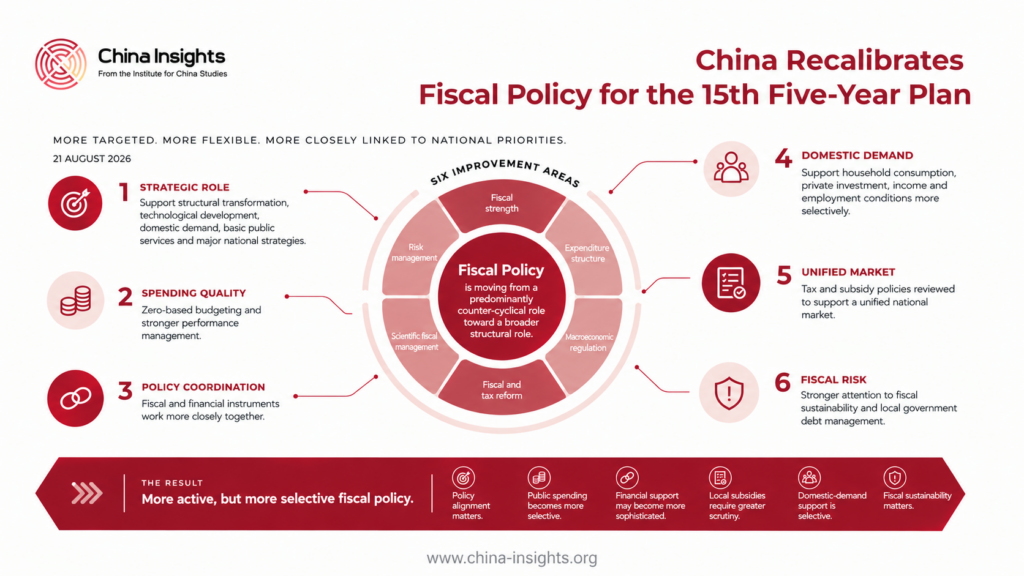
China is using the start of the 15th Five-Year Plan (2026–2030) to reshape the role of fiscal policy. The direction is not simply to increase government spending. It is to make fiscal policy more targeted, more flexible and more closely linked to national economic priorities.
On 21 August 2026, the Ministry of Finance (MOF) presented its approach at a State Council Information Office press conference on fiscal reform and development during the 15th Five-Year Plan. The MOF outlined a shift toward stronger fiscal capacity, better spending allocation, more effective macroeconomic adjustment, deeper tax and fiscal reform, improved budget management and stronger management of fiscal risks. The policy interpretation was published through the State Council Information Office on 21 August 2026.
Executive summary
- Fiscal policy is moving from a predominantly counter-cyclical role toward a broader structural role.
- Spending will be more closely linked to strategic priorities, public needs and measurable policy outcomes.
- Fiscal and financial instruments will increasingly be coordinated to amplify the impact of public funds.
- Budget management is shifting toward zero-based budgeting and stronger performance management.
- Tax and subsidy policies will be reviewed to support the development of a unified national market.
- Businesses should expect more targeted support, but also greater scrutiny of fiscal incentives and government spending efficiency.
Fiscal policy becomes more strategic
The main change is the broader role assigned to fiscal policy during the 15th Five-Year Plan. MOF has identified six areas for improvement: fiscal strength, expenditure structure, macroeconomic regulation, fiscal and tax reform, scientific fiscal management and risk management.
This represents a move away from treating fiscal policy primarily as a tool for short-term economic stabilization. Fiscal resources are increasingly expected to support structural transformation, technological development, domestic demand, basic public services and major national strategies. For businesses, this means that access to policy support will depend increasingly on alignment with defined economic and industrial priorities.
Spending quality becomes more important
MOF is placing greater emphasis on the structure and effectiveness of government expenditure. The ministry has stated that fiscal resources should be concentrated on areas where policy impact is strongest and where public needs are greatest. Zero-based budgeting and stronger budget-performance management are intended to reduce inefficient or low-value spending.
This has direct implications for companies that depend on public-sector demand. Government spending is likely to become more selective. Projects will face greater pressure to demonstrate economic, social or strategic value. Companies supplying government-funded projects may therefore need to compete increasingly on measurable outcomes rather than simply on eligibility for public procurement or local support.
Fiscal and financial policies will work more closely together
Another important change is the stronger integration of fiscal and financial instruments. MOF has indicated that fiscal policy should use diverse tools and strengthen coordination with monetary, financial, industrial and employment policies. The objective is to increase the leverage generated by limited public resources.
This approach was already visible in 2026 measures supporting private investment and consumption. These included loan-interest subsidies, government-backed guarantees and other mechanisms designed to reduce financing constraints. The significance is that fiscal policy is increasingly being used to influence private-sector behavior rather than simply financing public expenditure.
Greater emphasis on domestic demand
Supporting domestic demand remains a central fiscal priority. However, the approach is becoming more targeted. Fiscal resources are being directed toward measures intended to increase household consumption, support private investment and improve income and employment conditions.
This creates opportunities for companies exposed to domestic consumption and investment. The effect will vary by sector because support is increasingly designed around specific policy objectives rather than broad-based stimulus. Businesses should therefore monitor the eligibility conditions attached to individual programs rather than assume that general fiscal expansion will translate into stronger demand across all markets.
Tax and subsidy reform will affect the business environment
The 15th Five-Year Plan fiscal agenda also places greater emphasis on improving the tax system and regulating tax incentives and fiscal subsidies. MOF has linked these reforms to the development of a unified national market. The objective is to reduce distortions created by inconsistent local policies and improve the efficiency of resource allocation.
This could gradually change the competitive environment between Chinese regions. Companies may have less scope to base investment decisions primarily on discretionary local fiscal incentives. Location decisions will need to place greater weight on infrastructure, supply chains, labor, market access and industrial ecosystems.
Fiscal risk management becomes part of the growth strategy
The new fiscal approach combines stronger policy support with greater attention to sustainability. MOF has identified fiscal risk reduction as one of the six major objectives for the 15th Five-Year Plan. Local government debt management will remain a particular focus, alongside stronger controls over the use and repayment of government debt.
This creates an important constraint on fiscal expansion. The government is seeking to increase the effectiveness of fiscal policy without relying indefinitely on additional debt. For businesses, this means that public investment opportunities may remain substantial, but project selection and funding availability will become more closely connected to fiscal capacity and policy priorities.
The direction is toward selective fiscal expansion
The emerging model can therefore be characterized as more active but more selective fiscal policy. China intends to maintain sufficient fiscal support while improving the allocation and impact of public resources.
For companies, the key issue is not simply how much fiscal support is available. It is where the government intends to deploy it, which instruments it will use and what conditions businesses must meet to benefit. Companies aligned with strategic priorities are likely to have stronger opportunities than those relying mainly on general economic stimulus.
What this means for business
- Policy alignment will become more important: Companies should assess how their investments correspond with national strategic and fiscal priorities.
- Public spending will become more selective: Suppliers should expect stronger emphasis on measurable project outcomes and value for money.
- Financial support may become more sophisticated: Businesses should monitor fiscal-financial instruments that reduce financing costs or mobilize private investment.
- Local subsidies require greater scrutiny: Investment plans should not rely solely on discretionary local fiscal incentives.
- Domestic-demand sectors may benefit selectively: Companies should track the specific eligibility and implementation rules attached to consumption and investment measures.
- Fiscal sustainability matters: Government investment and procurement opportunities should be assessed against the fiscal position of the relevant government level.
Primary source
- https://www.gov.cn/zhengce/202608/content_7078855.htm
- https://www.news.cn/20260821/27b8c237af7e4a3a87b49e52f2273ecf/c.html
- https://www.mof.gov.cn/zhengwuxinxi/caizhengxinwen/202603/t20260316_3985331.htm
- https://www.mof.gov.cn/zhengwuxinxi/caizhengxinwen/202601/t20260120_3982255.htm
- https://www.cnfin.com/yw-lb/detail/20260821/4458569_1.html
Author
Dr. Richard van Ostende

Related Articles