
China Moves to Standardize Local Fiscal Subsidies and Reduce Regional Market Distortions
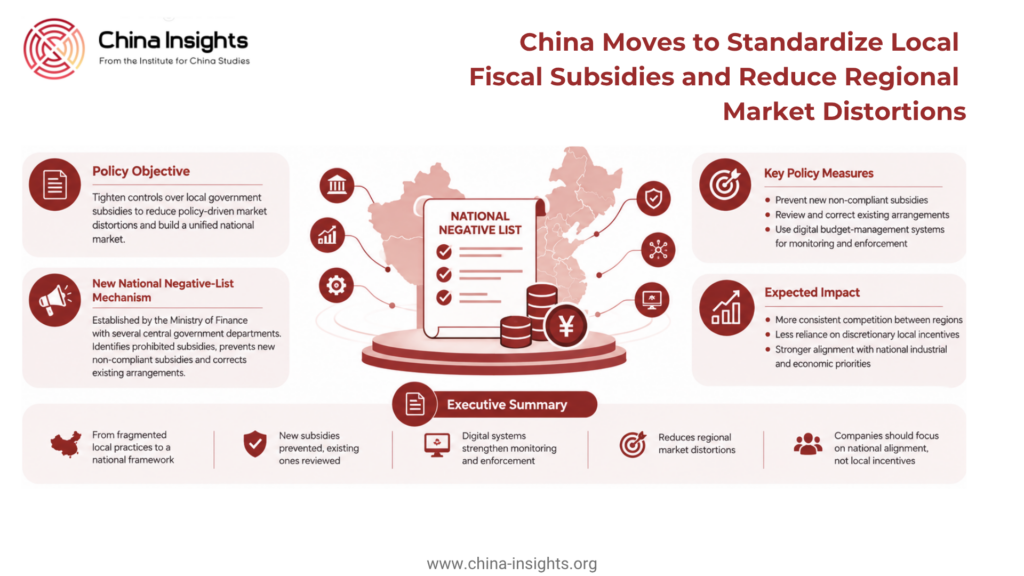
China is tightening controls over local government subsidies as part of its broader effort to build a unified national market. The policy direction targets differences in local fiscal support that can influence corporate investment and competition. The objective is to reduce policy-driven market distortions and make competition between regions more consistent.
The Ministry of Finance (MOF) outlined the new approach on 21 August 2026 at a State Council Information Office press conference on the implementation of the 15th Five-Year Plan. MOF Vice Minister Liao Min stated that a national negative-list management mechanism for local fiscal subsidies had been established jointly with several central government departments. The mechanism identifies prohibited forms of local subsidies, prevents new non-compliant subsidies and provides for the orderly correction of existing arrangements.
Executive summary
- China is moving from fragmented local subsidy practices toward a nationally coordinated negative-list system.
- New non-compliant local subsidies are to be prevented, while existing arrangements will be reviewed and corrected.
- Digital budget-management systems will be used to strengthen monitoring and enforcement.
- The policy reduces the scope for local governments to compete through subsidy arrangements that distort market conditions.
- Companies should place greater emphasis on national policy alignment rather than local incentives alone when assessing investment locations.
- Existing investment and operating arrangements based on local fiscal support may require renewed compliance and financial assessment.
From local incentives to national rules
The most important change is the move toward a common national framework. Local governments have historically used different fiscal support measures to attract investment, develop industries and support local companies. While such measures can promote regional development, inconsistent incentives can also affect competition and influence corporate location decisions for reasons unrelated to underlying commercial efficiency.
The new mechanism establishes a clearer boundary between permissible and non-compliant subsidies. MOF has worked with the National Development and Reform Commission, Ministry of Industry and Information Technology, Ministry of Commerce, General Administration of Customs, State Taxation Administration and State Administration for Market Regulation to establish the national negative-list mechanism.
Existing subsidies will be reviewed
The change is not limited to preventing new arrangements. Local governments are also expected to review existing subsidies and progressively address those that fall outside the new framework. The principle is that the government department responsible for creating a measure is responsible for its correction, while the relevant supervising authority is responsible for ensuring compliance.
This creates a transition issue for companies already receiving local financial support. Businesses should not assume that an existing subsidy will continue simply because it was previously approved by a local government. The durability of the underlying policy basis will become more important as local authorities review their subsidy portfolios.
Monitoring is becoming more systematic
MOF is linking the new mechanism to China’s integrated budget-management system. The objective is to identify potentially non-compliant subsidies through more systematic monitoring and enable authorities to investigate them in a timely manner.
This is a significant operational change. Monitoring is becoming less dependent on individual inspections or ad hoc investigations. The increased use of integrated fiscal data should make it easier for central authorities to identify unusual or potentially non-compliant local subsidy arrangements.
For companies, this means that subsidy compliance should be treated as an ongoing issue. Documentation, eligibility conditions and actual use of funds may receive greater scrutiny.
The investment-location equation is changing
The policy has implications for how companies compare Chinese locations. Local subsidies have often formed part of investment negotiations, particularly for manufacturing projects, strategic industries and major capital investments. A more restrictive national framework may reduce the differences between regions created by discretionary fiscal support.
This does not mean that regional competition will disappear. Local governments will continue to compete through infrastructure, industrial clusters, public services, talent policies and other legitimate economic-development tools. However, companies may need to place less weight on direct fiscal incentives and more weight on the underlying business environment.
Strategic industries remain supported, but through clearer channels
The new approach should not be interpreted as a withdrawal of government support for strategic industries. Instead, the policy direction is toward making support more consistent with national rules and industrial priorities. This distinction matters for companies operating in sectors such as advanced manufacturing, new energy, digital technologies and other areas aligned with national development objectives.
For investors, the question is therefore changing from “What subsidy can the local government offer?” to “What forms of support are permissible and sustainable under the national framework?” Companies that align their projects with central industrial priorities are likely to have a stronger basis for accessing legitimate forms of policy support.
A broader move toward a unified national market
The subsidy reform forms part of a wider effort to reduce regional barriers and strengthen the national unified market. MOF has linked subsidy reform with the broader objective of improving tax-policy consistency and government procurement rules. The stated aim is to reduce market distortions and create a more transparent and competitive environment for different types of businesses.
This is particularly relevant to foreign companies. A more standardized fiscal environment can reduce uncertainty caused by differences in local policy practices. At the same time, companies will need to become more careful when evaluating incentives offered during investment negotiations.
What this means for business
- Review existing subsidies: Companies should reassess the legal and policy basis of local fiscal support currently received.
- Recalculate investment economics: Investment decisions should rely less on discretionary local subsidies and more on sustainable commercial fundamentals.
- Strengthen subsidy compliance: Eligibility, contractual conditions, documentation and use of funds should be systematically monitored.
- Expect greater scrutiny: Integrated fiscal monitoring may increase the probability that non-compliant subsidy arrangements are identified.
- Focus on national priorities: Projects aligned with national industrial and economic priorities may have stronger access to compliant policy support.
- Reassess location strategies: Infrastructure, supply chains, talent and industrial ecosystems are likely to become more important relative to purely fiscal incentives.
Sources
- https://www.gov.cn/zhengce/202608/content_7078853.htm
- https://www.gov.cn/zhengce/202608/content_7078853.htm
- https://www.ccgp.gov.cn/news/202608/t20260825_27195598.htm
- https://news.cctv.com/2026/08/21/ARTIATpcWGEVz9dM992kxAWu260821.shtml
- https://nb.mof.gov.cn/caizhengjiancha/202601/t20260123_3982497.htm
Author
Dr. Richard van Ostende

Related Articles