
China’s 15th Five-Year Plan: Integrated Transport System Standardization Moves Toward Greater Integration and Digitalization
China is strengthening the role of standardization in the development of its integrated transport system. The policy direction is shifting from establishing basic standards across individual transport modes toward greater cross-modal integration, digitalization, international compatibility and support for emerging transport technologies.
On 20 July 2026, the Ministry of Transport (MOT), State Administration for Market Regulation, National Railway Administration, Civil Aviation Administration of China and State Post Bureau jointly issued the “15th Five-Year Plan for the Development of Integrated Transport Standardization” (《综合交通运输标准化发展“十五五”规划》). The policy interpretation was published by the State Council on 11 August 2026. The plan sets targets through 2030 and provides a framework for standardization during the 15th Five-Year Plan period.
Executive summary
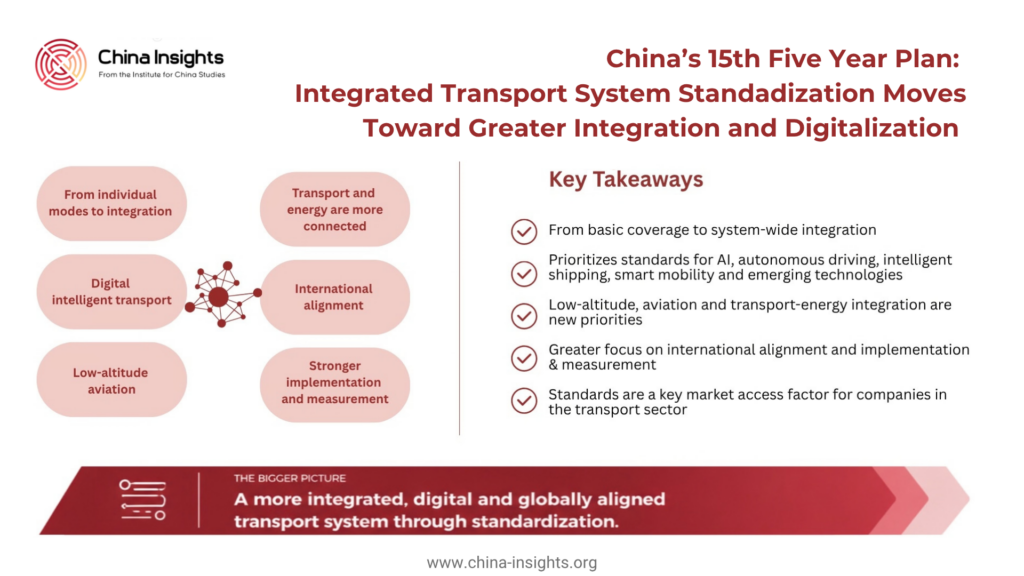
- Transport standardization is moving from basic coverage toward system-wide integration.
- Authorities are prioritizing standards for AI, autonomous driving, intelligent shipping, smart mobility and other emerging technologies.
- Low-altitude aviation and transport-energy integration are becoming new standardization priorities.
- International alignment is receiving greater attention, creating opportunities and compliance requirements for international companies.
- Standard implementation and measurement are being strengthened, increasing the importance of conformity and technical compliance.
- Companies supplying transport equipment, infrastructure, digital systems and services should treat standards as an increasingly important market-access factor.
From individual modes to integrated transport
The main change is the broader scope of standardization. During the 14th Five-Year Plan, China established and expanded standards covering road, rail, waterway, civil aviation and postal transport. The new plan places greater emphasis on coordination between these systems.
This reflects the wider policy objective of building a modern integrated transport network. The 15th Five-Year Plan for national economic and social development calls for stronger connections between transport modes, improved infrastructure integration and higher overall network efficiency. Standardization is increasingly being used to support this integration.
For businesses, this can reduce fragmentation over time. It can also create new technical requirements where equipment or systems need to operate across different transport modes.
Digital and intelligent transport becomes a standards priority
The new plan places greater emphasis on standards for emerging technologies. Priority areas include autonomous driving, vehicle-road coordination, intelligent shipping, smart mobility, intelligent transport equipment and platform-based transport services.
This is commercially important because standards can influence how emerging technologies move from pilot projects into wider deployment. Common technical requirements can improve interoperability and reduce uncertainty for suppliers. At the same time, companies whose products do not conform to emerging standards may face additional adaptation costs or barriers to market entry.
The policy therefore strengthens the connection between technology development and standard-setting. Companies developing transport-related AI, software, sensors, communications equipment or automated systems should monitor Chinese standards development earlier in the product cycle.
Low-altitude aviation enters the standardization agenda
Low-altitude aviation is explicitly identified as an area requiring forward-looking standard development. The plan calls for work on standards supporting air-ground coordination and integrated transport services.
This matters because China’s low-altitude economy is moving from policy promotion toward the development of supporting infrastructure and operating systems. Standardization will become important for ensuring compatibility between aircraft, infrastructure, communications, navigation and other systems.
For international technology suppliers, participation in emerging standards ecosystems may therefore become strategically relevant. Technical compatibility will be increasingly important as the sector develops beyond individual demonstration projects.
Transport and energy systems are becoming more connected
Another new priority is the integration of transport and energy. The plan calls for research into a standard system covering transport-energy integration.
This reflects the growing interaction between transport electrification and energy infrastructure. Charging, energy management and other transport-related energy systems require technical coordination if they are to operate efficiently at scale.
The development of standards creates potential opportunities for suppliers of charging infrastructure, energy-management systems, digital platforms and related equipment. It also means that technical specifications may become increasingly important when competing for infrastructure projects.
International standards gain greater importance
The plan also strengthens the international dimension of transport standardization. By 2030, China aims to increase the conversion of international standards into Chinese standards and expand international cooperation. The overall objective is to make the Chinese transport standards system more internationally compatible.
For international companies, greater compatibility can reduce some technical barriers between markets. However, the practical impact will depend on how international standards are adopted and implemented in specific Chinese sectors.
Companies operating internationally should therefore distinguish between formal international alignment and actual Chinese compliance requirements. Local standards, certification procedures and implementation practices will remain relevant.
Standard implementation becomes more important
The plan does not focus only on creating new standards. It also strengthens their implementation, supervision and supporting infrastructure. The authorities have identified standard supply, implementation effectiveness, institutional opening and standardization capabilities as four areas for measurable improvement by 2030.
This increases the importance of compliance management. Companies will need to monitor not only whether a relevant standard exists, but also whether it is mandatory, referenced in procurement requirements, incorporated into certification procedures or applied by industry regulators.
For suppliers, this could make standards a more significant part of product-development, tendering and market-entry strategies.
Standards become part of industrial policy
The broader significance is that standardization is increasingly being used as an instrument of industrial development. China is linking technical standards with digitalization, green transition, intelligent transport, infrastructure upgrading and the development of new transport technologies.
The approach is consistent with the wider 15th Five-Year Plan objective of developing a more integrated, resilient, intelligent and sustainable transport system.
For businesses, standards should therefore not be viewed only as technical compliance documents. They are becoming part of the competitive environment in which technologies are commercialized and transport infrastructure is developed.
What this means for business
- Monitor standards early: Companies should track Chinese standards under development, particularly in emerging transport technologies.
- Build compliance into product design: New technical requirements may increasingly influence product architecture and certification.
- Assess interoperability: Cross-modal transport integration will increase demand for systems that can operate across different platforms and networks.
- Watch emerging sectors: Low-altitude aviation, intelligent transport and transport-energy integration are developing new standards ecosystems.
- Engage with standardization bodies: Participation can provide earlier visibility of technical requirements and market direction.
- Reassess market-entry strategies: Standards, certification and procurement specifications should be considered alongside pricing and commercial factors.
Sources
- https://www.gov.cn/zhengce/202608/content_7078439.htm
- https://policy.mofcom.gov.cn/claw/clawContent.shtml
- https://www.mot.gov.cn/xinwen/jiaotongyaowen/202603/t20260316_4201890.html
- https://www.npc.gov.cn/npc/c2/c30834/202603/t20260316_453274.html
Author
Dr. Richard van Ostende

Related Articles