
China Moves Investment Promotion from Incentives to Business Environment
China is tightening the framework for local government investment promotion. At its 31 August 2026 meeting, the State Council Executive Meeting studied measures to promote high-quality investment attraction. The meeting placed greater emphasis on regulating local government economic promotion activities and aligning investment promotion with the development of a unified national market.
The shift is relevant for both domestic and foreign investors. Local governments are being encouraged to compete less through preferential treatment and more through business conditions, industrial ecosystems and public services. For companies considering new investment or expansion in China, this changes the criteria by which local investment propositions should be assessed.
Executive summary
- The State Council is strengthening rules around local government investment promotion.
- Local authorities are expected to clearly distinguish encouraged and prohibited investment-promotion practices.
- The policy emphasis is shifting from incentives and subsidies toward the business environment, industrial ecosystems and government services.
- Companies can expect greater attention to fair and predictable market conditions rather than purely financial incentives.
- Ongoing government engagement and post-investment services are becoming more important in retaining and expanding investment.
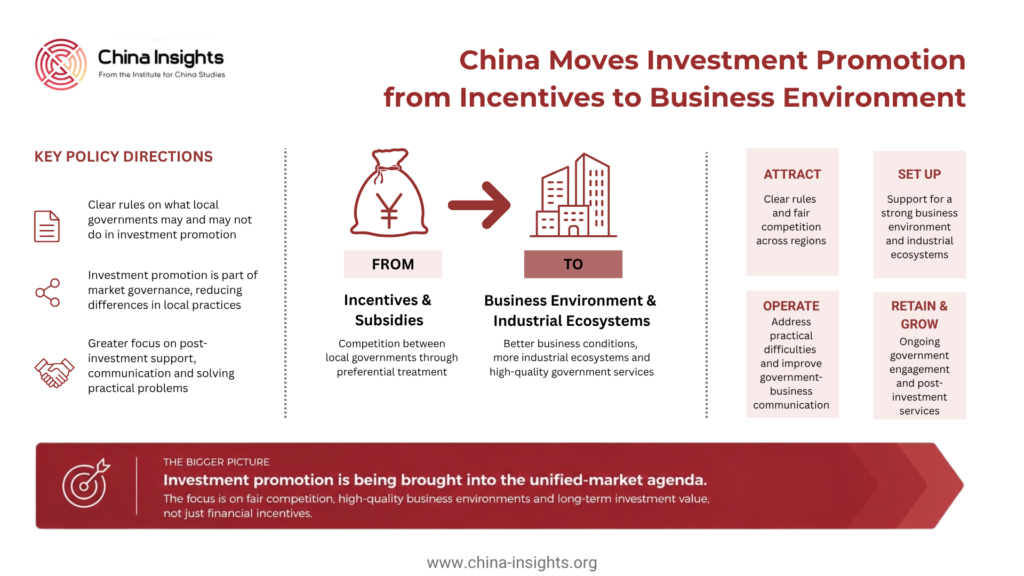
Investment promotion is being brought into the unified-market agenda
The State Council Executive Meeting, chaired by Premier Li Qiang on 31 August 2026, identified the regulation of investment promotion as an important component of building a unified national market. The meeting called for continued efforts to establish clear rules on what local governments may and may not do when attracting investment.
This represents a further move toward reducing differences in local government economic practices. Investment promotion is increasingly being treated as part of market governance rather than solely as a competition between cities and provinces for projects.
Local government incentives face greater scrutiny
The most significant change is the stronger emphasis on regulating local government economic promotion. The State Council called for both positive guidance and binding constraints. It also stated that investment promotion should focus more on improving the business environment, developing industrial ecosystems and providing high-quality government services.
The direction is consistent with the broader national-market agenda. China has been working to reduce practices that distort competition between regions. The National Development and Reform Commission’s 2026 China Business Environment Development Report notes that local investment-promotion practices are being brought within clearer boundaries and that investment incentives must respect national market rules.
From project attraction to investment retention
The policy also changes the focus after an investment decision has been made. The State Council called for improved communication mechanisms between governments and enterprises and for local authorities to actively help companies address practical difficulties.
This suggests a stronger emphasis on the full investment lifecycle. Investment promotion is no longer viewed simply as securing a project or signing an agreement. The ability of a locality to support operations, solve administrative problems and maintain effective government-business communication is becoming part of its investment proposition.
Business environment becomes a competitive factor
The new direction is particularly relevant as China seeks to attract and retain investment amid stronger competition between investment destinations. The Ministry of Commerce has already identified improving investment facilitation, expanding services for foreign-invested enterprises and strengthening investment-promotion mechanisms as priorities for foreign investment policy in 2026.
For companies, this means that the quality of the local operating environment is likely to become more important relative to headline incentives. Access to industrial suppliers, infrastructure, skilled labor, administrative efficiency and government coordination can have a greater impact on long-term investment performance than a one-off subsidy.
Greater importance of industrial ecosystems
The emphasis on industrial ecosystems also points to a more targeted approach to investment attraction. Rather than pursuing investment volume alone, local governments are being encouraged to strengthen the industrial capabilities around existing and priority sectors.
This fits with the broader direction of the 15th Five-Year Plan, which places greater weight on industrial upgrading, technological innovation and the development of advanced production capabilities. For investors, locations with established supply chains, research capabilities, infrastructure and complementary businesses may therefore become more attractive than locations competing primarily through financial incentives.
What this means for business
- Evaluate locations beyond incentives. Investment decisions should place greater weight on operating conditions, supply chains, infrastructure and administrative efficiency.
- Expect greater standardization. Local investment-promotion practices are likely to face stronger national-level constraints and greater scrutiny.
- Reassess existing government agreements. Companies should distinguish between legally enforceable commitments and discretionary local incentives.
- Engage governments beyond the investment stage. Effective communication and problem-solving capacity may become increasingly important to business continuity and expansion.
- Focus on industrial ecosystems. Companies can benefit from locations that provide established supplier networks, talent, infrastructure and institutional support.
- Monitor implementation at local level. The impact will depend on how provinces and municipalities translate the State Council’s direction into specific investment-promotion practices.
Sources
https://www.gov.cn/zhengce/202608/content_7079730.htm
Author
Dr. Richard van Ostende

Related Articles