
China’s 15th Five-Year Plan Sets a RMB 4 Trillion Investment Outlook for the Computing Network
China is accelerating construction of a national computing network as part of its broader 15th Five-Year Plan (2026–2030) infrastructure strategy. The policy direction is moving beyond expanding computing capacity. The focus is increasingly on connecting computing resources across regions, coordinating computing with electricity and communications, and improving utilization.
The National Development and Reform Commission (NDRC) stated in July 2026 that institutional estimates indicate computing-network construction could generate RMB 4 trillion in additional direct investment during the 15th Five-Year Plan period. The estimate highlights the scale of the emerging market for computing infrastructure and related technologies.
Executive summary
- Computing networks are becoming a core component of China’s 15th Five-Year Plan infrastructure strategy.
- The investment focus is shifting from individual data centers toward nationally coordinated computing infrastructure.
- Greater emphasis is being placed on matching computing demand with available power, communications capacity and regional resources.
- Intelligent computing is expanding rapidly and is becoming a major driver of new infrastructure investment.
- National monitoring and scheduling systems are being developed to improve cross-regional utilization of computing resources.
- The policy creates significant opportunities for private investment because computing infrastructure is largely enterprise-led.
- The strongest commercial opportunities are likely to extend beyond servers and data centers into power, networking, optical communications, energy efficiency and digital-management systems.
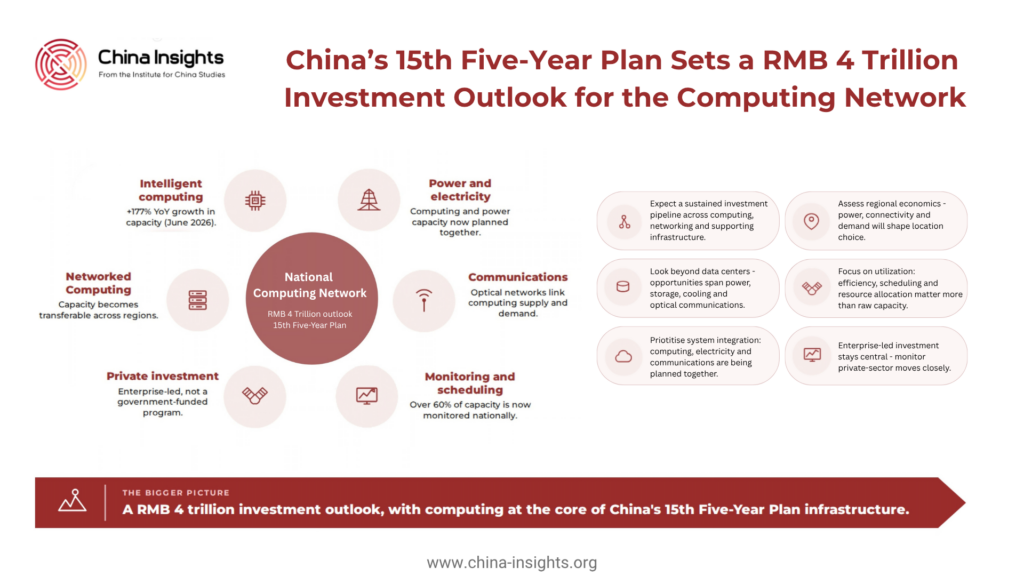
Computing infrastructure moves into the core infrastructure agenda
The main change is the strategic positioning of computing. China is no longer treating computing capacity only as a digital-economy input. It is increasingly being developed as networked infrastructure with national planning and coordination.
This forms part of the wider “Six Networks” infrastructure program under the 15th Five-Year Plan. NDRC has emphasized that the networks should not develop independently. Computing, electricity and next-generation communications infrastructure are expected to operate as interconnected systems.
For businesses, this changes the market from one focused primarily on local capacity expansion to one increasingly concerned with system integration, connectivity and resource optimization.
From data-center expansion to networked computing
The policy direction places greater emphasis on connecting computing resources between regions. This is particularly relevant to China’s existing strategy of distributing computing resources geographically and encouraging computing-intensive activities to use capacity where power and other infrastructure are available.
The objective is to make computing capacity more transferable. A company should increasingly be able to access computing resources based on availability, cost and application requirements rather than relying only on locally installed capacity.
This creates a market for technologies that enable scheduling, workload migration, network optimization and real-time resource allocation. It also increases the importance of interoperability between different computing platforms and infrastructure operators.
Intelligent computing becomes the main growth driver
The rapid expansion of AI-related computing is changing the composition of demand. According to the NDRC, national intelligent-computing capacity had increased substantially in 2026, supporting artificial intelligence and other emerging industries. By June, intelligent computing capacity had reached 21.85 billion floating-point operations per second in the stated measurement system, with year-on-year growth of 177%.
The investment implications extend beyond traditional cloud infrastructure. AI workloads require large-scale accelerator capacity, high-speed networking, advanced cooling and substantial electricity supply.
This makes the computing-network market increasingly dependent on the availability and economics of supporting infrastructure. Companies that can address several of these requirements together should be better positioned than suppliers focused on a single hardware category.
Computing and electricity are being planned together
One of the clearest policy changes is the emphasis on computing power and electricity coordination. NDRC has identified the need to match computing deployment with power availability and to improve the efficiency of electricity use by computing facilities.
This is commercially important because electricity is becoming a strategic input into AI infrastructure. Computing facilities require reliable power, while China’s energy transition is increasing the importance of renewable electricity and flexible power systems.
The resulting market extends into energy storage, power management, efficient cooling, renewable-energy integration and intelligent energy-management systems. The boundary between the data-center market and the energy market is therefore becoming less distinct.
Communications infrastructure becomes part of the computing equation
Computing capacity has limited value if data cannot be moved efficiently. The national computing-network strategy therefore places computing alongside next-generation communications infrastructure.
NDRC has highlighted the role of communications networks as the infrastructure that allows computing resources to be scheduled and coordinated across regions. The objective is to improve connectivity and reduce the limitations created by geographical separation between computing supply and demand.
This creates opportunities for high-capacity optical networks, network equipment, low-latency connectivity and intelligent network-management systems. It also increases the strategic importance of communications infrastructure in the development of China’s AI ecosystem.
National monitoring and scheduling are expanding
Another important change is the development of a more coordinated monitoring and scheduling system. NDRC reported in August that a national integrated computing-network monitoring and scheduling testing platform had entered trial operation, with more than 60% of computing capacity already included in unified monitoring.
This indicates a move toward treating computing capacity as a resource that can be measured, monitored and allocated across a broader system. The commercial implications are significant. Better visibility of available capacity can improve utilization and potentially reduce the need for unnecessary local overbuilding.
For infrastructure operators, this also means that performance will increasingly be measured not only by installed capacity but by utilization, connectivity and service quality.
A major opportunity for private investment
The RMB 4 trillion estimate is particularly relevant because computing infrastructure differs from some traditional public infrastructure. NDRC notes that computing construction is largely driven by enterprise investment.
This means the policy is not simply creating a government-funded infrastructure program. It is establishing a framework within which technology companies, telecommunications operators, energy companies, data-center operators and other investors can expand capacity.
The key commercial question will therefore be project economics. Demand visibility, electricity costs, network access, utilization rates and access to suitable locations will influence investment decisions more strongly than policy support alone.
From capacity expansion to utilization
China’s policy direction is increasingly concerned with ensuring that infrastructure produces economic value. NDRC has stressed the need to avoid indiscriminate computing expansion and instead improve supply-demand matching, energy efficiency, security and cost control.
This represents an important shift for the market. The next stage of development will not be judged solely by how many servers or data centers are added. The ability to deliver computing services efficiently and reliably will become more important.
For suppliers, this should favor technologies that improve the total cost and utilization of computing infrastructure, rather than simply increasing installed capacity.
What this means for business
- Expect sustained infrastructure investment: The 15th Five-Year Plan creates a large pipeline for computing, networking and supporting infrastructure.
- Look beyond data centers: Opportunities extend into power systems, energy storage, cooling, optical communications and intelligent infrastructure management.
- Prioritise system integration: Computing, electricity and communications are increasingly being planned as interconnected infrastructure.
- Assess regional economics: Power availability, network connectivity and demand will influence the attractiveness of individual computing locations.
- Focus on utilization: Technologies that improve computing efficiency, scheduling and resource allocation should gain importance.
- Monitor private-sector opportunities: Enterprise-led investment will remain central to the expansion of China’s computing network.
Sources
- https://www.gov.cn/zhengce/202607/content_7077279.htm
- https://www.ndrc.gov.cn/xwdt/wszb/7yxwfbh/wzsl/202607/t20260731_1406818.html
- https://www.ndrc.gov.cn/wsdwhfz/202608/t20260824_1407170.html
Author
Dr. Richard van Ostende

Related Articles