
China Releases Policy Framework to Accelerate Digital Industrial Transformation
On 20 June 2026, eight Chinese central government departments jointly issued the Implementation Opinions on Promoting High-Quality Development of Industrial Internet (《关于推动工业互联网高质量发展的实施意见》). The policy sets a coordinated framework for advancing industrial internet infrastructure, expanding digital industrial applications, and strengthening cross-sector integration of manufacturing and digital technologies. The initiative forms part of China’s broader strategy to accelerate new industrialization and build a modern industrial system.
Executive Summary
- The policy aims to improve industrial efficiency, supply chain coordination, and digital transformation capacity.
- It promotes integration of digital technologies with manufacturing and industrial systems.
- It strengthens cross-sector governance involving industry, finance, and technology regulators.
- Financial, regulatory, and capital market institutions are included in implementation coordination.
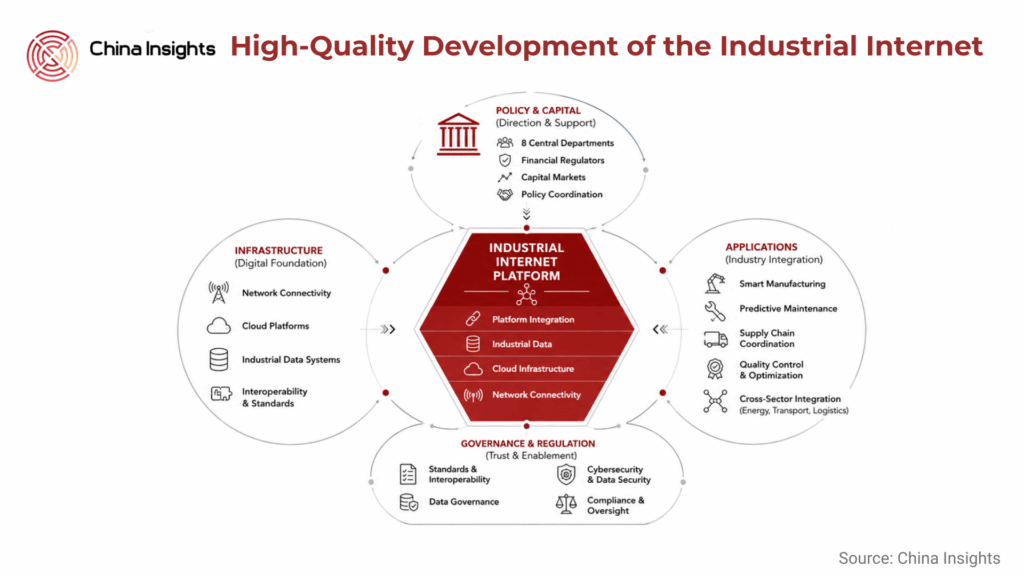
Policy Background and Strategic Context
The industrial internet is positioned as a core pillar of China’s digital economy strategy. It integrates cloud computing, big data, artificial intelligence, and industrial systems to improve production efficiency and supply chain coordination.
Read more about AI Industrialization
The initiative is jointly issued by eight authorities, including the Ministry of Industry and Information Technology, the National Development and Reform Commission, the Ministry of Human Resources and Social Security, the People’s Bank of China, and financial market regulators. The inclusion of financial and regulatory institutions indicates a shift from sectoral digital pilots toward systemic industrial transformation supported by coordinated policy and capital allocation mechanisms. The policy reflects growing emphasis on industrial resilience, productivity improvement, and digital infrastructure integration.
Policy Architecture and Institutional Coordination
The implementation framework is characterized by multi-agency coordination across industrial regulation, financial supervision, and labor policy institutions.
The Ministry of Industry and Information Technology serves as the lead authority for industrial internet development. The National Development and Reform Commission contributes macro-level planning alignment. Financial regulators, including the People’s Bank of China and securities authorities, support capital market access and financing mechanisms for industrial digitalization projects. This structure indicates that industrial internet development is no longer treated as a purely technological initiative. It is increasingly integrated into broader macroeconomic governance, including investment allocation and financial system support.
Infrastructure Development Priorities
The policy emphasizes strengthening industrial internet infrastructure as a foundation for large-scale deployment. This includes expansion of network connectivity across industrial parks, manufacturing clusters, and supply chain nodes. It also supports development of cloud platforms and industrial data systems that enable real-time production monitoring and optimization.
The policy highlights the importance of improving interoperability between industrial systems. This is intended to reduce fragmentation and enable cross-enterprise data exchange within industrial ecosystems. The development of standardized industrial internet frameworks is positioned as a prerequisite for scaling digital manufacturing applications.
Industrial Application Expansion
A key focus of the policy is accelerating application-level integration of digital technologies into industrial processes. Manufacturing enterprises are encouraged to adopt industrial internet platforms for production scheduling, supply chain coordination, and equipment management. The policy also supports expansion of predictive maintenance, intelligent manufacturing systems, and digital quality control tools. The emphasis is on improving efficiency across production cycles rather than isolated digital upgrades. This reflects a shift toward system-wide industrial optimization. The policy further promotes integration of industrial internet applications with key sectors such as energy, transportation, and logistics, reinforcing cross-sector digital integration.
Financial System Integration and Capital Support
The inclusion of financial regulators in the policy framework highlights the role of capital markets and financial institutions in supporting industrial internet development. The People’s Bank of China and securities regulators are expected to facilitate financing channels for industrial digitalization projects. This includes support for enterprise investment in digital infrastructure and technology upgrades. The policy also implies increased alignment between industrial policy and financial system incentives. This may include preferential credit support, structured financing mechanisms, and improved access to equity markets for digital industrial enterprises. This financial integration is intended to address funding constraints faced by industrial firms undertaking digital transformation.
Labor Market and Organizational Implications
The policy includes coordination with human resources authorities, indicating a workforce dimension in industrial internet development. Industrial digital transformation requires new skill sets in data analysis, system integration, and digital operations management. The policy therefore aligns with broader labor market upgrading efforts, including vocational training and technical workforce development. Enterprises are expected to adjust organizational structures to accommodate increased digital system integration. This includes the creation of hybrid roles combining engineering, IT, and operational management functions. The policy indirectly supports restructuring of industrial labor demand toward higher-skilled profiles.
Governance and Regulatory Framework
The policy reinforces the role of coordinated governance in managing industrial internet development. Regulatory authorities are expected to improve standard-setting, data governance, and cybersecurity oversight for industrial systems. This reflects the increasing importance of industrial data security and operational reliability. The policy also signals stronger oversight of platform-based industrial ecosystems, particularly in areas involving data exchange and cross-enterprise integration. Standardization and regulatory harmonization are identified as key enabling factors for scaling industrial internet applications.
Industrial Implications and Market Structure Effects
The policy is expected to accelerate consolidation in the industrial internet market. Large technology providers with integrated cloud, data, and industrial solutions are likely to gain competitive advantage, whereas smaller firms may face higher entry barriers due to increasing requirements for interoperability, compliance, and platform integration.
Manufacturing enterprises will likely increase demand for end-to-end digital solutions rather than fragmented technology tools. This may accelerate partnerships between industrial firms and technology providers.
The policy also reinforces China’s broader industrial upgrading strategy, focusing on efficiency, resilience, and technological autonomy.
What this means for business
For industrial enterprises, the policy increases pressure to adopt integrated digital systems across production and supply chain operations. Firms that delay digital transformation may face competitiveness gaps in efficiency and cost structure.
Technology providers in industrial software, cloud infrastructure, and industrial AI solutions are likely to benefit from expanded demand. Demand will shift toward full-stack industrial internet platforms rather than isolated tools. Smaller firms may face higher entry barriers due to increasing requirements for interoperability, compliance, and platform integration.
Financial institutions may see increased demand for project financing, industrial upgrading loans, and digital infrastructure investment products linked to industrial transformation projects.
Manufacturing companies will need to invest in workforce reskilling to support digital operations and system integration requirements.
Overall, the policy signals a transition toward system-level industrial digitization supported by coordinated financial, regulatory, and industrial policy instruments.
Source
https://www.gov.cn/zhengce/202607/content_7074267.htm
Author
Dr. Richard van Ostende

Related Articles